


Historical Brochure Egypt Trifold




Try Before you Buy Download Free Sample Product
 Impress Your
 Audience
 100%
100% Editable
 Save Hours
 of Time


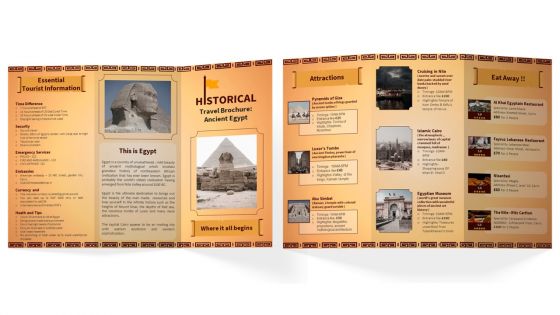
Advertise your travel agency business by using our outwardly engaging Egypt trade guide brochure Trifold Brochure Template. Use travel guide pamphlet presentation template to give a brief information about Egypt overview and essential tourist information such as time difference, security, emergency services, embassies, currency and health tips. With the assistance of Egypt city trade guide brochure PowerPoint theme, you can talk about popular attraction and restaurants to visit. Employ this professionally designed PPT brochure to showcase various attractive spots of city such as Pyramids of Giza, Luxors tombs etc. Leverage this Egypt city trade guide brochure PowerPoint template to perk the interest of your customers.
People who downloaded this PowerPoint presentation also viewed the following :
Historical Brochure Egypt Trifold with all 1 slides:
Use our Historical Brochure Egypt Trifold to effectively help you save your valuable time. They are readymade to fit into any presentation structure.
FAQs for Historical
Dude, the Egyptians were absolutely insane with their building skills. They figured out how to cut and move these massive stone blocks - we're talking 15-ton pieces of limestone they somehow hauled around with copper tools and wooden rollers. Pretty wild when you think about it. The pyramids still have engineers scratching their heads today. They also came up with columns, ramps, and lever systems way before anyone else. Honestly? Their stuff's been standing for thousands of years while our "modern" buildings start falling apart after like 50. Makes you wonder what we're doing wrong.
So basically, the Nile's annual floods created this super fertile farmland that fed everyone consistently. Egypt got rich from all that agricultural surplus. Plus the river was like their interstate highway - moving those crazy heavy pyramid stones would've been impossible otherwise, right? Pharaohs controlled the water and used that power to organize massive building projects. Their whole social system developed around managing irrigation and collecting taxes from farmers. Oh, and controlling river trade was huge too. The water literally determined who had power and how society was structured. Pretty wild how one river shaped everything.
So in ancient Egypt, religion controlled literally everything. The pharaoh was considered a living god, which meant religious and political power were totally mixed together. Your job, when you planted crops, daily rituals - all tied to pleasing different deities. Even mummification was religious! What's crazy is how the Nile's flooding connected to their ceremonies and farming decisions. Like, they'd time religious festivals around agricultural cycles. It's honestly fascinating how complete that integration was - way more than most people realize today.
So basically - Old Kingdom was the pyramid era. Think Giza, pharaohs becoming god-kings, all that iconic stuff (2686-2181 BCE). Then Middle Kingdom came after some chaotic period and they're trying to piece Egypt back together, plus their art got way more realistic instead of super idealized. New Kingdom though? That's when Egypt went full empire mode - conquering left and right, building massive temples like Karnak. You'll recognize names like Hatshepsut and Ramesses II from this time. Honestly just remember: pyramids → reunification → empire building. Makes studying way easier.
So pharaohs basically made themselves gods - like literally claimed to be Horus walking around. Smart move because who's gonna argue with a deity? They also controlled all the grain and water systems, which meant you'd starve without them. Wild how they figured that out thousands of years ago. Plus they had this whole network of scribes and governors spying on everyone in every village. It wasn't really about armies forcing people around - more like they made themselves so necessary for survival that rebelling seemed impossible. Pretty genius system when you think about it.
Egyptian mythology basically controlled everything back then. The pharaoh was literally seen as a god (Horus incarnate), so politics and religion were the same thing. Ra, Osiris, Isis - these weren't just deities people prayed to. They explained why the Nile flooded, who got to be in charge, when to plant crops, how to bury the dead. It's crazy how much it all connected. Oh, and their art always reflected these stories too. You can't really get Egyptian culture without understanding their gods first - it's like trying to read a book in a language you don't know.
So Egyptian trade started super local - just basic bartering stuff. But it exploded into these huge international networks across the Mediterranean and way beyond. Gold, papyrus, linen going out. Cedar wood from Lebanon, incense from Punt (that's like modern Somalia), silver from Anatolia coming in. The Nile basically became their trade highway - honestly such a geographic advantage. I always think it's wild how they went from Old Kingdom's limited regional stuff to New Kingdom being this total economic powerhouse. They built trading posts, diplomatic ties, even standardized their weights. If you're studying this, definitely track it chronologically - makes way more sense that way.
So they mostly worked with limestone, sandstone, granite, and wood. For colors, they ground up minerals like ochre and malachite into pigments. Their tools were copper and bronze chisels - honestly crazy how precise they got with those. They'd prep surfaces with gesso first, then do those flat colors in that classic Egyptian style we all recognize. The wild part is how consistent their techniques stayed for literally thousands of years. Same proportions, same poses, super strict rules. Oh and if you're digging deeper into this, the Met's online collection is perfect - you can actually see individual chisel marks up close.
So in ancient Egypt, your social class trumped gender pretty hard. Rich women? They could own property, run businesses, even rule as pharaohs - Cleopatra being the obvious example. Poor women were basically stuck doing house stuff and farm work. Men generally had more public roles no matter what, but a wealthy guy obviously had way more going for him than some peasant farmer. What's kinda cool is that class mattered more than gender a lot of the time, which was actually pretty ahead of its era. Oh, and different dynasties had different vibes about this stuff, so you'll want to pick a specific time period if you're digging deeper into it.
So basically it was a perfect storm of disasters. Foreign invasions were brutal - Sea Peoples hit around 1200 BCE, then Assyrians, Persians, Romans kept taking chunks. Wars and massive building projects (seriously, pyramids cost a fortune) destroyed their economy. Climate change dried up farmland too, which meant less food and taxes. Political chaos didn't help either - pharaohs and priests constantly fought for power instead of actually running things. Oh, and these problems just fed into each other, making everything worse. For your project, I'd definitely show how it all connected rather than listing them separately.
Oh man, the Rosetta Stone was a total game-changer! So it had the same text in three different scripts - hieroglyphs, Demotic, and ancient Greek. Scholars already knew Greek, so they could finally compare them side by side. Jean-François Champollion figured it out in 1822. Honestly brilliant if you ask me. Without that stone, we'd still be completely lost trying to read all those Egyptian temple walls and scrolls. Fun fact - bilingual texts are like cheat codes for linguists. They're incredible for cracking unknown languages!
Dude, ancient Egyptians were honestly way more advanced than you'd think! They did cataract surgery and even brain surgery through the nose during mummification - which is wild for 3000 BCE. Different doctors specialized in specific body parts, kinda like today. They used willow bark for pain (it has aspirin in it) and honey for infections, which actually works since honey kills bacteria. The Edwin Smith Papyrus shows they knew the brain controlled body functions. Oh, and they did dentistry too. You should check out their medical papyri sometime - they're like ancient textbooks and really systematic.
So basically, foreign invasions totally changed Egyptian culture through all this blending with outside stuff. The Hyksos invasion around 1650-1550 BCE brought horses, chariots, and bronze weapons that completely revolutionized how they fought wars. Then you've got the Persians, Greeks, and Romans all leaving their mark on art, religion, language - the whole deal. Alexandria's probably the coolest example of that Greek-Egyptian fusion thing. What's wild is how Egyptians didn't just fight back against everything - they were actually pretty smart about absorbing foreign elements while keeping their core identity. That's the key thing to focus on when you're studying this period.
Honestly, finding Tut's tomb intact was a total game-changer for understanding ancient Egyptian burial practices. Most royal tombs had been looted ages ago, so this was like hitting the archaeological jackpot. Over 5,000 artifacts just sitting there! We finally got to see royal funerary customs, religious beliefs, and craftsmanship techniques that had been mysteries for centuries. Carter's excavation notes are actually pretty fascinating reads if you're into that kind of thing - way less dry than you'd expect. It gave us this incredible window into daily life and metalworking skills we'd never really understood before.
Dude, archaeology has totally changed how we see ancient Egypt. It's not just pyramids and pharaohs anymore. They're using crazy tech like ground-penetrating radar and DNA testing - turns out Egyptians were way more ethnically diverse than those cheesy old movies showed. Satellite imaging keeps finding lost cities we never knew existed. Hidden chambers too. What really gets me though is how studying regular people's stuff (not just royal tombs) shows you what daily life was actually like. You should look up the Saqqara finds - they're literally discovering new things every month that make historians rewrite everything.
-
SlideTeam is my one-stop solution for all the presentation needs. Their templates have beautiful designs that are worth every penny!
-
Based on my personal experience, I would recommend other people to subscribe to SlideTeam. No one can be disappointed here!