

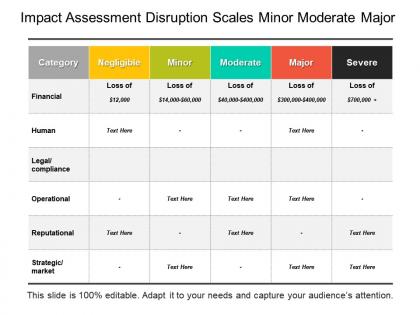
Impact assessment disruption scales minor moderate major




Try Before you Buy Download Free Sample Product
 Impress Your
 Audience
 100%
100% Editable
 Save Hours
 of Time


Professionally created Impact Assessment Disruption Scales Minor Moderate Major with all the right multimedia elements and animations included. This is all you need to sell that brilliant idea.
People who downloaded this PowerPoint presentation also viewed the following :
Impact assessment disruption scales minor moderate major with all 5 slides:
Inject fresh ideas with our Impact Assessment Disruption Scales Minor Moderate Major. Initiate changes that will be beneficial.
FAQs for Impact assessment disruption scales
So basically you want to map out all the ways your project could go sideways - good and bad stuff. Get your stakeholders involved early because they'll catch blind spots you totally missed. Document everything since you'll be checking that list constantly. Focus on the impacts that could actually mess with your timeline or budget, not every tiny what-if scenario. Don't just think operations either - environmental and social effects matter too. Honestly, the hardest part is knowing when to stop analyzing and just move forward. Start building your template now and keep tweaking it as new risks pop up.
So environmental impact assessment is all about the physical stuff - ecosystems, air and water quality, wildlife habitats. Social impact assessment? That's looking at how communities get affected, their livelihoods, cultural practices, general well-being. Different methods too. Environmental uses hard data and scientific modeling. Social relies way more on talking to people and qualitative research. Here's the thing though - companies constantly skimp on the social side, which is stupid because those impacts are harder to predict and can bite you later. Budget time for both, but honestly expect the social piece to take longer than you think.
So there are a few routes you can go. Logic models and theory of change frameworks are super popular - they help map everything out. RCTs are the gold standard but honestly? They're expensive as hell and take forever. Before-and-after comparisons are way simpler, just not as bulletproof. Mixed methods work well too - you get numbers plus actual stories from interviews. Really depends on your budget and timeline though. I'd probably start with a basic logic model first, figure out what outcomes you're expecting, then build your data collection around that. Way less overwhelming than diving into the fancy stuff right away.
Honestly, qualitative data is where you get the real story behind your numbers. Like your survey shows satisfaction dropped 20% - but why? Interviews might reveal people are just confused by new terminology, not actually unhappy with the service. Numbers can't capture that stuff. Focus groups are pretty solid for this, or just do some one-on-one interviews alongside your usual metrics. You'll catch things you didn't even think to measure. The human stories and context you get? Way more actionable than spreadsheets alone.
Honestly, you can't skip stakeholder engagement - I've watched so many projects crash because they treated it like a checkbox. Get the affected communities and local groups involved right from day one. They'll spot risks you'd never think of and actually know what works in practice. Plus people are way more likely to support something they helped shape, you know? Map out who matters early on and don't just do one meeting - keep checking in throughout. Sometimes the best solutions come from random conversations with people who live this stuff every day.
So basically every industry has different rules for impact assessments - it's kinda crazy how much they vary. Finance follows Basel III for risk stuff, environmental work uses NEPA (which is honestly a pain), and healthcare deals with FDA guidelines. Each one feels like learning a new language tbh. These frameworks decide your methodology, what you report, and how long everything takes. Oh and timelines are usually way longer than you'd expect. My take? Figure out your specific sector's requirements before you even start planning anything. Don't assume what works in one industry applies to another.
Honestly, the trickiest part is proving your program actually made the difference you're claiming - attribution is a nightmare. Data availability will bite you too. Plus everyone defines "impact" differently, which gets messy fast. Time constraints make everything worse obviously. Here's what works though: nail down your theory of change first, collect baseline data early (like, really early), and use multiple methods to back up your findings. The real game-changer? Get everyone to agree on success metrics before you start. Trust me, arguing about definitions after the fact is painful.
Dude, GIS is honestly a game-changer for impact assessments. You can layer all your data sources together - environmental stuff, demographics, infrastructure - and actually see how everything connects spatially. Way better than staring at endless spreadsheets. The modeling features let you run "what if" scenarios and catch problems early, which is huge. I mean, stakeholders get maps instantly but good luck explaining a complex dataset to them otherwise. Start by figuring out what spatial data you already have access to. The visualization alone makes it worth it.
Honestly, it totally depends on what you're measuring, but I'd mix quantitative stuff with some qualitative feedback. Environmental? Look at emissions, biodiversity, water quality changes. Social metrics work better as employment rates, community satisfaction, service access - that kind of thing. ROI and cost-benefit ratios are your go-to for economic impact. Here's what I learned the hard way though - grab baseline data first, then check in regularly. Don't go crazy tracking 20 different things. Pick maybe 3-5 solid metrics that actually matter to your stakeholders. Figure out what "winning" looks like for them, then find ways to measure that progress.
Don't just do impact assessments once and call it a day - build them into your regular routine. I'd say quarterly reviews work well for most teams. Here's the thing though: so many places collect all this data but then... nothing. They file it away and forget about it. Pick someone to actually own the follow-up actions. Track if your changes are working. Honestly, tie it to performance reviews if you can - that's what gets people's attention. Oh, and don't try fixing everything at once. Start with maybe 2 improvements per cycle, see how those go first.
You literally can't measure impact without knowing your starting point - it's like trying to figure out if you lost weight without stepping on a scale first. Baseline data gives you that pre-project snapshot of what conditions actually looked like environmentally, socially, economically, all of it. Without it? Your whole assessment turns into educated guessing at best. Regulators won't buy it either, honestly. The trick is collecting this stuff early in your planning phase, not scrambling for it later when you realize you need it.
Honestly, working across different sectors is a game-changer for impact assessments. You'll catch so many blind spots when you have environmental scientists, community folks, economists, and industry people all weighing in together. Each group brings their own data and methods, so you get this way more complete picture than if you just stuck with your usual team. Community buy-in makes everything run smoother later too - learned that the hard way on a project last year. I'd say grab 2-3 people from outside your normal circle and get them involved in your next planning session. The different perspectives are worth the extra coordination headaches.
Look, the big stuff you've gotta worry about is consent, not hurting people, and actually representing communities fairly. Get proper consent from everyone involved. Protect vulnerable folks. Make sure you're not making things worse - which honestly happens more than you'd think. Privacy's massive too - can't just toss around people's personal data. Don't be one of those researchers who swoops in, takes what they need, then disappears. Get the community involved from day one. Here's what I always ask myself: who's actually benefiting here and who might get screwed over?
Honestly, the trick is weaving social, environmental, and economic stuff into your whole evaluation process. Don't just look at immediate results - think long-term impacts on communities and ecosystems too. I've found it's actually less work in the end, even though it seems overwhelming at first. Getting stakeholders involved throughout is huge, especially marginalized groups who get hit hardest. Skip the traditional metrics and use indicators that actually track sustainability progress. My advice? Start small - add just one sustainability angle to your next assessment and grow from there. Way less intimidating that way.
Honestly, public opinion can make or break your whole assessment. I've watched so many reports just sit there collecting dust until communities got fired up about them. That's when decision-makers actually pay attention. Strong pushback or support from locals? Game changer. It forces people to take your findings seriously instead of filing them away somewhere. The trick is getting stakeholders involved early - like, way before you're ready to present final results. Don't just check that box at the end when everything's basically decided already. Give your assessment some real teeth by building community pressure behind it.
-
Great product with effective design. Helped a lot in our corporate presentations. Easy to edit and stunning visuals.
-
Excellent products for quick understanding.