

Importance Of Value Chain Analysis For Ikea Company




Try Before you Buy Download Free Sample Product
 Impress Your
Audience
 100%
Editable
 Save Hours
of Time


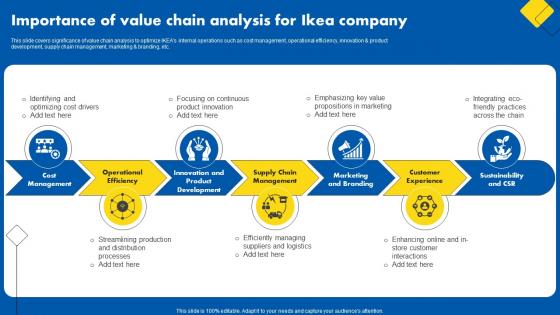
This slide covers significance of value chain analysis to optimize IKEAs internal operations such as cost management, operational efficiency, innovation and product development, supply chain management, marketing and branding, etc.
People who downloaded this PowerPoint presentation also viewed the following :
Importance Of Value Chain Analysis For Ikea Company with all 9 slides:
Use our Importance Of Value Chain Analysis For Ikea Company to effectively help you save your valuable time. They are readymade to fit into any presentation structure.








FAQs for Importance Of Value Chain Analysis
So there's two main buckets here - primary and support activities. Primary stuff is your bread and butter: inbound logistics, operations, outbound logistics, marketing/sales, and service. That's what directly creates value. Support activities are things like procurement, HR, tech development, and firm infrastructure. They keep everything running behind the scenes. People always underestimate how crucial the support side is, but honestly? It can make or break you. When you're analyzing this, map out your costs and value for each piece. You'll quickly see where you're crushing it and where money's just disappearing.
So first thing - just brain dump everything your company actually does. Like literally everything. Then sort it into two buckets: stuff that directly touches your product or customers (that's primary activities - logistics, operations, sales, service), and stuff that keeps everything running behind the scenes (support activities - HR, tech, procurement, all that overhead nonsense). Honestly, the easiest way is asking "does this directly impact our product or customer experience?" If yes, it's primary. If it just enables those things to happen, it's support. Sketch it out visually so you can see how it all connects.
Look, value chain analysis is pointless unless you're thinking about competition. Map out your activities and spot where you actually beat rivals - those are the advantages worth protecting. You'll also see where you suck compared to them, which honestly can be just as valuable. Then fix those weak spots or outsource them. I mean, otherwise you're just doing some expensive self-reflection exercise that doesn't move the needle. Focus on activities where you can realistically win against competitors. That's where the money is.
So value chain analysis is basically mapping out your entire operation - raw materials all the way to final delivery. Break it down into primary stuff (production, sales) and support activities (HR, tech, whatever). Think of it like giving your business a full diagnostic, you know? Once you've got everything laid out, the waste becomes super obvious. Bottlenecks jump out at you. You'll spot redundancies you didn't even know existed. Then you can actually see where putting money will make the biggest difference. Honestly, just start with mapping what you're doing now - that's always the hardest part but you need that baseline first.
For value chain analysis, I'd definitely pair it with Porter's Five Forces first - gives you the competitive context you need. SWOT works great too since it maps strengths and weaknesses right onto each activity. Resource-based view is super useful for finding those unique capabilities hiding in your chain. Oh, and activity-based costing shows you exactly where money's bleeding out, which is always eye-opening. Don't go crazy with like ten frameworks at once though - I've watched people confuse themselves that way. Start with Porter's and maybe one other, then build from there.
So basically, value chain stuff changes big time by industry. Manufacturing companies obsess over supply chains and making things efficiently. But if you're in consulting or something, it's all about your people and client relationships - honestly makes sense since that's literally what clients pay for. Retail focuses on getting products out there and marketing. Tech companies? They're pouring money into R&D and their infrastructure. You really gotta figure out what actually drives value in YOUR business, not just copy what Amazon does or whatever.
Look, first figure out where things are getting stuck in your operations - that's your starting point. Then pick tech that actually fixes those specific problems, not just whatever's trendy right now. AI can nail demand forecasting, IoT sensors give you real-time inventory data, and cloud platforms connect your suppliers with production teams seamlessly. Honestly, the waste reduction from better data flow between departments is kind of mind-blowing. Don't go crazy though - test one process first, see what happens, then expand from there. Way less risky that way.
Each part of your value chain needs its own metrics since they do totally different things. Track supplier lead times and inventory turnover for inbound stuff. Production efficiency and quality rates matter most for operations. Delivery times and shipping accuracy for outbound logistics. Marketing metrics can be a nightmare honestly - customer acquisition costs and conversion rates, but there's like a million digital channels to track now. Sales is straightforward: revenue per rep, close rates. Don't forget support activities like employee productivity and tech ROI. Stick to 2-3 key ones per area or you'll drown.
So value chain analysis is basically dissecting where you're actually winning vs. just burning cash. Map out your main stuff - operations, marketing, sales - then your behind-the-scenes work like HR and tech. Honestly, most companies have no clue which activities customers actually care about. Once you see it laid out, the strategic moves become obvious. Maybe outsource the boring stuff. Double down on what makes you special. I'd start with just one business unit though - otherwise you'll drown in spreadsheets. Trust me, the patterns will jump out at you pretty fast.
Don't make it a one-and-done thing - that's the biggest screwup I see. Most companies get way too focused on their own stuff and forget to check what competitors are doing. Trust me, benchmarking matters more than you think. You'll also get buried analyzing every little detail instead of the activities that actually move the needle on costs or competitive edge. Skip relying just on financial numbers too. Operational metrics are clutch. Oh, and start with your most critical processes first - sounds obvious but you'd be surprised how many people jump around randomly.
Look, customer feedback basically tells you exactly where your business is screwing up. Complaints about slow shipping? Your logistics are the problem. Quality issues popping up everywhere? Time to check your operations and how you're sourcing stuff. It's honestly like having customers draw you a map of what's broken. I always tell people to just list out the main complaints, then figure out which part of your process each one points to. Then tackle the biggest pain points first - the ones you hear about most often that'll actually move the needle when you fix them.
Your suppliers basically control how well your whole operation runs. Bad timing or crappy quality from them? That mess rolls downhill fast through everything you do. Cost-wise, they set a huge chunk of your pricing structure. The smart ones who actually invest in R&D can give you a real edge over competitors. Honestly, difficult suppliers are the worst - they just drain your energy and slow everything to a crawl. When you need to scale up quickly or change direction, they're either going to help or totally hold you back. Figure out which suppliers are absolutely critical and baby those relationships.
So basically you map out every single thing your business does - from getting supplies to helping customers. Then you dig into each step asking "what if we did this totally different?" Honestly, it's wild how many blind spots you'll find just by doing this exercise. Getting people from different teams involved is clutch because they see stuff you don't. I'd start small though - pick one area and really tear it apart. You might discover some process that's been broken for years or spot where new tech could flip everything. It's like... suddenly the whole puzzle makes sense.
Get everyone on the same dashboard first - seeing real-time data together changes everything. Those cross-functional meetings? Yeah, they suck at first but honestly they're worth it. Don't let segments just talk past each other anymore. Set up shared KPIs so teams actually want to help each other instead of just hitting their own numbers. Communication channels need to be crystal clear too - who calls who and when. Oh, and start small! Pick one partnership to pilot this stuff before rolling it out everywhere. The shared planning sessions are probably where you'll see the biggest difference.
Honestly, you've gotta speak their language - execs want to see dollar signs and competitive edge stuff, but your ops people need the nitty-gritty process details. Visual dashboards work way better than boring reports (I learned this the hard way). Show clear before/after numbers and actual ROI, not fluffy "optimization" nonsense. Break up your presentations by audience so you're not boring half the room. Oh, and definitely start with some quick wins first. Builds trust. Then hit them with the bigger strategic stuff once they're buying what you're selling.
-
Great work on designing the presentation. I just loved it!
-
Excellent work done on template design and graphics.