


IT Support Helpdesk Business Model




Try Before you Buy Download Free Sample Product
 Impress Your
 Audience
 100%
100% Editable
 Save Hours
 of Time


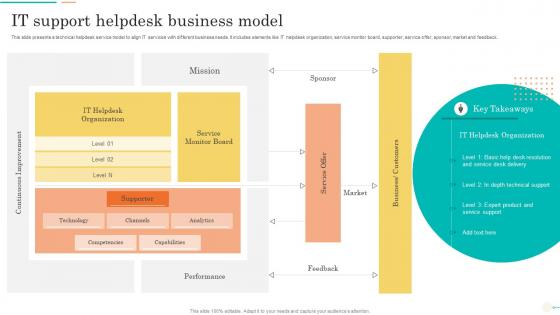
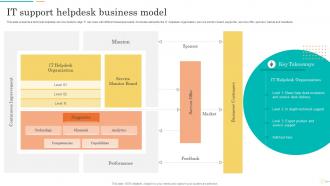
This slide presents a technical helpdesk service model to align IT services with different business needs. It includes elements like IT helpdesk organization, service monitor board, supporter, service offer, sponsor, market and feedback.
People who downloaded this PowerPoint presentation also viewed the following :
IT Support Helpdesk Business Model with all 6 slides:
Use our IT Support Helpdesk Business Model to effectively help you save your valuable time. They are readymade to fit into any presentation structure.





FAQs for IT Support
Key IT support helpdesk responsibilities include incident resolution, user account management, hardware and software troubleshooting, system monitoring, and documentation maintenance. These functions streamline organizational technology operations by minimizing downtime, ensuring seamless user experiences, and maintaining system integrity, with many enterprises finding that effective helpdesk support ultimately delivers enhanced productivity and operational efficiency.
IT support helpdesks improve critical issue response times through automated ticket prioritization, escalation workflows, dedicated specialist teams, real-time monitoring systems, and proactive issue detection. These technologies streamline incident management by categorizing urgency levels, routing complex problems directly to experts, and enabling predictive maintenance, with many organizations finding that strategic automation reduces resolution times by 40-60% while enhancing overall system reliability.
Ticketing software centralizes support request management by automatically organizing, prioritizing, tracking, and routing customer issues to appropriate IT specialists. Through systematic workflows and real-time status updates, organizations streamline response times, enhance accountability, and maintain comprehensive service histories, with many enterprises finding that automated ticket assignment and escalation protocols ultimately deliver faster resolution rates and improved customer satisfaction.
IT support helpdesk metrics enhance service quality by identifying performance gaps, tracking resolution times, and measuring customer satisfaction levels across different service categories. These analytics enable organizations to streamline workflows, allocate resources more effectively, and proactively address recurring issues, with many companies finding that data-driven approaches ultimately deliver faster response times and significantly improved user experiences.
Common IT support helpdesk challenges include managing high ticket volumes, resolving complex technical issues quickly, maintaining consistent service quality, handling frustrated users, and keeping up with evolving technologies. These challenges often strain resources and impact response times, with many organizations finding that streamlined ticketing systems, automated solutions, and comprehensive staff training ultimately enhance efficiency and deliver better user experiences.
Training enhances IT support helpdesk performance by improving technical competencies, strengthening communication skills, and standardizing problem-resolution processes across teams. Through comprehensive programs covering emerging technologies and customer service excellence, organizations streamline ticket resolution times, reduce escalation rates, and deliver more consistent user experiences, ultimately boosting both team confidence and customer satisfaction levels.
Helpdesk teams can reduce repetitive calls through comprehensive self-service portals, proactive system monitoring, automated ticket routing, detailed knowledge bases, and user training programs. These strategies streamline support by enabling users to resolve common issues independently, automatically detecting problems before users report them, and ensuring faster resolution times, ultimately delivering improved user satisfaction and reduced operational costs.
IT support helpdesks prioritize issues through severity-based classification systems, business impact assessments, service level agreements, and automated ticketing workflows that categorize requests by urgency and affected user volume. This strategic approach enables organizations to allocate limited resources efficiently, with many companies finding that clear prioritization matrices reduce resolution times while maintaining service quality standards.
Remote support tools benefit IT helpdesk operations by enabling faster issue resolution, reducing on-site visits, and streamlining technician workflows through screen sharing and remote access capabilities. These technologies enhance operational efficiency by minimizing travel costs, accelerating troubleshooting processes, and delivering improved customer experiences, with many organizations finding that remote capabilities significantly expand their service reach while reducing resolution times.
Customer feedback enables IT helpdesks to identify service gaps, optimize response times, and enhance user satisfaction through targeted improvements. By analyzing feedback patterns, organizations can streamline troubleshooting processes, reduce ticket volumes, and ultimately deliver more efficient technical support, with many companies finding that proactive feedback integration significantly improves both operational efficiency and customer experiences.
IT support helpdesk staff can stay updated through continuous learning programs, industry certifications, technology webinars, vendor training sessions, and professional networking groups. These approaches enable teams to master emerging technologies, anticipate user needs, and resolve issues more efficiently, with many organizations finding that well-trained helpdesk staff deliver faster resolution times and enhanced user satisfaction.
Multi-tiered IT support helpdesk structures deliver enhanced efficiency, faster resolution times, specialized expertise allocation, improved customer satisfaction, and streamlined resource management. These systems enable organizations to handle routine issues at tier one while escalating complex problems to specialized teams, ultimately reducing costs, minimizing downtime, and delivering more effective technical support across departments.
Knowledge management systems streamline helpdesk operations by centralizing solution databases, automating ticket routing, and enabling self-service portals for common issues. These systems reduce resolution times by providing instant access to troubleshooting guides and historical solutions, while empowering customers with 24/7 self-help capabilities, ultimately delivering faster support and improved operational efficiency.
Emerging technologies shaping IT support helpdesks include artificial intelligence for automated troubleshooting, chatbots for instant responses, predictive analytics for proactive maintenance, augmented reality for remote assistance, and machine learning for intelligent ticket routing. These technologies streamline operations by reducing response times, minimizing downtime, and enhancing user experiences, with many organizations finding that strategic implementation delivers significant cost savings and competitive advantage.
Cultural factors significantly influence IT support helpdesks through communication styles, hierarchy expectations, problem-solving approaches, and service preferences across different regions. Global companies adapt by implementing multilingual support, culturally-aware training programs, and region-specific escalation protocols, with many organizations finding that localized support teams enhance user satisfaction, reduce resolution times, and ultimately deliver more effective technical assistance across diverse international markets.
-
SlideTeam, Please don’t stop sharing discount coupons! I love your occasional discounts and tend to buy your products around that corner.
-
I really liked their customized design services. I got my desired template made by their expert team. Thank You!