

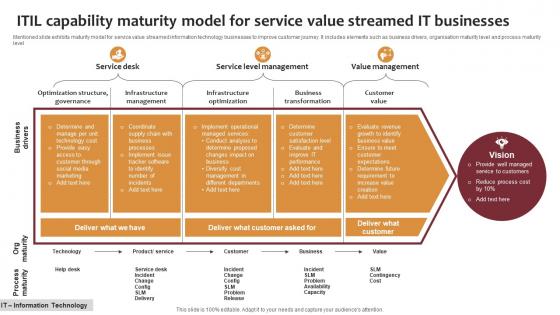
ITIL Capability Maturity Model For Service Value Streamed It Businesses




Try Before you Buy Download Free Sample Product
 Impress Your
 Audience
 100%
100% Editable
 Save Hours
 of Time


Mentioned slide exhibits maturity model for service value streamed information technology businesses to improve customer journey. It includes elements such as business drivers, organisation maturity level and process maturity level.
People who downloaded this PowerPoint presentation also viewed the following :
ITIL Capability Maturity Model For Service Value Streamed It Businesses with all 6 slides:
Use our ITIL Capability Maturity Model For Service Value Streamed It Businesses to effectively help you save your valuable time. They are readymade to fit into any presentation structure.





FAQs for ITIL Capability Maturity Model For Service Value
So ITIL CMM basically has 5 levels to figure out how mature your IT service management is. Level 1 is total chaos - processes are all over the place. Then you've got Repeatable, Defined, Managed, and Optimizing at the top. Most companies I've seen get completely stuck at Level 2 or 3 for years (it's honestly frustrating to watch). Each level builds on the last one, covering stuff like incident management and change management. You can use it to see where you're at now and map out what needs fixing. Pretty straightforward framework once you get the hang of it.
So basically, ITIL's maturity model is like a roadmap for getting your IT service management together. It shows you five levels - starting from total chaos up to actually having your stuff optimized. Think of it as GPS for IT processes, I guess? You can figure out where you currently suck and what "good" actually looks like. Instead of randomly fixing things, it tells you which fires to put out first. Honestly, most companies think they're better than they actually are. Start with assessing your main processes - you'll probably be surprised at how messy things really are under the hood.
So ITIL's got these 5 maturity levels, right? You kick off at Initial - total chaos basically. Then Repeatable where there's some structure (but not much). Level 3 is Defined - now you're actually documenting stuff organization-wide. Managed means you're tracking metrics and controlling processes. Optimizing is the holy grail where you continuously improve everything. Honestly, most companies I've seen are stuck around level 2 or 3, which isn't terrible. Don't stress if you're not hitting level 5 - it's more about using this as a map to figure out where your ITIL game needs work.
Look at your current processes against ITIL's five areas - strategy, design, transition, operation, and continual improvement. Map what you're doing now versus what ITIL recommends. Honestly, most companies bring in outside consultants because it's tough to see your own blind spots objectively. I'd probably do the same tbh. Check both your actual processes AND your org's capabilities like skills and tech adoption. The culture piece matters too. Document all the gaps you find, then focus on fixing whatever's actually breaking your service delivery first.
You literally can't move up ITIL maturity levels without nailing feedback and continuous improvement. Each level demands that you spot gaps, fix stuff, and actually measure if it worked. The feedback shows you what's really happening vs what your processes claim should happen - and trust me, there's usually a gap. Monthly reviews with stakeholders keep things moving forward. You've got to capture lessons learned and tweak based on real data, not just theory. Skip this step? You'll stay stuck forever. Oh, and make sure those review cycles are consistent - sporadic efforts don't cut it.
Oh man, culture is HUGE for ITIL implementations. Seriously, if your company has that whole blame-game thing going on or people hate change, you're screwed regardless of how pretty your processes look. Leadership needs to be on board first - that's non-negotiable. Then you gotta work on getting everyone else to actually want to follow the new procedures instead of just winging it like they always have. Communication and training help a ton. Honestly though, I'd figure out what's gonna fight you culturally before you even start rolling stuff out. Saves so much headache later.
Yeah, totally doable! COBIT and ITIL actually work great together - COBIT handles the governance side while ITIL covers your service processes. The maturity model just helps you figure out where you're at across both. Agile's a bit trickier to mesh but you can map your sprints to the maturity levels. Honestly, I've seen teams nail it by using COBIT for oversight, ITIL for processes, and Agile for speed. Oh, and don't overthink it - just find where they overlap first, then build your improvement plan from there.
So here's the deal with higher ITIL maturity - your incident response gets way faster and service availability shoots up because everything's more predictable. Customer satisfaction scores improve since you're delivering consistent quality. The best part? Your team stops constantly firefighting, which honestly makes work so much better for everyone. Compliance becomes a breeze to maintain. You can actually start catching issues before they hit users, which is pretty cool. Just track these improvements as you go - leadership loves seeing real numbers that prove the ITIL investment was worth it.
So when your ITSL processes get more mature, customers stop getting pissed off about constant outages. Your incident management actually works instead of being a total mess. I've seen studies showing 20-30% better efficiency in companies that have their ITSM together - honestly makes sense when you think about it. Instead of firefighting every crisis, your service desk can actually get ahead of problems. The real win though? Mature processes give you predictability, which means the business can plan stuff out and focus on bigger picture moves. Oh, and definitely figure out where you stand now so you can grab some easy wins first.
Honestly, getting people to actually change how they work is the worst part - everyone's so stuck in their old ways even when stuff's clearly broken. Budget and time constraints will hit you hard too. Quick wins help build momentum though, so start there. Leadership backing is crucial or you're basically screwed from day one. Oh and measuring progress? Super tricky since this stuff is pretty abstract. Skills gaps become painfully obvious once you try moving from just putting out fires to actually preventing them. Cultural shifts take forever but that's where the real work happens.
Pick tools that match where you're actually at right now, not where you think you should be. ITSM stuff like ServiceNow or Remedy covers your basics. Then add monitoring - Nagios, SolarWinds, whatever works. Here's the thing though: everyone wants to jump straight to the shiny AI tools but honestly? That's backwards. Get your foundation solid first with automation for boring repetitive stuff, analytics to track what matters, and knowledge management so you don't keep losing all your hard-won insights. Roll things out slowly or they'll just sit there unused. Start small, show it works, then build from there.
Focus on the basics first - incident resolution times, change success rates, service uptime. Those tell you if things are actually getting better. Employee satisfaction with IT is massive though, probably tells you more than half the technical stuff combined. Are people actually following the processes consistently? That's another big one to watch. Stakeholder feedback scores matter too. Oh, and don't skip compliance tracking - you'll want audit findings and scores to prove you're keeping improvements over time. Honestly just pick 3-4 metrics that hit your worst problem areas. You can always add more later once you've got those dialed in.
Dude, stakeholder buy-in will literally make or break your ITIL rollout. I've watched companies completely bomb because they skipped this part - leadership gets annoyed, IT pushes back, users revolt. Not pretty. You need people actually excited about the changes, not just going through the motions. Map out who matters early on. Then figure out what each group cares about and speak their language. Show them the benefits that actually matter to *them*. Oh, and don't forget the communication plan - sounds boring but trust me, it's crucial for keeping everyone on board.
Start with basic ITIL training for everyone, then build up from there. Map out what skills your team has now versus what you actually need - that gap analysis will save you tons of time. Cross-functional workshops are honestly game-changers for breaking down silos. Way more effective than I expected when we first tried them. Get your incident managers into problem management certs, change coordinators trained in release stuff, you know the drill. Leadership development becomes crucial once you hit those higher maturity levels. Someone's gotta drive the whole continuous improvement thing or it just dies on the vine.
Don't try to do everything at once - that's a recipe for burnout. Pick maybe incident management or change control, whichever is causing you the biggest headaches right now. Map out where you actually are first (might be messier than you think lol). The CMM thing is way more flexible than it seems, which is nice. Look for quick wins that won't cost much - free templates work just fine instead of dropping money on fancy software. I'd honestly just start measuring one simple thing this week. Build from there slowly. You'll get better results than trying to check every single box right away.
-
Like always a great experience with you guys. Always there on the drop of hat to help.
-
I've been looking for a good template source for some time. I'm happy that I discovered SlideTeam. Excellent presentations must try!