


ITIL 4 Customer Journey Mapping For Stakeholder Value Creation





Try Before you Buy Download Free Sample Product
 Impress Your
 Audience
 100%
100% Editable
 Save Hours
 of Time


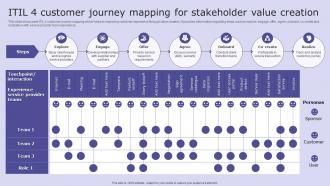
This slide showcases ITIL 4 customer journey mapping which helps in improving customer experience through value creation. It provides information regarding steps such as explore, engage, offer, agree, onboard, co create and realization with service provider team experience.
People who downloaded this PowerPoint presentation also viewed the following :
ITIL 4 Customer Journey Mapping For Stakeholder Value Creation with all 6 slides:
Use our ITIL 4 Customer Journey Mapping For Stakeholder Value Creation to effectively help you save your valuable time. They are readymade to fit into any presentation structure.





FAQs for ITIL 4 Customer Journey Mapping For
So ITIL 4 breaks the customer journey into five stages: Explore (they're researching), Engage (first contact), Onboard (getting started), Use (actually using your service), and Advocate (when they love you enough to tell others). What's cool is how this connects to the service value chain stuff. Each stage has different problems customers hit - like when something breaks during "Use" and they can't figure out how to get help. That's usually where things fall apart. I'd start by mapping these stages for whatever services you're dealing with. Figure out where people get stuck most often.
So customer journey mapping is basically seeing your services through their eyes - super eye-opening honestly. You'll catch pain points you totally missed, like customers getting stuck between departments or hunting for basic info. I always tell people to start with just one service and map it end-to-end. The visual part makes everything click. Then you can redesign based on how customers actually experience things, not your internal mess of processes. Plus you figure out which touchpoints really drive satisfaction. Trust me, improvement opportunities jump out immediately once you see the whole flow laid out.
Dude, customer feedback is like your secret weapon for ITIL 4 journey mapping. Without it, you're basically flying blind and making assumptions that are probably wrong. Collect it at every single touchpoint - surveys, interviews, whatever works. It'll show you where things are actually breaking down versus where you think they are. Trust me, there's always a gap between reality and what's on paper. Use that feedback to spot pain points and fix your maps regularly. Otherwise you're just creating pretty diagrams that don't help anyone.
Start by mapping your service streams against where customers actually interact with you - shows you which ITIL processes help vs. hurt their experience. Honestly? Begin with incident management since that's where people get most frustrated when stuff breaks. Journey maps should feed directly into your continual improvement work, and customer feedback tells you what to fix first. Your service design team needs to actually look at these maps when planning changes (not just file them away somewhere). The whole point is questioning whether your processes deliver real value to customers or just make operations smoother. Pretty diagrams don't mean much if they're sitting in a drawer.
Lucidchart and Miro are your best bets - they handle the visual mapping plus tie into ITIL 4 stuff pretty seamlessly. Visio's decent if you're stuck in Microsoft land. But honestly? I've watched teams crush it with basic tools like Draw.io or even PowerPoint (yeah, really). Don't get hung up on finding the "perfect" software. Pick something everyone can actually use and won't fight you on. We spent way too long debating tools at my last job when we should've just started mapping. Whatever you've got access to right now is probably fine to begin with.
Oh this is actually genius! So basically you map out the whole customer journey and suddenly everyone gets it. Marketing finally sees what happens after they pass leads over. IT realizes their system crashes actually mess with real people. Support can point to exactly where things go wrong. Honestly, silos just kind of... dissolve when everyone's looking at the same visual. The best part? Teams start catching those awkward handoff moments together. Next time you kick off a project, just walk through it as a group first. You'd be surprised how fast people get on board.
So here's the thing - you've gotta figure out where your customers are getting pissed off or really happy during service calls. Map those feelings into your ITIL processes and boom, you can fix problems before they blow up. I mean, think about it - when your laptop dies, you don't want to feel like you're screaming into the void, right? Once you spot these emotional moments, you can build better communication flows and set realistic expectations. Maybe even set up some automated responses that don't sound robotic. Just ask customers how they *felt* during recent incidents instead of only focusing on technical details.
Honestly, the biggest mistake is just assuming you know what customers want instead of actually asking them. Most companies map out this perfect "happy path" journey while completely ignoring all the frustrating detours people actually take. Then they create these gorgeous maps and... nothing happens with them. Oh, and trying to map everything at once is a recipe for disaster - you'll get overwhelmed fast. Focus on one key service first, back it up with real customer feedback (not your gut feelings), and make sure someone's actually responsible for fixing what you discover. Otherwise you're just making pretty diagrams.
Honestly, customer personas are like having a cheat sheet for building realistic user journeys in ITIL 4. You get to actually understand who's using your services instead of just guessing. Map different journeys for each persona type - a millennial developer vs some C-suite exec will have totally different expectations and pain points. Personas show you which communication channels work best and where people usually get frustrated. I'd start with maybe 3-4 main personas, then create separate journey maps for each one. It sounds like extra work but you'll spot improvement opportunities you'd never catch otherwise.
Track the obvious stuff first - customer satisfaction scores, NPS, and completion rates at each stage. Those numbers don't lie. But honestly? The qualitative feedback is where you'll find the real goldmine of insights. Look at abandonment rates at specific touchpoints and how often people are calling support mid-journey. Pain point frequency is huge too. Time-to-resolution tells you a lot about friction spots. Set up monthly reviews so you can actually catch trends before they become problems. I learned this the hard way - checking quarterly just isn't enough when customer behavior shifts fast.
You've gotta treat those customer journey maps like they're actual living things - check on them every quarter or so. Pull up recent feedback, support tickets, stuff like that. Most teams just make these maps and then... crickets, which is honestly such a waste. Your frontline people are gold for this - they'll catch outdated steps way before management does. Oh, and whenever you launch something new? Check how it messes with your existing journeys right away. Trust me, just put those quarterly reviews in your calendar now. Otherwise you'll keep putting it off forever.
So for ITIL 4 customer journey mapping, you'll want to hit the big touchpoints - incident resolution, service requests, user onboarding. Microsoft and IBM mapped their whole IT service delivery process, which honestly sounds like a nightmare but probably worth it. Map both when things go right AND when they go sideways. That's where you find the real pain points. The "how we think it works" vs reality gap is usually pretty brutal. I'd start small though - pick one common service request and map that thing end-to-end first. Way less overwhelming than trying to boil the ocean.
Oh man, this bit us so hard when we tried rolling out the same journey map everywhere. Japanese customers wanted super formal, detailed stuff while Americans just wanted quick and casual. Even contact preferences are totally different - some cultures still love phone calls, others won't touch anything but chat. We got wildly different satisfaction scores by region and had to basically start over. Now we build in cultural tweaks at each touchpoint. It's way more work but you can't just assume what works in one place will work everywhere else, you know?
So basically you can watch what customers are doing and fix problems as they happen instead of waiting around. Analytics show you where people get stuck, then automation kicks in to help them out automatically. APIs connect everything so it doesn't feel weird jumping between your app and website - though honestly the tech changes so much I feel like I'm always playing catch-up. The trick is using that data to make quick fixes rather than doing those massive quarterly reviews. I'd start by finding your worst bottleneck, then grab one tool that can automatically jump in when customers hit that wall.
Start with ITIL 4 foundation training - the service value chain stuff is crucial. Your team also needs process mapping and data analysis skills. Someone should definitely know touchpoint analysis and customer feedback tools. Design thinking workshops are honestly a game changer (way more fun than regular training sessions). Don't sleep on the soft skills either - facilitation and working across departments matters more than you'd think. Stakeholder interviews require finesse. Get ITIL 4 Foundation certs first, then add journey mapping tools training on top.
-
Templates are beautiful and easy to use. An amateur can also create a presentation using these slides. It is amazing.
-
Happy to found you SlideTeam. You guys are value for money. Amazing slides.