


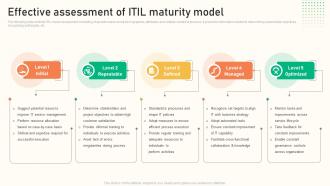
Effective Assessment Of ITIL Maturity Model





Try Before you Buy Download Free Sample Product
 Impress Your
 Audience
 100%
100% Editable
 Save Hours
 of Time


The following slide exhibits ITIL model assessment consisting of questionnaire about demographics, attributes and outputs related to process. It presents information related to determining shareholder objectives, recognizing set targets, etc.
People who downloaded this PowerPoint presentation also viewed the following :
Effective Assessment Of ITIL Maturity Model with all 6 slides:
Use our Effective Assessment Of ITIL Maturity Model to effectively help you save your valuable time. They are readymade to fit into any presentation structure.





FAQs for Effective Assessment Of
So there are five main things in the ITIL Maturity Assessment. Process Maturity looks at how solid your workflows are. People & Skills checks if your team actually knows what they're doing. Technology & Tools is pretty obvious - does your tech even work with ITIL? Then there's Governance & Management for leadership oversight. Culture & Organization might be the biggest one though - I've seen places with perfect processes where everyone just ignores them anyway. Each area gets rated 1-5, from "total chaos" to "we've mastered this." Just be brutally honest about where you're starting from.
So basically it's like a report card for your IT processes. You get scored on different areas - incident handling, change management, all that stuff - from "we're just winging it" to "we've got our act together." Honestly, most companies are shocked at how low they score initially. But that's the point! You can see exactly where you stack up against competitors and figure out what's broken. I'd start with that baseline assessment (even though it might sting a bit), then tackle the biggest gaps first. Makes planning your improvements way less overwhelming.
So ITIL breaks this down into five levels - you've got Initial (basically chaos), Managed (some basic control), Defined (actual standardized stuff), Quantitatively Managed (you're measuring things), and Optimizing (always improving). It's like leveling up, honestly. Most companies land between Initial and Managed when they start, which isn't bad at all. The trick is being real about where you actually are right now, not where you wish you were. I'd probably start by looking at your incident management first - that's what users see most anyway, so it's a good place to figure out your baseline.
Start with getting an honest assessment of where your ITSM stuff currently stands compared to ITIL standards. Hit the big areas - incident management, change management, service desk ops, plus how well documented everything actually is. Most places either use maturity assessment tools or bring in outside consultants because, let's be real, it's tough to be objective about your own processes. You'll get scored on like a 1-5 scale from "total chaos" to "actually optimized." Then you can build a proper roadmap instead of just throwing darts at what might be broken. Way better than guessing, trust me.
You really can't skip stakeholder engagement for this - the assessment will be garbage without it. Get your IT leaders, service owners, process managers, and end users involved because they're the ones actually living these processes daily. Honest feedback from them beats guessing any day. Plus people are way more likely to support changes when they helped create them (shocking, I know). Map out who you need early and involve them in both assessment and planning phases. Oh, and don't just collect their input - actually show them how you'll use it or they'll feel ignored.
Think of those assessment results like a GPS for where you want to go. Pick 2-3 big gaps to work on first - seriously, don't try fixing everything because that's how teams crash and burn. Set actual deadlines and measurable goals for each area. Here's the thing though: it's not a one-and-done deal. You'll want to check back every 6-12 months to see what's working. Start with some easy wins to get momentum going, then move onto the harder stuff. It becomes this ongoing cycle where you're constantly tweaking priorities based on what you learn.
Honestly, focus on stuff that actually shows if your processes work - not just whether they exist. Track incident response times, how often changes succeed, uptime percentages, customer satisfaction. Mix that hard data with softer stuff like whether teams actually follow procedures consistently (spoiler: they usually don't at first). Process maturity things matter too - automation levels, knowledge base usage across departments. Don't go crazy measuring everything though. Pick 3-4 key metrics per process and build from there. SLA adherence is obvious, but staff competency assessments tell you what's really happening day-to-day.
So basically the maturity model makes you connect your IT stuff to what actually drives business results at every stage. First step is figuring out which services your business stakeholders genuinely care about - not just what IT thinks is important. Then you assess how your current processes stack up against those priorities. Honestly, it's kind of a wake-up call sometimes! Instead of measuring IT with just technical metrics, you'll start using business ones that matter. Each maturity level builds stronger partnerships with other departments. I'd start by comparing your service catalog to real business needs - might surprise you what gaps you find.
Honestly, getting people to be real about their skills is brutal - they either think they're amazing or trash themselves completely. Each department tracks stuff totally differently too, so good luck comparing anything. Most places don't even document what they actually do (which is wild but whatever). The whole thing turns into a blame game pretty fast when teams start pointing fingers. I'd say pick one small area to test this out first. Oh, and definitely get someone from outside to run it - people get way less weird when it's not their boss asking.
Honestly, once a year works for most places. But if you're just getting started with ITSM or dealing with big changes, maybe bump it up to every 6 months - you'll want to see how things are moving along. Organizations that have their stuff together can probably wait 18-24 months between assessments. At that point you're basically just making sure nothing's fallen apart. The real trick is giving yourself enough time to actually fix things before the next assessment rolls around. Otherwise what's the point? Definitely put it on the calendar now though - trust me, this kind of thing always gets pushed aside when you're drowning in tickets.
So basically, better ITIL maturity = way less headaches for everyone. Your incident times drop, fewer things break, and customers actually stop complaining as much. Level 3-4 is where the magic happens - that's when you're not just putting out fires anymore. Honestly, anything below level 3 and you're still scrambling constantly. Track your current resolution times and satisfaction scores first though. Those numbers will smack you in the face with how much room there is to improve. Changes feel smoother, communication gets clearer during outages - customers definitely pick up on this stuff right away.
Honestly, get some good ITSM tools - they'll save you so much time on data collection and those reports everyone hates making. I'd map out what metrics you actually need first (trust me on this one). Then find platforms that can automatically pull everything instead of living in Excel hell. A lot of these tools have maturity frameworks baked right in, which is nice. Analytics dashboards are great for showing progress to the higher-ups too. You can benchmark against ITIL standards and spot gaps way faster than doing it manually. The visual stuff really helps when you're trying to get buy-in for improvements.
Dude, you literally can't move up ITIL maturity levels without solid training - I've watched companies completely stall out because they cheaped out on developing their people. Your teams need way deeper knowledge as you progress, plus they have to start thinking strategically instead of just putting out fires all day. Higher maturity levels get pretty complex with how all the service management pieces connect. Oh, and the problem-solving skills become way more important too. I'd start by figuring out where your current processes are weakest, then build training around those specific gaps. It's honestly one of those things you can't skip.
Map where you are now against your target ITIL maturity levels first. Focus on the biggest gaps - that's where you'll get the most bang for your buck. Break it into phases tackling maybe 2-3 processes each. Don't go crazy trying to fix everything at once (learned that the hard way). Set timelines you can actually hit given your team size and how much change your org can handle. Each phase needs clear wins and metrics to show progress. Oh, and get leadership backing upfront - plus assign owners who'll actually follow through. Too many roadmaps just sit there collecting digital dust otherwise.
Don't just ask people to rate themselves - everyone thinks they're crushing it when they're probably not. Get feedback from IT, business teams, and higher-ups since they all see different pieces. Actually document stuff with real evidence instead of going off feelings. I'd definitely bring in outside people to assess things objectively if you can swing it. Standardized frameworks help too, but here's the thing - focus on whether processes actually work, not just whether they exist on paper. Like, having a change management document is meaningless if changes still break everything.
-
Spacious slides, just right to include text. SlideTeam has also helped us focus on the most important points that need to be highlighted for our clients.
-
I am really satisfied with their XYZ products. Used their slides for my business presentations and now I am taking their help for my son's high-school assignments. Super satisfied!!