


Key Components Of Itil 4 Service Level Management




Try Before you Buy Download Free Sample Product
 Impress Your
 Audience
 100%
100% Editable
 Save Hours
 of Time


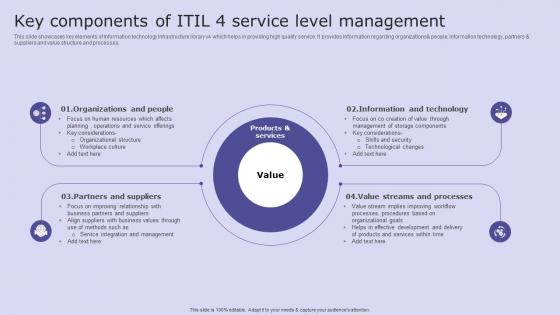
This slide showcases key elements of Information technology infrastructure library v4 which helps in providing high quality service. It provides information regarding organizations and people, information technology, partners and suppliers and value structure and processes.
People who downloaded this PowerPoint presentation also viewed the following :
Key Components Of Itil 4 Service Level Management with all 6 slides:
Use our Key Components Of Itil 4 Service Level Management to effectively help you save your valuable time. They are readymade to fit into any presentation structure.





FAQs for Key Components Of Itil 4
Key components of Service Level Management in ITIL 4 include service level agreements (SLAs), operational level agreements (OLAs), underpinning contracts, service level requirements, and continuous monitoring frameworks. These components work together by establishing clear expectations, defining internal responsibilities, and enabling proactive performance management, with many organizations finding that structured SLM ultimately delivers improved customer satisfaction and operational efficiency.
ITIL 4's Service Level Management emphasizes value co-creation, customer experience focus, and continuous improvement through the four dimensions model, shifting from traditional SLA-centric approaches to outcome-based service relationships. This evolution enables organizations to deliver more responsive, agile service management by integrating DevOps practices, embracing digital transformation, and fostering collaborative partnerships with stakeholders, ultimately enhancing operational efficiency and customer satisfaction.
Service Level Agreements serve as the foundational contracts that define measurable service commitments between providers and customers, establishing clear performance targets, responsibilities, and accountability frameworks within SLM processes. These agreements enable organizations to monitor service quality systematically, resolve disputes transparently, and maintain consistent service delivery standards, with many enterprises finding that well-structured SLAs ultimately enhance customer satisfaction and operational efficiency.
Organizations can effectively measure service performance through automated monitoring tools, real-time dashboards, key performance indicators, regular service reviews, and customer feedback mechanisms. These approaches enable continuous tracking of availability, response times, and resolution rates across IT services, while providing stakeholders with transparent reporting and actionable insights, ultimately delivering improved service quality and stronger customer relationships.
Effective SLM continuous improvement practices include regular performance reviews, stakeholder feedback collection, trend analysis, benchmarking against industry standards, and implementing automated monitoring tools. Organizations enhance service quality by conducting quarterly SLA assessments, analyzing incident patterns, and adjusting service targets based on business needs, ultimately delivering improved customer satisfaction and operational efficiency while maintaining competitive service delivery standards.
Communication and collaboration significantly enhance SLM effectiveness by ensuring clear expectations, proactive issue resolution, and continuous service improvement across all stakeholders. Through regular dialogue between IT teams, business units, and vendors, organizations streamline service delivery, minimize misunderstandings, and accelerate problem resolution, ultimately delivering stronger customer satisfaction and operational efficiency.
Tools supporting ITIL 4 Service Level Management include service desk platforms, monitoring and analytics software, automated reporting systems, SLA tracking dashboards, and integrated ITSM suites. These technologies streamline SLM activities by providing real-time performance visibility, automated breach notifications, and comprehensive reporting capabilities, with many organizations finding that strategic tool integration ultimately delivers enhanced service transparency and improved customer satisfaction.
Organizations align SLM practices with customer expectations and business objectives by establishing clear service level agreements, conducting regular stakeholder consultations, implementing continuous feedback mechanisms, and integrating performance metrics with strategic goals. Through collaborative workshops and data-driven insights, companies in sectors like banking, healthcare, and retail streamline service delivery, enhance customer satisfaction, and ultimately achieve operational efficiency while maintaining competitive advantage in increasingly demanding markets.
Common challenges in implementing and maintaining SLM include defining realistic service level targets, securing stakeholder buy-in across departments, establishing accurate measurement frameworks, managing conflicting business priorities, and maintaining consistent reporting processes. These obstacles often arise from poor communication between IT teams and business units, inadequate monitoring tools, and resource constraints, with many organizations finding that successful SLM requires dedicated governance structures and continuous stakeholder engagement to deliver measurable service improvements.
SLM contributes to service quality and customer satisfaction by establishing clear performance expectations, monitoring service delivery against agreed targets, and creating structured feedback loops for continuous improvement. Through proactive performance tracking and regular service reviews, organizations can identify potential issues before they impact customers, ultimately delivering more reliable services and enhanced user experiences while building stronger stakeholder relationships.
Organizations should handle SLA breaches through immediate incident response, root cause analysis, stakeholder communication, and corrective action plans, while implementing preventive measures for future occurrences. These systematic approaches enable businesses to maintain customer trust, minimize service disruptions, and strengthen operational resilience, with many finding that transparent breach management ultimately enhances client relationships and competitive positioning.
Key SLM success metrics include service availability percentages, response and resolution times, customer satisfaction scores, SLA compliance rates, and mean time to restore services. These metrics enable organizations to demonstrate value delivery, identify improvement opportunities, and maintain competitive advantage, with many enterprises finding that balanced scorecards combining operational efficiency with customer experience indicators ultimately drive stronger business outcomes.
SLM integrates with other ITIL 4 practices through shared data flows, collaborative processes, and unified service objectives across incident management, problem management, change enablement, and continual improvement. This strategic integration enables organizations to align service targets with operational capabilities, streamline resolution workflows, and enhance customer experiences, with many enterprises finding that interconnected practices ultimately deliver improved service quality and operational efficiency.
ITIL 4 Foundation and Specialist-level certifications provide essential knowledge, complemented by SLA design workshops, metrics analysis training, and stakeholder management courses. Many organizations find that combining formal ITIL education with hands-on experience in service monitoring tools, customer relationship management, and continuous improvement methodologies delivers practical expertise, ultimately enabling SLM professionals to enhance service quality and business alignment.
Automation and AI revolutionize Service Level Management by enabling predictive analytics, real-time monitoring, intelligent incident resolution, and automated reporting capabilities. These technologies streamline SLA tracking, enhance proactive issue identification, and deliver faster resolution times, with many organizations finding that AI-driven insights ultimately improve service quality while reducing operational costs and manual overhead.
-
It makes easy work of my work presentations. I’ve never had to be nervous about my presentations for meetings.
-
Excellent Designs.