


ITIL 4 Service Value Chain Model




Try Before you Buy Download Free Sample Product
 Impress Your
 Audience
 100%
100% Editable
 Save Hours
 of Time


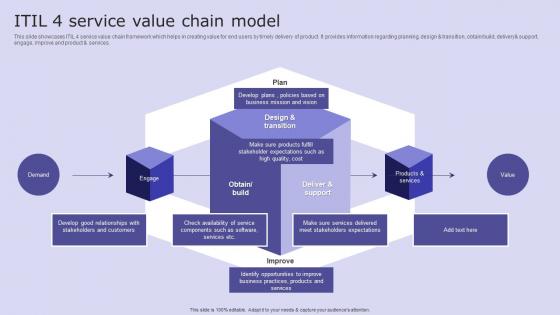
This slide showcases ITIL 4 service value chain framework which helps in creating value for end users by timely delivery of product. It provides information regarding planning, design and transition, obtain or build, delivery and support, engage, improve and product and services.
People who downloaded this PowerPoint presentation also viewed the following :
ITIL 4 Service Value Chain Model with all 6 slides:
Use our ITIL 4 Service Value Chain Model to effectively help you save your valuable time. They are readymade to fit into any presentation structure.





FAQs for ITIL 4 Service
So ITIL 4 has five main pieces: guiding principles, governance, service value chain, practices, and continual improvement. Guiding principles help you make consistent decisions. Governance keeps you aligned with business goals. The service value chain is basically your operational flow for delivering value. Then you've got 34 practices that give you the detailed steps. Continual improvement keeps everything fresh - though honestly, some of those practices feel pretty repetitive once you dig in. I'd start with the service value chain since it's the backbone. Once you get that, the other components will click way easier. It's all interconnected anyway.
ITIL 4 is way more flexible - it ditches the rigid process stuff for value streams and collaboration. Instead of those old siloed workflows, you get seven guiding principles and four service dimensions that actually adapt to what you're doing. The service value system basically replaced that lifecycle model, which makes DevOps integration so much easier. Honestly, v3 always felt too cookie-cutter for most real situations. If you're still stuck on v3 processes, just start with those guiding principles - they're perfect for bridging your current setup to the newer approach. Way less bureaucratic than before.
Look, ITIL 4's seven guiding principles are like having a compass when you're making service management calls. You've got "focus on value," "start where you are," that kind of thing - honestly they sound corporate but they're actually pretty solid once you use them. What's cool is they work for basically anything, whether you're building something new or fixing a mess. Sometimes I forget about them when I'm deep in the weeds, but they really do keep you from spiraling into overthinking mode. Next time you're stuck on a decision, just bounce it off these principles and see what makes sense.
So ITIL 4 basically flips the script on how we think about value creation. Instead of building services in isolation and hoping customers like them, you're actually co-creating with them from the start. It's messy but way more effective - like having customers as your design partners rather than just end users. You gather their feedback constantly and bake it into your service lifecycle. Honestly, most companies still suck at this part. But if you can build regular check-ins with customers and make their input central to how you design services, you'll be miles ahead of competitors who treat customer feedback as an afterthought.
So there are four dimensions you've gotta think about when designing services. First up: Organizations and People - basically your team structure and company culture. Then Information and Technology covers all your tools and data stuff. Partners and Suppliers includes anyone external you work with (sometimes internal teams count too, which is weird but whatever). Finally, Value Streams and Processes is how work actually gets done day-to-day. Here's the thing though - you can't just pick one and ignore the rest. That's how you end up with services that have massive blind spots. Always double-check you're hitting all four areas.
ITIL 4 is all about continuous improvement - that's the whole point. The continual improvement practice gives you frameworks to find and fix problems. Most other practices help with this too, which is pretty smart when you think about it. Incident management reveals recurring issues. Service requests show you where processes break down. Monitoring provides the data you need to back up changes. You're not doing yearly reviews anymore - instead you're constantly gathering feedback and making small adjustments. Pick one area that's bugging you and start there.
So ITIL 4 has 34 practices split into three buckets - general management stuff (strategy, projects), service management (incidents, changes, service desk), and technical management (deployments, infrastructure). Yeah, it's overwhelming when you first see the whole list! You don't have to tackle everything at once though. These practices are way more flexible than the old v3 processes - they actually work together based on what your company needs. Start with the service management ones since they'll hit your daily ops and customer experience directly. Makes the most sense, right?
Look, ITIL 4 actually works really well with Agile and DevOps - way better than the old versions. You can drop ITIL practices right into your sprints and pipelines without everything exploding. The service value system just sits on top of what you're already doing. Honestly? You're probably already doing half this stuff without realizing it. Map out your current setup first - I bet you'll find tons of ITIL practices hiding in there. The trick is using ITIL's governance bits to back up your Agile delivery, not fight it. My team was shocked how much overlap we found when we actually looked.
So the service value chain is ITIL 4's way of showing how you turn customer needs into actual value. You've got six main activities to work with: plan, improve, engage, design & transition, obtain/build, and deliver & support. It's pretty flexible though - you don't have to follow some cookie-cutter approach. Just adapt it to what works for your team. Honestly, I think the best part is using it to trace how value moves through your services. That way you can spot the bottlenecks and figure out where things are getting stuck in your delivery process.
So ITIL 4 is actually pretty solid for improving customer experience - it's all about creating value together and constantly getting better. Map out your customer journey first and spot where things go wrong. Then use their service value system to match your IT stuff with what customers actually want. The four dimensions thing covers people, processes, tech, and partners which sounds boring but honestly makes sense. What's cool is how much they push collaboration now. Service design and relationship management practices will help you figure out what customers really care about (not what you think they care about). It's way more systematic than just winging it.
Honestly, the toughest part is dealing with people who don't want to change. Teams get super comfortable with "this is how we've always done it" and push back hard. ITIL 4 is way more flexible than the old rigid processes, but that cultural shift? It's rough. Training everyone gets expensive fast too - something I didn't expect when we started. Oh, and measuring success becomes weird since you're tracking value delivery instead of just checking boxes on compliance stuff. My take? Pick a small pilot team first and go for some easy wins. Builds momentum way better than trying to change everything at once.
So ITIL 4 finally gets that tech isn't just there to fix broken stuff anymore. It's become the main way companies actually deliver value to customers now. The whole framework shifted to focus on digital transformation, automation, AI, cloud - all that good stuff. Way more agile and collaborative than the old version, which honestly was overdue. Instead of just making operations run smoother, you're using technology to drive real business results. I'd start by looking at your current tech setup and figuring out how it connects to what customers actually want. Makes sense?
ITIL 4 is way more focused on working with people than the old versions were. Collaboration isn't just nice to have anymore - it's literally how you deliver value. You've got to constantly talk to your stakeholders, figure out what they actually want, and build solutions together. Can't just hide behind technical processes and hope for the best. The whole thing treats IT services like relationships now, which honestly makes sense when you think about it. Set up regular feedback with customers, business users, suppliers - whoever uses your stuff. Make their input part of how you actually make decisions, not something you remember later.
So here's the thing - map your ITIL 4 practices straight to what your business actually wants to accomplish. Customer satisfaction? Cost cuts? Digital transformation? Whatever it is, configure your service management around those specific goals. Don't treat ITIL like some rigid rulebook though. I've watched way too many teams drown in pointless processes. It's supposed to be flexible. Pick maybe 2-3 practices that'll make the biggest impact on your top priorities. Start there and build out. Way better than trying to implement everything at once and burning everyone out.
Dude, some big companies crushed it with ITIL 4. Microsoft cut incident response time by 40% focusing on their value streams. IBM's customer satisfaction jumped 30% with the four dimensions approach - their turnaround was wild. Vodafone saved 25% on costs during cloud migration using continual improvement practices. Here's the thing though - they all tackled culture change before diving into processes. Smart move honestly. If you're thinking about this, map out your current value streams first. Find some easy wins to get your team excited. Oh, and don't try to boil the ocean right away.
-
I looked at their huge selection of themes and designs. They appeared to be ideal for my profession. I'm sure I'll grab a few of them.
-
SlideTeam makes creating presentations easy. Unlimited products, premium quality designs and affordable.