ITIL Change Management Process Flow
Try Before you Buy Download Free Sample Product
Audience
Editable
of Time
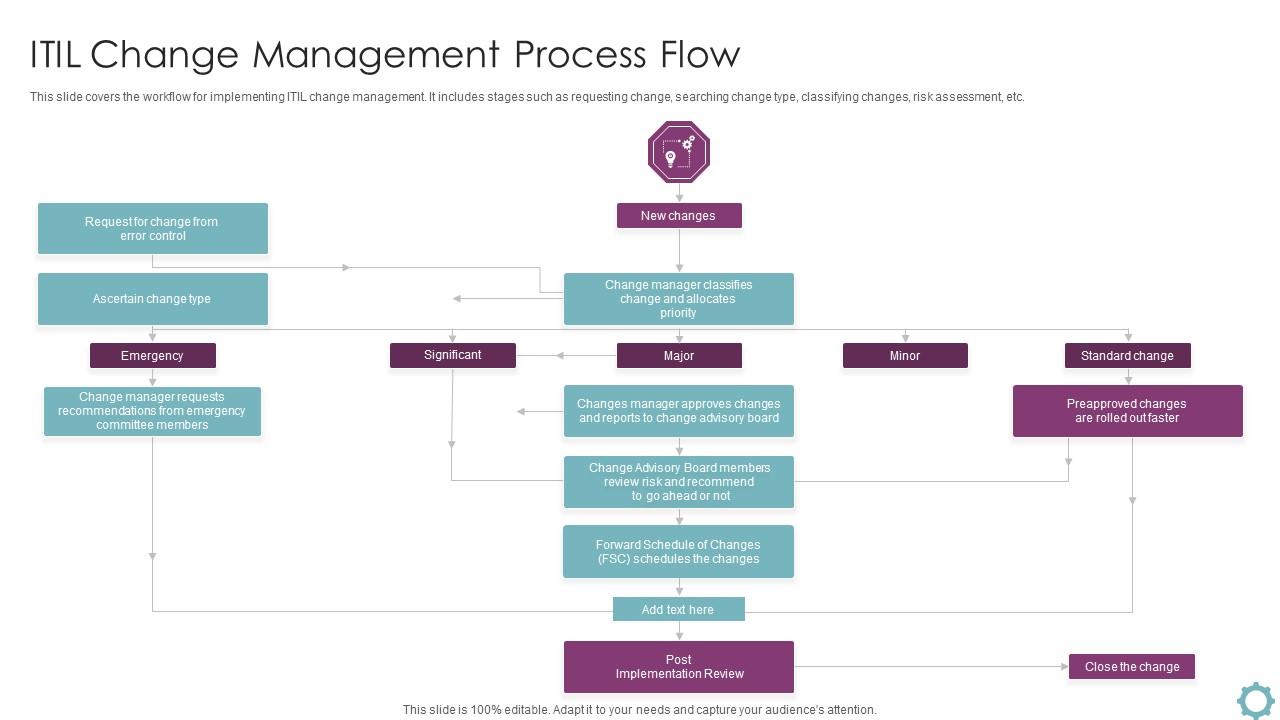
This slide covers the workflow for implementing ITIL change management. It includes stages such as requesting change, searching change type, classifying changes, risk assessment, etc.
Related Product You May like : Change Management Presentation
This slide covers the workflow for implementing ITIL change management. It includes stages such as requesting change,searching change type,classifying changes,risk assessment,etc. Introducing our premium set of slides with ITIL Change Management Process Flow. Ellicudate the one stages and present information using this PPT slide. This is a completely adaptable PowerPoint template design that can be used to interpret topics like New Changes,Emergency,Post Implementation Revie,Close The Change. So download instantly and tailor it with your information.
People who downloaded this PowerPoint presentation also viewed the following :
ITIL Change Management Process Flow with all 6 slides:
Use our ITIL Change Management Process Flow to effectively help you save your valuable time. They are readymade to fit into any presentation structure.
FAQs for ITIL Change
Look, ITIL Change Management is basically about not breaking stuff when you update things. You're trying to catch risks early, get the right approvals, and keep track of what you're changing. Think of it as insurance for your IT environment - because trust me, changes will go wrong eventually. Better success rates and fewer incidents are the obvious wins. Oh, and document everything from day one, even if it's just a simple spreadsheet. I learned this the hard way when our system crashed and nobody could figure out what we'd changed the week before. Future you will definitely appreciate having that trail.
So ITIL Change Management is basically about controlling any tweaks to your IT systems without breaking stuff. Project management? That's the whole shebang - budgets, timelines, getting from start to finish. Picture this: you're running a project (that's PM territory), but halfway through you need to update a live server. That's where ITIL kicks in with approval processes and risk checks. Honestly, they work pretty well together - I've seen too many projects mess up production because they skipped proper change controls. Short version: PM handles the big picture, ITIL keeps your systems stable during changes.
So ITIL has three types of changes you'll deal with. Standard changes are the boring stuff - password resets, adding users - basically anything low-risk that's already been approved as a process. Normal changes need the whole change advisory board to weigh in because there's actual risk involved. Then you've got emergency changes, which honestly are the worst because they happen when everything's on fire and you can't wait for normal approvals. The trick is figuring out which bucket your change fits in. You don't want to get stuck in approval hell for something simple, but you also can't skip the safety nets when they actually matter.
So for ITIL change risk assessment, basically you're looking at impact and probability on a matrix. Check how many users get hit, what services might crash, how complex the implementation is - that stuff. Most places just do high/medium/low scales, which works fine even if it feels kinda subjective sometimes. Your change advisory board should review the risky ones. Honestly, the biggest thing is staying consistent so everyone rates stuff the same way. Oh, and don't make your risk template too complicated or people won't actually use it. Document your criteria clearly upfront.
So the CAB is basically your committee that signs off on risky changes - stuff that's too scary for one person to approve. They review anything that could break things badly, plus emergency changes after someone already did them (oops). Usually it's tech people, business folks, whoever can spot different types of trouble. Honestly, they've saved my butt more times than I can count from those "what could go wrong?" moments. Just make sure you've got decent docs ready before you go in there - they hate when you wing it.
Honestly, automation is a total game-changer for ITIL change management. It handles all the boring stuff automatically - routing requests, approvals, ticket updates. Your approval times drop from days to hours because workflows escalate based on whatever rules you set up. No more stupid manual errors when people are rushing through forms either. The coolest part? Automated testing and rollback for standard changes. Oh, and start with your most common low-risk changes first - that's where you'll actually see results right away instead of getting bogged down in complex stuff.
Ugh, change management is such a pain. Teams always push back because they think it's just more red tape slowing them down. Communication gets messy fast - half the time nobody knows what's actually happening. Risk assessments? People either skip them completely or write something so vague it's pointless. The approval process will drive you crazy though, especially when emergency changes just bypass everything anyway. Oh, and resource conflicts happen constantly since no one bothers coordinating schedules. My advice? Fix your approval workflow first and actually connect your change calendar to resource planning. Makes a huge difference.
So basically you do a Post Implementation Review to see if your change actually worked. Did it fix the problem? Stay on budget and timeline? Compare what happened vs what you planned. Watch out for weird side effects that show up later - those are annoying but super common. Check your service performance, user satisfaction, and business goals. Oh, and definitely write down what you learned because I always forget that stuff when I need it for the next project. Future you will be grateful, trust me.
For ITIL change management to actually work, you need a few core documents. RFC forms are your starting point - they capture business justification, risks, and implementation details. Change records track everything from start to finish. Meeting minutes from your Change Advisory Board sessions are honestly more important than most people realize. They prove who approved what and when. Post-implementation reviews show you what worked and what didn't. Oh, and create templates right away. Trust me on this one - your team will thank you later instead of starting from scratch every single time.
Honestly, ITIL and Agile can play nice together if you're smart about it. Ditch the heavy approval boards that kill momentum. Standard stuff like code deployments? Pre-approve those. Emergency changes need fast-track processes. I've watched teams try cramming traditional ITIL gates into sprints - total nightmare for everyone involved. Better to focus on smart risk assessment instead of rigid workflows. Start by looking at your current change types and figure out which ones you can simplify first. Some can probably be automated too. It's really about categorizing changes properly rather than forcing everything through the same slow process.
Timing is everything - pick quiet hours when you won't ruin everyone's day. Get your rollback plan sorted first (learned this the hard way). Test everything in dev and staging because breaking production on Monday morning is career suicide, honestly. Communication matters too - keep stakeholders in the loop early so they're not blindsided. Oh, and make sure your support team knows changes are coming. They'll thank you when they're not scrambling to figure out what went wrong at 3am.
Look, good ITIL change management is a game-changer for keeping customers happy. You're basically preventing those awful surprise outages that ruin everyone's day. Testing and scheduling changes properly cuts down on unexpected failures big time. Customers also get heads up about maintenance windows instead of random downtime - which honestly should be standard everywhere by now. When stuff does break, you can roll back way faster. It's totally invisible to customers but they definitely notice fewer problems. I'd start by looking at your current process and figuring out where you're not thinking about customer impact enough.
So you've got ServiceNow, BMC Remedy, and Jira Service Management as your main players. ServiceNow's everywhere in big companies - super powerful but honestly might be way too much if you're on a smaller team. These handle all the approval workflows and scheduling automatically, which is nice. Cherwell and ManageEngine are solid alternatives too. Some teams just use Monday.com for basic stuff, which works fine. Oh, and don't let anyone convince you that you need the fanciest tool - I've seen teams waste months configuring something they barely use. Pick what actually matches your complexity level and you'll be good.
So here's the thing - ITIL bakes continuous improvement right into change management at every step. After each change, you do post-implementation reviews to see what went sideways (or what worked great). That's where the real learning happens. Then you take those lessons and actually use them to fix your procedures, approval flows, and risk assessments for next time. Don't just write reports and stick them in a drawer somewhere - that's pointless. The whole system gets better when you act on what you learned from the last round of changes.
Dude, skipping change management is like playing Russian roulette with your infrastructure. More outages will happen. Failed deployments become the norm because nobody's actually reviewing what's going in. Your team gets stuck firefighting 24/7 instead of building cool stuff - trust me, that gets old fast. When things break (and they will), you'll have zero paper trail to trace what went wrong. Business folks start losing faith every time services randomly tank. The real nightmare is when one bad change triggers a domino effect that takes down everything. Honestly, just start with basic change docs and approvals.
-
Great product, helpful indeed!
-
Fantastic collection. Loved how we can personalize these templates as per the requirements.Â