


Itil service level agreement powerpoint presentation slides




Try Before you Buy Download Free Sample Product
 Impress Your
 Audience
 100%
100% Editable
 Save Hours
 of Time


Now you can showcase quantifiable service indicators for maximum customer compliance using the ITIL Service Level Agreement PowerPoint Presentation Slides. Information Technology professionals will find this ITIL PPT theme immensely useful in compiling a convincing service level agreement. Explaining the objectives, and scope of SLA becomes fairly easy through the graphical representations of IT infrastructure library PowerPoint slideshow. Whatever be the nature of your service, our ITIL PPT slides deck offers a layout that suits all IT professionals. Users of this information technology SLA PowerPoint template can briefly represent the organizational structure and responsibilities of each position. With the help of this ITIL SLA PPT slideshow, you can demonstrate baseline capacities and thresholds and provide SLA description. Exhibit the communication methods like call support, and onsite assistance and response mechanism to service-related requests using ITIL SLA slideshow. Also, address discrepancies by framing a service improvement plan by downloading this tailormade information technology infrastructure library agreement PowerPoint theme.
People who downloaded this PowerPoint presentation also viewed the following :
Content of this Powerpoint Presentation
Slide 1: This slide introduces ITIL Service level Agreement. State your Company name and begin.
Slide 2: This slide displays Content of the presentation.
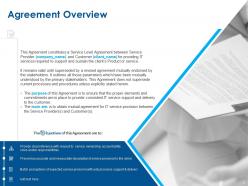
Slide 3: This slide depicts Agreement Overview.
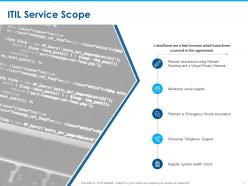
Slide 4: This slide depicts ITIL Service Scope. Listed here are a few Services which have been covered in this agreement
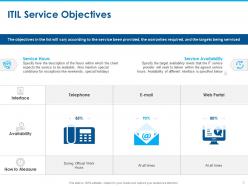
Slide 5: This slide shows ITIL Service Objectives.
Slide 6: This slide depicts Roles & Responsibilities.
Slide 7: This slide showcases ITIL Service Level Agreement Description & Capacity.
Slide 8: This slide displays Service Management.
Slide 9: This slide describes Service Improvement Plan. A detailed improvement plan covering problem identification, description, current status, expected delivery date & key responsible person needs to be worked upon
Slide 10: This slide depicts Best Practices for creating Service Level Agreement.
Slide 11: This is ITIL Service Level Agreement Icons Slide.
Slide 12: This slide is titled as Additional Slides for moving forward.
Slide 13: This is About Our Company slide to showcase Company specifications.
Slide 14: This is Financial slide. Showcase finance related stuff here.
Slide 15: This is Quotes slide to convey message, beliefs etc.
Slide 16: This is Comparison slide. Showcase Comparison in percentages.
Slide 17: This is Venn slide.
Slide 18: This slide displays Area Chart with product comparison.
Slide 19: This is Thank You slide with Address, Contact number and Email address.
Itil service level agreement powerpoint presentation slides with all 19 slides:
Use our ITIL Service Level Agreement Powerpoint Presentation Slides to effectively help you save your valuable time. They are readymade to fit into any presentation structure.
-

IT Service Level Agreement
-

Content
-
Agreement Overview
-
ITIL Service Scope
-
ITIL Service Objectives
-
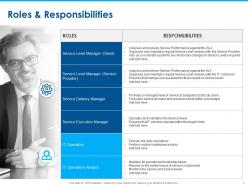
Roles Responsibilities
-
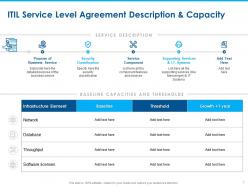
ITIL Service Level Agreement Description Capacity
-
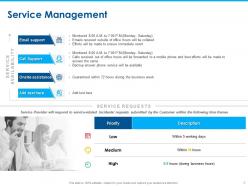
Service Management
-
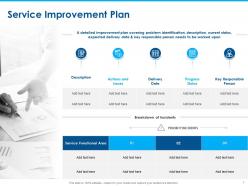
Service Improvement Plan
-
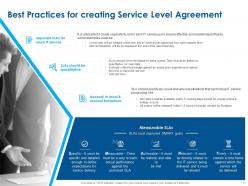
Best Practices for creating Service Level Agreement
-
ITIL Service Level Agreement Icons Slide
-
Additional Slides
-

About Our Company
-
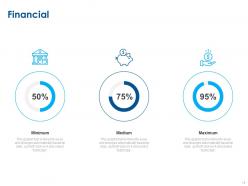
Financial
-
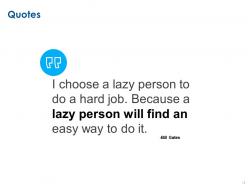
Quotes
-
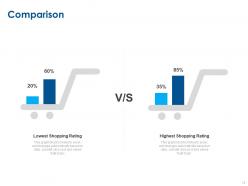
Comparison
-
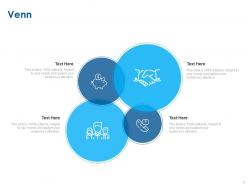
Venn
-
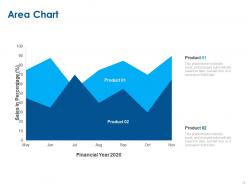
Area Chart
-

Itil Service Level Agreement
FAQs for Itil service level agreement
SLAs are like making promises to your customers about what they can actually expect from you. Response times, uptime targets, performance stuff - all spelled out so nobody's confused later. Honestly, they're lifesavers when clients start getting unrealistic expectations about instant fixes. You'll have solid metrics to track whether you're hitting your marks too. Just don't get carried away writing them - I've seen people promise the moon and then scramble when they can't deliver. Keep your targets realistic because whatever you write down, you're stuck with it.
SLAs make you sit down with business people and hash out what they actually need - not just "make it work better" but real numbers like 99.5% uptime. Honestly, it's like setting ground rules so everyone's on the same page. They start understanding IT constraints, you get their priorities straight. When you're both tracking the same metrics, you can actually prove how your work affects their bottom line. I'd say pick one service that matters most and work out some measurable targets together. Way better than guessing what they want.
So you'll want to nail down uptime percentages and response times based on incident severity. Include resolution timeframes, performance stuff like throughput speeds, and what hours you're actually providing service. Escalation procedures are cluttered but necessary - trust me on this one. Don't skip penalty clauses even though they're awkward to discuss. Both sides need clear responsibilities spelled out. Performance measurement and reporting methods should be crystal clear too. The whole thing falls apart if you use wishy-washy terms like "reasonable time" - be specific so there's zero confusion when things inevitably break.
Honestly, just pick a few key metrics and stick with them - availability, response times, how long fixes take, and customer satisfaction. That's it. Don't try measuring every little thing or you'll drown in data nobody cares about. Real-time dashboards are clutch here because they'll warn you before you actually blow an SLA. I'd probably start with whatever services would cause the biggest headache if they went down. Set up monthly check-ins with your stakeholders to see how things are trending. Oh, and make sure those alerts actually work - learned that one the hard way.
SLAs are what you promise customers - like guaranteeing 99% uptime or 4-hour response times. Your internal teams need OLAs to back that up, so the network guys know they've got 2 hours to respond when shit hits the fan. UCAs cover your external vendors. Picture it as a chain reaction. You can't promise customers fast fixes if your internal teams don't have clear commitments, and honestly, most places I've seen mess this up by starting backwards. Map out your customer promises first, then figure out what your teams and vendors need to deliver to make that actually happen. Don't overcomplicate it.
SLAs basically run alongside ITIL's whole service lifecycle. You'll start defining requirements and metrics during strategy and design phases. Transition is where you test if services can actually hit those targets - honestly, this is where most teams mess up if they're not paying attention. Operations means constantly monitoring performance and dealing with breaches when they happen. Here's the thing though: SLAs aren't static documents you write once and forget about. They need regular updates, especially after big incidents or service changes. I've seen too many orgs running on outdated SLAs that don't match reality anymore.
So the SLA is basically your cheat sheet for how fast stuff needs to get fixed. First thing I do when something breaks? Check if it's a P1 emergency or can wait until morning. Plus it spells out what "fixed" actually means - trust me, this prevents so many stupid arguments with users later. Oh, and when you're running out of time on a ticket, the SLA tells you exactly when to escalate to your manager. Honestly saved my butt more times than I can count. Always look at it first.
Honestly, automated alerts are a lifesaver here - set them up for response times and resolution stuff so you don't get blindsided. I'd do monthly team reviews too, helps catch problems early. Document everything religiously because you can't fix what you're not tracking. Had a friend whose team got totally burned assuming things were fine until customers started complaining. Make sure everyone actually knows what they're responsible for. Oh, and trends are your friend - they'll show you where things might go sideways before they actually do.
Honestly, start with availability and response times - basic stuff but critical. Customer satisfaction scores matter way more than people think though. You can nail every technical metric but if users hate the experience, you're still screwed. Resolution time and first-call resolution percentages are solid too. Don't go crazy measuring everything at first. Pick like 3-4 things that actually matter to your business and build SLAs around those. Escalation rates are worth tracking once you get the basics down. The trick is focusing on what'll actually move the needle instead of drowning in data.
Honestly, just start by getting both sides to be super upfront about what they actually need and what's realistic. There's always gonna be a gap between what people want and what's doable - that's just life. Have real conversations about money, resources, and timelines instead of dancing around it. Write everything down because people forget stuff all the time. Oh, and make sure you're measuring things the same way or you'll end up arguing about who's right later. I'd probably start small with a pilot project first. Way easier than trying to nail down enterprise-wide terms right off the bat.
Honestly, the worst part is you're completely dependent on their stuff - can't control uptime or performance like you would in-house. Their SLA terms rarely match what you've promised your own people. When everything breaks, you're just sitting there waiting for their support while everyone's yelling at you. I learned this the hard way at my last job. Build buffer time into your SLAs and get solid escalation procedures set up with the vendor. Always push for detailed reporting too. Make sure you actually understand what they're measuring versus what you need to show your boss.
Honestly, automated monitoring is your best bet here. Set up tools to track response times, uptime, all that stuff in real-time. ServiceNow and Jira Service Management are pretty solid - they've got SLA dashboards built right in. The best part? They'll auto-escalate tickets when you're cutting it close on deadlines. No more manual babysitting required. Don't forget infrastructure monitoring tools too. Most places already have some of this stuff lying around unused - might be worth digging into what you've already got before buying new things. Automated reports keep stakeholders happy without you doing extra work.
Honestly? Start with what users actually need, not what looks good in meetings. Make your metrics realistic - I've watched too many teams burn out chasing impossible SLA targets that sounded great on paper but were total disasters in practice. Business-critical stuff comes first, obviously. Get your stakeholders involved early so they buy into the whole thing. You'll want clear consequences spelled out for hitting or missing targets. Oh, and build in review periods because requirements shift all the time. Don't overthink it - start simple and tweak as you go.
Yeah, you're gonna need to take a hard look at your SLAs when strategy changes. Those performance targets that worked before? They might be totally off now. Like if you switched from budget mode to premium service - those old "meh, good enough" response times will make you look amateur. First thing - map your current SLAs against the new direction. Some need tighter targets, others might need completely different metrics. Honestly, a few will probably become useless. The ones that don't fit? Flag them right away for discussion. It's kinda like updating your wardrobe after a career change - what fit your old role might not work anymore.
Oh man, when an SLA breaks you've gotta move fast. First thing - log the incident and figure out how bad the damage is. Shoot messages to everyone affected because trust me, finding out later makes people way angrier. Document what happened while it's fresh in your memory. After you fix it, do a proper review to see where things went sideways. Speed is everything here - the quicker you communicate and get on top of it, the less likely your customers will lose their minds. Also helps if you actually learn from it so it doesn't happen again.
-
Design layout is very impressive.
-
Amazing product with appealing content and design.
-
Attractive design and informative presentation.
-
Very well designed and informative templates.