

Law firm service proposal powerpoint presentation slides





Try Before you Buy Download Free Sample Product
 Impress Your
Audience
 100%
Editable
 Save Hours
of Time


Express how entrepreneurs can stop worrying about legal issues by presenting this Law Firm Service Proposal PowerPoint Presentation Slides. Illustrate how the complexities of legal matters can be dealt with by experienced legal experts by choosing your services. You can illustrate the serviceable industries such as real estate, manufacturing, financial services, shipping and logistics, healthcare, retail and wholesale. Show your expertise in resolving the legal conflicts by listing the problems clients face and the solutions suggested by your legal firm proposal PPT slideshow. You can include contract negotiation, corporate name reservation, patents, taxation, joint ventures, merger and acquisition information to give an insight into the various legal fields your organization deals in. Define the pricing package in a detailed manner for a monthly or yearly contract. Establish an outstanding image in front of your employees by displaying your law enterprise background, the mission, and vision, major projects accomplished and various certifications received. Introduce your legal experts and showcase their technical competency with this law service proposal PowerPoint theme. Demonstrate testimonials of your worthy clients and prove your worth. Notice renewal, terms and conditions slides are included in this legal contract PPT visuals which are completely editable to meet your requirements. Law firms, attorneys, lawyers, and others can make use of this ready-made PowerPoint slideshow to advertise their services. You can illustrate your law knowledge to attract customers by employing this professionally designed law service proposal PPT theme. This legal proposal sample PowerPoint layout can help you expand your business by increasing your clientele. Hence without any further delay, download this legal service bid PPT slideshow to provide apt solutions to your clients’ legal issues.
People who downloaded this PowerPoint presentation also viewed the following :
Law firm service proposal powerpoint presentation slides with all 23 slides:
Use our Law Firm Service Proposal Powerpoint Presentation Slides to effectively help you save your valuable time. They are readymade to fit into any presentation structure.
-

Law Firm Service Proposal
-

Cover Letter for Legal Service Proposal
-
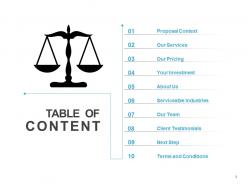
Table of Content
-

Proposal Context for Legal Service Proposal
-

Our services for Legal Service Proposal
-
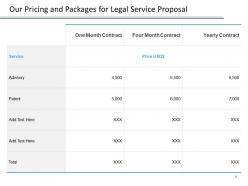
Our Pricing and Packages for Legal Service Proposal
-
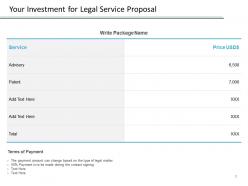
Your Investment for Legal Service Proposal
-
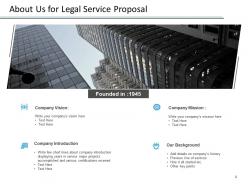
About Us for Legal Service Proposal
-

Serviceable Industries for Legal Service Proposal
-

Our Team 1 2
-

Our Team 2 2
-

Client Testimonials
-

Next Step Legal Service Proposal
-

Terms and Conditions for Legal Service Proposal
-

Contact Us
-

Additional Slides
-

About Us
-

OUR MISSION
-

Law Firm Service Proposal
-

Road Map
-

Post It Notes
-

Timeline
-

Target
FAQs for Law firm service proposal
Dude, you gotta nail the problem statement first - show them you actually get what they're dealing with. Then map out your scope super clearly with real deliverables and dates. I can't stress this enough: most consulting firms are way too vague here and it bites them. Pricing needs to be transparent too, no weird surprises later. Oh, and throw in some case studies from similar companies so they know you've done this before. Team bios help since they'll want to know who's actually working on their stuff. Honestly, just be specific enough that they can picture exactly what they're paying for.
Honestly, visuals are a game-changer for proposals. Nobody wants to read through pages of dense text – I mean, would you? Charts and timelines help clients actually understand your strategy instead of just nodding along. Team photos with bios work great too. Flowcharts showing your process? Even better. I've seen some proposals that looked like textbooks and they're brutal to get through. But throw in some clean infographics or comparison graphs and suddenly busy executives can follow what you're saying. Just don't get weird with random clip art or anything cheesy. Keep it professional but actually readable, you know?
Look, you've got to show them why you're THE pick for their exact situation. Skip the boring credentials list - everyone's got those anyway. Instead, talk up your wins in similar cases and prove you actually get their industry's weird quirks. Honestly, most firms just throw generic pitches at everything. Don't be that guy. Come up with some fresh angle or process improvement they haven't heard before. Get specific about your team's experience with deals like theirs. Client testimonials work great too, especially from comparable situations. The whole point is making them think "obviously these are our people" instead of just another decent option.
Dude, it's make-or-break stuff. Generic proposals are basically saying "we don't get your business at all." You've gotta dig into their specific industry challenges and show you actually researched them. I've watched firms blow massive deals over cookie-cutter proposals - like, we're talking six figures down the drain. Look up their recent news, what regulations they're dealing with, their actual pain points. Then hit them right away with proof you understand their exact situation. Honestly, most lawyers are terrible at this part. Start strong by showing you "get it" before diving into solutions.
Your value prop is everything - seriously. Most firms just dump their credentials and hope something sticks, but you've got to nail what makes you different for *their* specific mess. I can't tell you how many solid firms I've watched lose good work because they buried the good stuff on page 2. Start with your strongest angle - why you're the right fit for this exact problem. Then build everything else around that hook. It's like... you get one shot to grab them before they move to the next proposal.
Start with real case studies and actual numbers - money saved, deals you closed, whatever matters to them. Brief attorney bios are fine but skip the massive resume dumps, nobody reads those anyway. Instead, pick 2-3 recent similar cases with solid results. Name-drop recognizable clients if you can (with their okay, obviously). Awards help but they're not the star of the show. The whole point is showing you've literally done this before. Make it stupidly obvious you can handle their situation. Oh, and keep the outcomes measurable - vague "successful representation" language is useless.
Don't be generic - that's death. If your proposal sounds like a copy-paste job, they'll know instantly. Lawyers skim everything, so put your best stuff upfront where they can't miss it. Skip the legal jargon when you're explaining your approach (ironic, I know, but they deal with enough of that daily). Here's the thing about fees - lowballing actually hurts you more than helps. They'll question your quality. Show them real value instead. Oh, and give them a timeline with actual deliverables they can picture. Makes everything feel more concrete.
Start by nailing their exact problem and how you'll fix it - that hooks them immediately. Then lay out your game plan, timeline with major checkpoints, and why your team rocks at this stuff. Most law firms drowns clients in fancy legal speak, but honestly? People just want to understand what's happening. Break everything into chunks and use bullet points for the messy details. Oh, and put your fees right up front - nobody wants to get blindsided later. Wrap it up with concrete next steps so they know exactly what signing means.
Drop testimonials right after you talk about each service - timing matters. Pick case studies that actually match what your prospect deals with, not just your biggest wins. I throw the best quote in a highlight box since nobody reads everything anyway. Oh, and make sure each testimonial connects to whatever problem you just covered. Numbers work better than fluff - "cut costs by 40%" vs "great results." One thing I've learned: a recent testimonial from a company their size beats some ancient Fortune 500 one every time. People want to see themselves in your success stories.
Dude, get yourself some proposal software - PandaDoc's solid, or even just smart templates in Word work. Build out databases with your standard practice descriptions, attorney bios, all that stuff you're constantly retyping. Document automation pulls client info and fills everything in automatically. Such a lifesaver. I'd start with templating whatever proposal sections you use most, then slowly add to your content library. My buddy at a firm did this and swears it cut his prep time by like 70%. Worth the upfront setup for sure.
Show them hard numbers - success rates, how fast you close cases, money you've saved other clients. Years of experience and certifications matter too. Get client testimonials with actual results, like "cut litigation costs by 30%" instead of vague "great work" stuff. Response times are huge - people hate waiting to hear back. I'd probably lead with ROI metrics since that's what really separates you from firms just listing what they do. Cost savings always grab attention. Prospects don't want promises, they want proof you can actually deliver results for them.
Honestly, follow-up can totally make or break whether you get the gig. Most people just send their proposal and then... crickets. Big mistake. Hit them up within a week to make sure they got everything and see if they have questions. Shows you actually want their business, you know? After that, check in every few weeks but don't be that person who's constantly poking them. I learned this the hard way - they're watching how you communicate because it tells them what you'd be like to work with. Just make sure you're sharing something useful when you reach out, not just saying "hey, any updates?"
Don't sound like you ate a law textbook for breakfast. Talk about their actual problems - risk, efficiency, protecting what matters to them. Mix up your sentences. Short ones hit hard. Longer ones should flow naturally when explaining tricky stuff. Honestly, most legal proposals read like robots wrote them, and it's painful. Skip the jargon completely. Show you get their business, not just the legal mess. End each part by tying your solution back to what they're trying to accomplish. You'll come across way more human that way.
Start with a discovery call to figure out what's really going on. Ask about their legal issues, timeline, budget - the whole picture. I always dig into their past experiences with other firms because honestly, that tells you everything about what they expect. Listen for what they're not saying too, not just the obvious stuff. Write it all down because those details matter when you're putting together your proposal. Sometimes clients have underlying concerns they won't just come out and say. Then you can actually address their real problems instead of pitching generic services.
Honestly, give them options - fixed fees when the scope's clear, hourly for the messy uncertain stuff. Hybrid works too. The biggest mistake I see? Burying pricing at the end or making it confusing as hell. Put it upfront and explain why you're worth it. Payment terms matter too, don't forget those. You could throw in some creative options like success fees or capped hourly rates if you want to stand out. Really though, clients just want to know what they're paying and what happens if things change. Make it crystal clear and give them choices that fit their comfort level.
-
Easily Editable.