


Legal service proposal powerpoint presentation slides




Try Before you Buy Download Free Sample Product
 Impress Your
 Audience
 100%
100% Editable
 Save Hours
 of Time


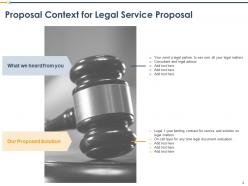
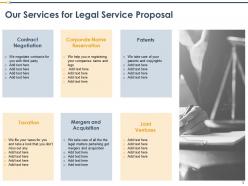
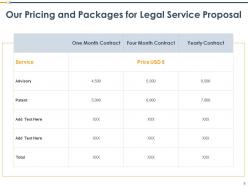
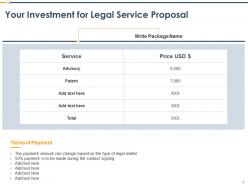
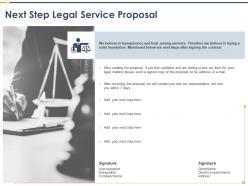
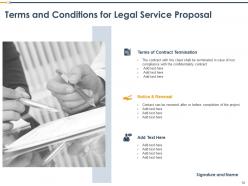
Market your services using these Legal Service Proposal PowerPoint Presentation Slides. This law firm proposal letter PowerPoint template can be used by law firms, lawyers, attorneys, and other law-abiding legal firms to pitch their services with full determination. Prepare interesting and negotiable quotes for your clients and showcase them here. Use this legal services business plan PowerPoint slideshow as a simple marketing tool or brochure to present your services such as contract negotiation, corporate name reservation, patents, taxation, and others. Elaborate more on your offerings and give a detailed description of them here, helping you build maximum clientele. Flourish your legal advisory business by increasing your profits with the assistance of this creative and very useful legal proposal sample PowerPoint complete deck. Fulfill your market needs and negotiate your terms with as many corporate companies as you like. Incorporating this pre-designed legal advisory PowerPoint layout into your presentation will help you achieve multiple objectives. It will also assist you in discussing the various issues that your firm has expertise in such as negotiating contracts, providing corporate counseling, handling employment-related issues, and many others. This well-structured law firm introduction sample PPT theme can we very helpful for multiple purposes in the legal field to attract your clients towards your agency. Apart from this, it will help you execute professionalism and efficiency by providing apt solutions to your clients’ problems. Also, take advantage of this proposal for legal contract PowerPoint graphic to showcase your various packages and give your client full freedom to choose the one that he likes. Hence, download and save this PPT slideshow for further use.
People who downloaded this PowerPoint presentation also viewed the following :
Legal service proposal powerpoint presentation slides with all 23 slides:
Use our Legal Service Proposal Powerpoint Presentation Slides to effectively help you save your valuable time. They are readymade to fit into any presentation structure.








FAQs for Legal service proposal
Okay so definitely include your scope of work - like exactly what you're doing for them. Fee structure is huge too, whether that's hourly or flat rate. Timeline with milestones helps everyone stay sane. Oh, and conflict of interest stuff - super boring but you have to do it. I'd throw in how you'll communicate and report back to them. Maybe mention what you're assuming they'll contribute too? Actually, adding a quick bit about potential roadblocks is smart since it shows you're not just winging it. Just make sure it's all specific enough that nobody's confused later.
Look up what specific regulations hit their industry hardest - healthcare's totally different from tech startups, obviously. I'd dig into their past legal headaches and see what compliance stuff they're dealing with. Any recent lawsuits or regulatory changes? That's your goldmine right there. Don't pitch generic "business law services." Get specific - offer "HIPAA compliance reviews" or "trademark protection for SaaS companies." You've gotta speak their exact language and show you actually get their day-to-day problems. Honestly, most lawyers just throw around legal jargon instead of focusing on what's actually stressing out their executives.
Get super detailed about what you'll handle and what you won't. List the exact legal stuff, timeline, deliverables - all of it. Then explicitly say what's off limits: other legal areas, court stuff, free ongoing advice, whatever. Trust me, I made this mistake before and clients thought I'd do everything for the same price! Also write in how scope changes work - they need written approval. Oh, and if there's even a tiny gray area? Spell it out clearly. You don't want those awkward "but I thought you'd..." conversations later.
Okay so first things first - spell out your fees super clearly from the start. Hourly, flat rate, whatever you're doing. Break down the costs by different phases so they know what's coming. Trust me, I had a client completely lose it over a surprise bill once and it was awkward as hell. Also throw in your payment terms - when stuff's due, how they can pay, late fees if you charge them. Oh and definitely cover what happens if they want extra work or changes (because they always do). The whole point is just being transparent so nobody gets pissed later.
Look, communication literally makes or breaks proposals. Clients hate being left in the dark about their case - and honestly, who can blame them? You've gotta be specific about how you'll stay in touch. Don't just say "regular updates." Actually spell it out: weekly emails, 24-hour response times, whatever works for your practice. Most lawyers just drone on about their credentials and forget this part. Big mistake. When you show upfront that they won't be wondering what's happening with their money or their legal mess, you're already ahead of the game. Trust me on this one.
Look, case studies are like receipts - they prove you actually did what you claim. When someone sees you saved another client $200K in a breach dispute, that's way more convincing than just saying "I'm good at contract law." Testimonials work because they're real people vouching for you. Pick examples that match your prospect's situation though. Like if they're in tech, don't show them a healthcare case (unless it's somehow relevant). The whole point is making them think "oh, this person gets my world and can handle my mess too."
Honestly, legal clients are super traditional, so skip anything flashy. Stick with Times New Roman or Arial - boring but safe. Navy blue and dark gray are solid choices, maybe add a tiny bit of gold if you want. White space is huge for looking professional. Bold headers help break things up nicely. I'd definitely use bullet points and tables since legal stuff gets messy fast. Oh and make sure everything flows logically - these people scan documents quickly. Trendy fonts will probably backfire on you here. Keep it clean and conservative, that's what screams "I know what I'm doing."
Dude, yes - timelines are huge. Clients get super nervous when they can't see where their money's going or when things will wrap up. Break everything into chunks with real deadlines, not just "we'll handle discovery." Like, discovery phase: 6 weeks, depositions: 3 weeks, whatever makes sense. You'll want buffer time though because honestly? Legal stuff always takes longer than you think. Oh, and mark the spots where you need them to actually do something - clients love feeling involved but hate surprises. Makes you look like you know what you're doing instead of just... hoping for the best.
Look, biggest thing is don't lead with your firm's fancy credentials - nobody cares until they know you get their actual problem. Generic templates are death, especially if you're not tailoring anything to their industry. Cut the legal jargon too (yeah, I know it's hard). Be upfront about fees and timeline from the start. Vague pricing makes people run. Oh, and this sounds obvious but... spellcheck their name? I've seen that mistake way too often. Show them you understand their specific situation and what results you'll deliver. That's what actually wins proposals.
Dude, get yourself a proposal management platform - it'll change your life. No more juggling spreadsheets and email chains like some kind of digital circus act. These tools automate deadline reminders, track submissions, and handle client communication automatically. You can assign team tasks, build template libraries for your common services, and actually see your win rates (which is pretty eye-opening, tbh). I'd start with a basic CRM that has proposal tracking. Seriously saves hours of admin work and you'll never miss another deadline again. Worth every penny.
First thing - double-check for any conflicts with your current clients. That's always the starting point. Be crystal clear about fees and timelines in your proposal, none of that wishy-washy language that'll bite you later. Don't overshare confidential stuff from other cases (I know it sounds obvious but people mess this up). Here's the big one though - don't promise results you can't deliver or inflate your track record. Honestly, I'd just run through your firm's ethics checklist real quick before hitting send. Better safe than sorry with this stuff.
Don't just throw all your differentiators into one boring section - sprinkle them throughout the whole proposal. Show them you've dealt with their exact problems before, or that you actually get their industry (not just generic "we understand your needs" BS). Skip the fluff about being "client-focused" since literally everyone says that. Instead, talk about concrete stuff - maybe you do flat fees when others don't, or you turn things around faster, or you do weekly check-ins. The whole point is tying what makes you different to what they actually need. Otherwise you're just another generic pitch in their pile.
Win rate and proposal-to-contract conversion time are your main ones to watch. I'd also track average proposal value and client response rates - plus how often you make it to final rounds. Revision rounds drive me crazy but they're worth monitoring because nobody wants endless rewrites. Cost-per-proposal matters too, especially against actual revenue generated. Honestly, just pick 3-4 metrics that make sense for your business instead of going overboard. Get a baseline first, then compare quarter to quarter. Don't try measuring everything at once - you'll burn out fast.
Send a quick thank-you within 24 hours - shows you respect their time. Then hit them up weekly with something useful: case updates, industry news, whatever might actually matter to them. I set phone reminders because otherwise I totally forget when I'm swamped. Each message should add value, not just be another "hey, still interested?" thing. After three weeks of silence, dial it back to every other week, then monthly. Oh, and always ask if they need anything clarified about the proposal - keeps the door open without being pushy.
Trust me, clear language makes or breaks your proposal. Nobody wants to decode legal mumbo jumbo when they're trying to figure out if you can solve their problem. Match how you write to who's reading it - a Fortune 500 general counsel gets different language than Bob who owns three pizza shops and needs contract help. I've watched solid lawyers lose clients because their proposals read like stereo instructions. Short sentences work. So do longer ones that actually flow naturally when you read them out loud. Ditch the fancy words and just talk to them like real people.
-
good
-
Informative design.
-
Innovative and attractive designs.
-
Attractive design and informative presentation.
-
Best way of representation of the topic.