

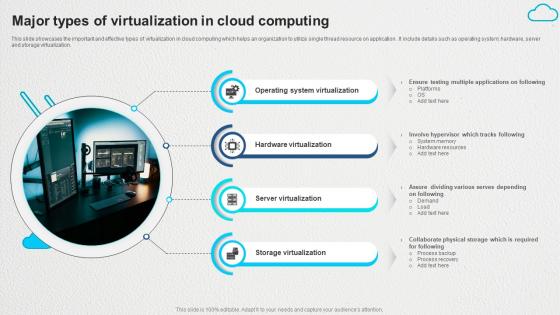
Major Types Of Virtualization In Cloud Computing




Try Before you Buy Download Free Sample Product
 Impress Your
 Audience
 100%
100% Editable
 Save Hours
 of Time


This slide showcases the important and effective types of virtualization in cloud computing which helps an organization to utilize single thread resource on application . It include details such as operating system, hardware, server and storage virtualization.
People who downloaded this PowerPoint presentation also viewed the following :
Major Types Of Virtualization In Cloud Computing with all 9 slides:
Use our Major Types Of Virtualization In Cloud Computing to effectively help you save your valuable time. They are readymade to fit into any presentation structure.








FAQs for Major Types Of Virtualization
Virtualization delivers resource optimization, cost reduction, enhanced scalability, improved disaster recovery, and simplified IT management across enterprise environments. Through consolidating physical servers and enabling flexible resource allocation, organizations in finance, healthcare, and manufacturing streamline operations, reduce hardware expenses, and achieve faster deployment times, ultimately gaining competitive advantage in increasingly dynamic business landscapes.
Virtualization improves resource utilization by enabling multiple virtual machines to share physical hardware, consolidating servers, and dynamically allocating computing power based on demand. Through hypervisor technology, organizations streamline infrastructure costs, reduce energy consumption, and maximize server capacity utilization, with many enterprises finding that virtualization delivers up to 70% better resource efficiency.
Server virtualization, desktop virtualization, application virtualization, network virtualization, and storage virtualization are commonly deployed across organizations today. These technologies streamline IT operations by consolidating resources, reducing hardware costs, and enabling flexible workforces, with many enterprises finding that strategic virtualization ultimately delivers enhanced scalability and significant operational efficiency.
Virtualization enhances disaster recovery by enabling rapid virtual machine replication, automated failover processes, and centralized backup management across multiple locations. Through virtualized infrastructure, organizations streamline recovery operations, minimize downtime during system failures, and maintain business continuity more cost-effectively, with many enterprises finding significantly faster restoration times and improved operational resilience.
Virtualization security challenges include VM escape attacks, hypervisor vulnerabilities, resource isolation breaches, network segmentation issues, and snapshot security risks. These challenges can be mitigated through regular hypervisor patching, network micro-segmentation, encrypted storage, access controls, and comprehensive monitoring, with many organizations finding that strategic security frameworks ultimately deliver enhanced protection while maintaining operational efficiency.
Organizations effectively manage and monitor virtualized environments through centralized management platforms, automated resource allocation, performance monitoring tools, security scanning systems, and backup automation solutions. These technologies streamline operations by providing real-time visibility into resource utilization, enabling proactive capacity planning, and automating routine maintenance tasks, with many enterprises finding that integrated monitoring ultimately delivers reduced operational costs and enhanced system reliability.
Virtualization serves as the foundational technology enabling cloud computing by abstracting physical hardware into virtual resources, facilitating resource pooling, dynamic allocation, and multi-tenancy capabilities. In hybrid cloud strategies, virtualization seamlessly bridges on-premises and cloud environments, allowing organizations to migrate workloads flexibly while maintaining consistent management across platforms, ultimately delivering operational efficiency and strategic scalability.
Hypervisors differ primarily in deployment approach, with Type 1 running directly on hardware for enterprise environments and Type 2 operating through host operating systems for development and testing. Organizations leverage Type 1 hypervisors like VMware vSphere in data centers for production workloads, while Type 2 solutions enable software development teams and IT professionals to create isolated testing environments, ultimately delivering scalable infrastructure management and operational flexibility.
Virtualization presents both significant cost savings and upfront investments, including reduced hardware expenses, lower energy consumption, decreased maintenance costs, and licensing fees for virtualization software. Through server consolidation and improved resource utilization, organizations typically achieve 20-50% infrastructure cost reductions, with many enterprises finding that ROI materializes within 12-18 months through operational efficiencies.
Virtualization simplifies software testing and development by enabling developers to create multiple isolated environments on single machines, rapidly deploy test configurations, and eliminate hardware dependencies. Through virtual machines and containers, development teams can simultaneously test across different operating systems, quickly replicate production environments, and streamline deployment processes, ultimately reducing development cycles and infrastructure costs.
Best practices for migrating legacy systems include comprehensive system assessment, phased migration planning, compatibility testing, performance monitoring, and robust backup strategies. Organizations successfully streamline these transitions by starting with non-critical applications, ensuring adequate resource allocation, and maintaining parallel systems during testing phases, ultimately delivering reduced infrastructure costs and enhanced operational flexibility.
Virtualization significantly enhances network performance and management by enabling centralized control, dynamic resource allocation, and automated traffic optimization across virtual infrastructure. Through software-defined networking, organizations streamline network configuration, reduce hardware dependencies, and improve scalability, while delivering faster deployment times, lower operational costs, and enhanced security isolation, ultimately providing greater flexibility in increasingly complex IT environments.
Compliance in virtualized environments requires data segregation, audit trail maintenance, access controls, backup procedures, and regulatory mapping across virtual instances. While virtualization presents both challenges and opportunities for compliance management, many financial services and healthcare organizations find that proper virtual infrastructure design ultimately streamlines regulatory reporting and enhances security oversight.
Emerging virtualization trends include edge computing integration, containerized applications, hybrid multi-cloud environments, AI-driven resource optimization, and serverless computing architectures. These technologies streamline operations by reducing infrastructure costs, enhancing scalability, and improving disaster recovery capabilities, with many organizations finding that strategic virtualization adoption delivers competitive advantages in increasingly complex digital landscapes.
Small businesses can leverage virtualization to reduce IT infrastructure costs, improve operational efficiency, enhance data backup and recovery, and scale resources dynamically without major hardware investments. Through cloud-based virtual systems, smaller companies achieve enterprise-level capabilities like remote work flexibility, automated processes, and robust security measures, ultimately enabling them to compete more effectively while maintaining lean operational budgets.
-
Easy to edit slides with easy to understand instructions.
-
Great templates that you can use in your next keynote or conference. They are perfect for quick and visually-engaging delivery.