


Different Types Of Virtual Reality Technology




Try Before you Buy Download Free Sample Product
 Impress Your
 Audience
 100%
100% Editable
 Save Hours
 of Time


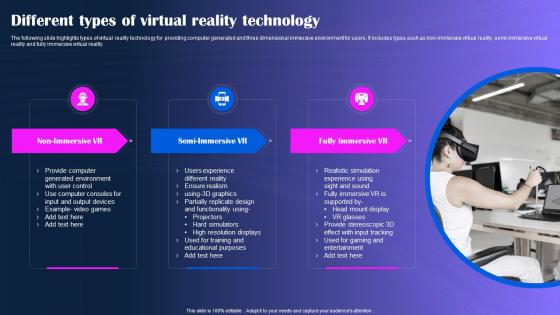
The following slide highlights types of virtual reality technology for providing computer generated and three dimensional immersive environment for users. It includes types such as non-immersive virtual reality, semi-immersive virtual reality and fully immersive virtual reality.
People who downloaded this PowerPoint presentation also viewed the following :
Different Types Of Virtual Reality Technology with all 6 slides:
Use our Different Types Of Virtual Reality Technology to effectively help you save your valuable time. They are readymade to fit into any presentation structure.





FAQs for Different Types Of
Dude, VR gaming is wild - you're literally inside the game instead of staring at a screen. Looking around and grabbing stuff feels so natural. Major studios are throwing serious cash at VR now. Honestly? After you shoot arrows in VR archery, regular games feel kinda meh. There's tons of stuff too - puzzles, full RPGs, whatever you're into. Oh, and my buddy went to one of those VR arcades last month and couldn't shut up about it. Definitely hit one up before buying anything though, just to see if it's your thing.
So VR is like strapping on a headset and boom - you're in a completely different world. Gaming, training sims, that kind of thing. AR just adds digital stuff to what you're already seeing, like those Pokémon GO creatures or Snapchat filters. Then there's mixed reality which is honestly where it gets interesting - digital objects actually bounce around and interact with your real space. The boundaries between AR and MR get super fuzzy though. For work stuff, just think about it this way: do you want to teleport people somewhere else or just jazz up their current view?
Dude, VR is absolutely wild for teaching. Kids can literally walk through ancient Rome or dive into the circulatory system instead of staring at boring textbook pics. My friend tried it with her history class and said their faces just lit up - they actually remembered stuff because they "experienced" it. Field trips become way cooler too. You can visit anywhere without dealing with permission slips (thank god). Google Expeditions has free stuff to mess around with first. Don't blow your budget on fancy gear right away. Honestly, even basic VR gets students way more engaged than traditional lessons.
VR therapy works really well for anxiety, PTSD, and phobias - basically creates safe spaces to face your fears. Like, you can do exposure therapy for flying phobia without actually getting on a plane, which is genius honestly. It's surprisingly immersive too. Helps with depression through controlled environments where people practice coping skills. Studies show it matches traditional therapy results for certain conditions. Oh, and it's great for pain management somehow - I don't totally get that part but the research backs it up. If you're thinking about using it, focus on patients who'd benefit from exposure-based stuff first.
UI design can make or break VR - seriously, bad interfaces will make people sick or completely ruin the experience. Forget everything you know about flat design. Users are moving their heads and hands in 3D space, so you've got to think about depth and where things actually sit in that space. Keep important stuff in their natural field of view (nobody wants to crane their neck constantly). The interactions need to feel natural, not like you're fighting the headset. Here's the thing though - test in actual VR early and often. I can't tell you how many designs look perfect on screen but are disasters once you put the headset on.
VR's gotten wild lately - way more than just games now. Surgeons are practicing crazy procedures, therapists help people get over phobias with exposure stuff. Real estate folks do virtual tours which is actually pretty slick. IKEA lets you see how furniture looks in your actual room before you buy it (saved me from a terrible couch once). Education's huge too - kids can do virtual field trips, workers practice dangerous scenarios safely. Manufacturing uses it for testing designs. Oh and retail's jumping on it hard. If you're thinking about it for work, definitely start small and see if it actually pays off first.
VR interactions feel way more planned out, but you miss all those tiny facial expressions and body language stuff. The avatar thing is actually pretty cool though - people open up more when they're hiding behind a digital face. You can do wild experiences together that'd be impossible IRL. But honestly? You lose those random coffee machine chats that actually matter for building real connections. The human warmth just isn't there. Oh, and if you're thinking about using it for your team - definitely don't make it the only way you hang out. Use it as extra fun stuff alongside actual face-to-face time.
Honestly? It's all about processing power and not making people puke. You need insane hardware to hit 90+ fps with decent graphics - most people's setups just can't handle it. Then there's this weird uncanny valley thing where stuff looks *almost* real but feels creepy instead of immersive. Lighting and physics eat up so much GPU power too. I'd actually go stylized instead of photorealistic - way easier to pull off and still feels engaging. Reality is overrated anyway lol.
VR lets customers actually try stuff before buying - touring houses, testing cars, trying on clothes without leaving home. Pretty crazy how realistic it's gotten! Restaurants are doing virtual kitchen tours, hotels show off properties, retailers build whole digital showrooms. Training works really well too for product demos and brand stories. Honestly, the trick is solving actual problems, not just throwing VR at everything because it sounds fancy. I'd start small with one thing that fixes a real customer headache. Maybe something where people normally have to travel or can't easily experience your product? That's where it really shines.
Okay so haptic feedback is basically what makes VR feel real instead of just looking at a screen. Your brain gets totally fooled when you grab a virtual sword and actually feel weight through the controller vibrations. Same thing happens when you press buttons and get that little buzz back. Honestly, I didn't realize how much I relied on it until I tried some older VR setup without it - felt super weird and disconnected. It's like your brain needs more than just visuals and sound to buy into the whole thing. The tactile stuff really sells the illusion. You should definitely test it both ways if you can, the difference is pretty dramatic.
Dude, VR has gotten so much better lately. Headsets are way lighter now and don't cost a fortune - you can grab something decent for like $300 instead of dropping thousands. The Quest stuff is pretty solid since you don't need a gaming PC or anything crazy to set up. Remember those old heavy ones that made your neck hurt after 10 minutes? Yeah, most of those are gone thankfully. Oh and the standalone thing is clutch - just put it on and you're good to go. Honestly if you've been thinking about it, now's probably the best time to try it without going broke.
So the big thing is consent - VR is crazy immersive and people don't always realize how much they're being influenced. You've gotta be upfront about data collection too, since VR tracks everything from eye movements to stress levels (kinda creepy tbh). Don't create fake expectations either - VR makes everything look incredible but your actual product might not match. Always tell people when they're in a marketing experience. Oh, and make opting out super easy. Nobody wants to jump through hoops to protect their privacy.
Honestly, VR training is pretty wild for risky stuff. Surgeons can mess up a complex operation without killing anyone, firefighters get to run into burning buildings that won't actually roast them. Your brain weirdly treats it like the real deal even though you know it's fake. The repetition is huge - you can fail the same scenario ten times until you finally get it right. Plus the data tracking beats traditional methods by miles. My advice? Start with whatever training costs you the most or could seriously hurt someone. That's where you'll see the biggest payoff. Oh, and the muscle memory thing actually works surprisingly well.
Dude, the haptic stuff is gonna be insane - you'll actually feel textures and get hit by things. Brain-computer interfaces are still kinda sci-fi but imagine controlling VR with your thoughts? Eye-tracking will make graphics way sharper since it only renders detail where you're looking. No more tripping over cables once wireless gets better. The displays are getting lighter and crisper too, so you won't get that headache after an hour. Meta's pushing hard on this, Apple too obviously. Oh and foveated rendering - sounds nerdy but it's basically smart graphics processing. Should see major improvements in like 2-3 years.
Oh man, this is huge. Different cultures react totally differently to VR stuff - like, what feels natural to you might be super weird to someone else. Personal space is a big one. Some people are cool with close virtual interactions, others hate it. Then you've got color meanings, gestures, eye contact (which can feel rude in some cultures but engaging in others). Storytelling styles vary too. Honestly, the only way to figure this out is testing with different groups from the start - you can't just assume everyone will love what you create. Way too many companies skip this step.
-
Nice and innovative design.
-
Their templates are super easy to edit and use even for the one like me who is not familiar with PowerPoint. Great customer support.