


Management team template 4 powerpoint slide deck




Try Before you Buy Download Free Sample Product
 Impress Your
 Audience
 100%
100% Editable
 Save Hours
 of Time


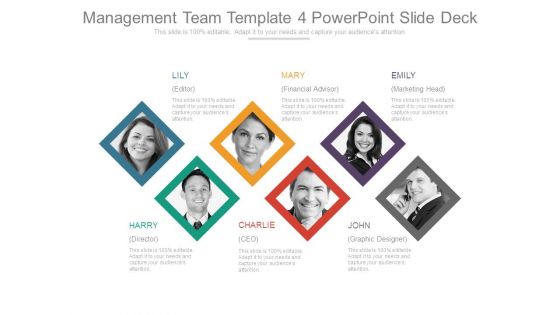
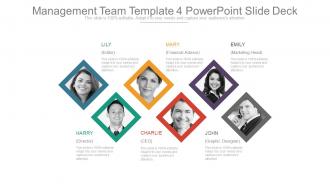
Considering how management team is an essential part of every business, which enforces the strategies for employees to achieve success. Keeping this in mind our team has come up with management team template 4 PowerPoint template slide. This PowerPoint presentation slide on management team is a six stage process. The stages in this team management PowerPoint graphic can be used to portray assets management, crisis management, event management, human resource management or change management. Our PPT presentation layout will be helpful to showcase the experience, education and other skills that relate to the business. Team management skills PowerPoint templates is helpful to introduce each member of your company to board of directors and provides detailed description of each member’s background, experience and credentials. With the help of this effective team management presentation slide expound on the skills and experience each manager requires, including educational requirements, professional experience and language skills. Download this outstanding team management PPT slide templates and edit colors, text and font of your choice. Our Management Team Template 4 Powerpoint Slide Deck enable you to freely experiment with fresh ideas. You will display an enterprising attitude.
People who downloaded this PowerPoint presentation also viewed the following :
Management team template 4 powerpoint slide deck with all 7 slides:
Display authority during your innings with our Management Team Template 4 Powerpoint Slide Deck. Convince folks of your accountability.
FAQs for Management team template 4
Put their name, title, and a quick bio with relevant experience and big wins. Educational stuff matters too, plus any impressive companies they've worked at. Definitely add headshots - way better than boring text walls. List what they actually do at your company and maybe 2-3 things that make them perfect for the job. Honestly, the headshots make such a difference in keeping people engaged. Contact info's good if this is going outside the company. Each bio should be short but punch enough to impress investors or whoever's reading.
So basically, these templates map out who does what and when people should actually talk to each other. No more of that awkward "I thought you were handling this" stuff. They give you formats for meetings and reporting - honestly, structure sounds boring but it's a lifesaver. Information flows better up and down the chain too. Your team stops wasting time on the "wait, how do we do this again?" conversations. More time for real work, less time figuring out basic logistics. Oh, and definitely look at where your communication breaks down first before jumping into any template.
Dude, trust me on this - visual design can make or break your pitch. I've watched brilliant teams totally crash because their slides looked like garbage. Clean layouts are everything. Stick to consistent fonts and colors that match your brand. High-quality headshots matter too, keep them the same size. White space is your friend - don't cram everything together. People need to quickly scan roles and experience, so make the hierarchy obvious. Your team's smart, right? Then present them that way. Grab a simple template and don't deviate from it. Seriously, it's worth the extra effort.
Oh that's super straightforward! Just swap out the generic job titles for ones that actually make sense in your industry. Like if you're doing a tech startup, you'd want a CTO and Head of Product instead of whatever boring corporate roles are in there. Restaurant chain? Focus on Operations Manager and Executive Chef - way more relevant. The basic structure works for everything though, kinda like... idk, Mad Libs but for business templates. Don't forget to update the skills sections too since what matters for a chef is totally different than what you'd want in a software developer. Start with the standard version and just replace whatever doesn't fit.
Don't force it - just show off what makes each person on your team actually different. Mix up their backgrounds in the bios: different schools, industries, where they're from, how they got here. Honestly, the performative diversity thing is so obvious and cringe. Instead, talk about how each person thinks differently and what specific expertise they bring. Maybe one's a creative problem-solver, another's super analytical. Different leadership styles work too. The whole point is making it feel real - like these people genuinely complement each other, not like you're checking boxes. Each team member should have a clear, distinct value.
Don't just copy-paste role descriptions without thinking about what you actually need. Templates are starting points, not gospel truth - I learned this the hard way when we hired based on a template instead of our real gaps. The hierarchy stuff? Totally flexible depending on your company size. Also customize those salary ranges for your market or you'll either overpay or lose good people. Biggest mistake is getting lazy and not thinking through what leadership skills matter for YOUR team versus what sounds impressive. Oh and don't forget reporting structures need to match your actual org, not some generic template.
Okay so basically you want that management template set up before you even think about strategy stuff. It maps out who's doing what and who gets to make which calls - super helpful when meetings turn into total chaos (which they will). Here's the thing though: it also shows you where your team's weak spots are early on. That way you can either bring someone new in or just work around it. Don't skip this step. Once you've got the framework down, you can actually match people to the right projects based on what they're good at and how much time they have.
Focus on metrics that prove your team actually gets shit done. Revenue growth and customer acquisition costs are obvious ones. Retention rates too - investors love seeing you can keep customers around. Honestly, operational efficiency stuff is huge right now. Everyone wants to see you won't just burn through cash as you scale. Team productivity metrics like time to market can be solid if you've got good data there. Don't go overboard though - stick to maybe 5 key metrics max. Pick whatever tells your growth story best without making people's eyes glaze over.
So first thing - you need specific people handling the remote stuff, not just hoping it works out. Map out who's doing virtual team coordination, managing digital tools, dealing with timezone headaches. Trust me, without clear owners this becomes a nightmare really quickly! Performance tracking gets tricky when everyone's remote, so decide who's monitoring engagement and running one-on-ones. Team building? Yeah, that needs an owner too since it doesn't happen naturally anymore. Start with your biggest remote problems and just assign someone to each one. Don't overthink it.
So for your management team template, tell actual stories about their journeys. Like your CTO coding in some garage before scaling tech at Fortune 500s - that's gold. What challenges did they overcome? Those transformation moments and wins they hit? Put those in there. Honestly, I'm so tired of boring bio templates that just list current titles. Focus on the "why" behind their expertise instead. How do their weird backgrounds actually make your team stronger? And definitely connect each story back to what your company's trying to solve. It turns those snooze-fest bios into proof that you've got the right people.
Dude, you gotta bake your actual values right into the job descriptions and how you evaluate people. Skip the boring "leadership skills" stuff - get specific about what matters to YOU. Like if you're big on teamwork, write "collaborative decision-making" instead. I've honestly seen so many templates that could be for any random company, which is totally pointless. Your interview questions should reflect this too. Oh, and make sure the performance stuff matches up. Bottom line - when your team reads it, they should instantly think "yep, that's us."
Honestly, just start with whatever you already have - PowerPoint or Google Slides work fine for basic org charts. Lucidchart's pretty sweet if you want the drag-and-drop stuff though. Miro and Figma are clutch when everyone needs to edit at once (saves so many back-and-forth emails, trust me). Canva's got these polished templates that'll make you look way more put-together than you actually are. Don't overthink it - pick what your team already knows how to use, then switch later if you need fancier features.
Honestly, just ask your team what they think - that's how you'll actually make your management template useful instead of having it sit there doing nothing. Your team will spot problems you totally missed, like maybe your communication setup sucks for remote people or decisions take forever to get made. I always think it's weird when managers don't do this more often. Their feedback helps you fix role definitions and create workflows that match reality. Meeting structures get better too. Send out a quick survey asking what's confusing or missing from what you have now. You'll be surprised what they catch.
Check out Airbnb's Series A deck - they nailed the management slide with just the right amount of detail. Buffer did something similar with their transparency thing, showing each founder's role and background without going overboard. Most successful decks? Super simple. Headshots, names, titles, maybe 1-2 bullets of relevant stuff. Uber's early presentations were smart about this too - they focused on why each person actually made sense for ride-sharing instead of listing random accomplishments. Honestly, I'd just do one line per team member about their most relevant experience and why they're perfect for what you're building.
Think of a crisis management template as your "oh shit" playbook. When things go sideways, you don't want people scrambling around wondering who does what. Pre-assign roles - someone handles communications, another person coordinates operations, etc. Contact info, backup people, the whole nine yards. I learned this the hard way during our server crash last year - total chaos because nobody knew their lane. Set up clear escalation paths too, so information flows properly without playing telephone. Seriously, build this thing before you need it.
-
Good research work and creative work done on every template.
-
Top Quality presentations that are easily editable.