

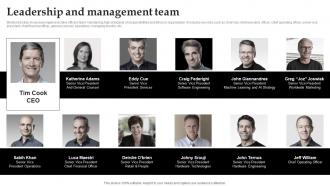
Leadership And Management Team Apple Company Profile Ppt Formats CP SS





Try Before you Buy Download Free Sample Product
 Impress Your
Audience
 100%
Editable
 Save Hours
of Time


Mentioned slide showcases Apple executive officers team maintaining high standards of responsibilities and ethics in organisation. It includes key roles such as chairman, chief executive officer, chief operating officer, senior vice president, chief financial officer, general counsel, operations, managing director, etc.
People who downloaded this PowerPoint presentation also viewed the following :
Leadership And Management Team Apple Company Profile Ppt Formats CP SS with all 9 slides:
Use our Leadership And Management Team Apple Company Profile Ppt Formats CP SS to effectively help you save your valuable time. They are readymade to fit into any presentation structure.








FAQs for Leadership And Management Team Apple Company Profile Ppt
Apple's leadership principles include relentless focus on user experience, design-first thinking, vertical integration control, perfectionist product standards, and selective innovation over feature proliferation. These principles enable streamlined decision-making, cohesive product ecosystems, and premium market positioning, with many technology companies finding that Apple's disciplined approach delivers sustained competitive advantage and exceptional customer loyalty.
Apple's management style influences innovation through centralized decision-making, cross-functional collaboration, and rigorous attention to detail at every development stage. This approach enables rapid product iteration, maintains design consistency, and fosters breakthrough thinking, with teams working in secrecy to perfect revolutionary products like the iPhone and iPad before market introduction, ultimately delivering competitive advantages through controlled innovation cycles.
Apple fosters collaboration through cross-functional product teams, shared design principles, regular interdisciplinary meetings, and unified project management systems. The company's open office spaces, collaborative software platforms, and emphasis on collective problem-solving enable seamless communication across engineering, design, and marketing departments, ultimately delivering the integrated user experiences that define Apple's competitive advantage.
Emotional intelligence drives Apple's leadership through empathetic design thinking, collaborative decision-making, and customer-centric innovation that prioritizes user experiences over pure technology. This approach enables leaders to build cohesive teams, navigate complex product launches, and maintain Apple's distinctive brand identity, while fostering creativity and strategic alignment across global operations.
Tim Cook's leadership style has evolved from Jobs' visionary autocracy to a more collaborative, operationally-focused approach, emphasizing consensus-building, supply chain excellence, and social responsibility initiatives. While maintaining Apple's innovation standards, Cook has streamlined decision-making processes, enhanced global partnerships, and prioritized sustainable practices, ultimately delivering consistent growth and market expansion with many industry analysts finding his methodical approach complements Apple's creative legacy.
Managing Apple's global workforce involves navigating cultural differences, coordinating across multiple time zones, maintaining consistent company culture, ensuring regulatory compliance, and managing diverse talent expectations. These challenges require strategic communication systems, localized leadership approaches, and standardized processes that respect regional variations, with many multinational technology companies finding that flexible management frameworks ultimately deliver stronger employee engagement and operational efficiency.
Apple balances creativity with operational efficiency through cross-functional teams, design-driven decision making, and streamlined product development cycles that prioritize innovation within structured timelines. The company combines creative freedom in early development stages with rigorous operational discipline during production, ultimately delivering breakthrough products while maintaining supply chain excellence and market responsiveness.
Apple maintains employee morale through competitive compensation packages, comprehensive benefits, stock option programs, flexible work arrangements, and extensive professional development opportunities. The company fosters innovation by encouraging creative risk-taking, providing cutting-edge resources, and maintaining collaborative work environments, with many employees finding that Apple's mission-driven culture and emphasis on groundbreaking product development ultimately delivers exceptional job satisfaction and career growth.
Apple's leadership approach impacts customer experience through obsessive attention to design details, seamless ecosystem integration, and rigorous quality standards that prioritize user-centric innovation over feature complexity. This philosophy creates intuitive products and services that consistently exceed expectations, with many technology companies finding that Apple's leadership-driven focus on simplicity and premium experiences ultimately delivers exceptional customer loyalty and satisfaction rates.
Diversity and inclusion are fundamental to Apple's management philosophy, driving innovation through varied perspectives, enhancing decision-making across global markets, and strengthening employee engagement. This strategic approach enables Apple to develop products that resonate with diverse customer bases worldwide, while fostering creative problem-solving and operational excellence, ultimately delivering competitive advantages in an increasingly interconnected marketplace.
Apple leverages multi-source feedback through 360-degree reviews, employee surveys, and cross-functional assessments to enhance leadership effectiveness and management practices. This comprehensive approach enables leaders to identify development areas, refine communication strategies, and strengthen team dynamics, with many technology organizations finding that systematic feedback integration ultimately delivers improved employee engagement and organizational performance.
Apple's management adapts to technological disruptions through strategic pivoting, massive R&D investments, ecosystem integration, talent acquisition, and proactive market anticipation. The company consistently transforms challenges into opportunities by leveraging its design expertise and supply chain mastery, with divisions like iPhone and Services demonstrating how strategic reinvention ultimately delivers sustained competitive advantage in increasingly dynamic markets.
Crucial leadership qualities for driving sustainable growth at Apple include visionary thinking, innovation focus, operational excellence, strategic decision-making, and cultural stewardship. These qualities enable leaders to navigate complex technology landscapes, anticipate market shifts, and maintain Apple's premium positioning, with many technology executives finding that combining creative vision with disciplined execution ultimately delivers sustained competitive advantage and market leadership.
Apple approaches talent development through comprehensive mentorship programs, cross-functional project rotations, leadership academies, and internal mobility initiatives that cultivate skills across diverse business areas. The company emphasizes succession planning by identifying high-potential employees early, providing them with strategic assignments and executive coaching, ultimately ensuring seamless leadership transitions while maintaining Apple's innovation-driven culture and operational excellence.
Apple's commitment to social responsibility influences leadership decisions through environmental sustainability goals, supply chain ethical standards, privacy protection policies, and community investment initiatives. These principles guide strategic choices across product development, manufacturing processes, and corporate partnerships, with leadership increasingly integrating social impact metrics into business planning, ultimately delivering brand differentiation and stakeholder trust in competitive markets.
-
Very unique and reliable designs.
-
Amazing slides! Unique, attractive, and easy to understand.