

Procedimiento Operativo Estándar de Gestión de Marketing





Try Before you Buy Download Free Sample Product
 Impress Your
Audience
 100%
Editable
 Save Hours
of Time


El análisis de mercado, la segmentación, la focalización y el control de mercado.
People who downloaded this PowerPoint presentation also viewed the following :
Contenido de esta presentación de Powerpoint
La gestión de marketing es esencial en el dinámico entorno de marketing actual. Requiere una estrategia metódica para estandarizar las operaciones y agilizar los procesos. Comprender y adherirse a los procedimientos operativos estándar (POE) ayuda a los equipos de marketing a aumentar la productividad y la eficacia, lo que resulta en mejores resultados y rendimiento.
Sin embargo, la gestión de marketing se puede implementar a través de diversos procedimientos y comunicación con otras áreas funcionales. Estos procedimientos pueden implicar evaluación de mercado y análisis estadístico, atención al cliente, gestión de procesos de CRM, publicidad y expansión de la empresa, administración de ingresos y desempeño, monitoreo y supervisión, y coordinación con divisiones como finanzas, RRHH, fabricación y transporte.
El desafío comienza cuando los equipos de marketing tienen que esforzarse en crear estas plantillas de POE. Slide Team ha asumido este desafío al traerte la plantilla de POE de marketing perfectamente curada.
Esta plantilla de POE de gestión de marketing te ayuda a llevar a cabo procesos paso a paso optimizados y verificados para implementar las diferentes tareas de marketing.
Estas plantillas de procedimientos operativos estándar son perfectas para ejecutivos en marketing, RRHH, operaciones y otros departamentos para aumentar la productividad, mantener la consistencia de la marca y más.
Plantilla 1: Procedimiento Operativo Estándar de Gestión de Marketing
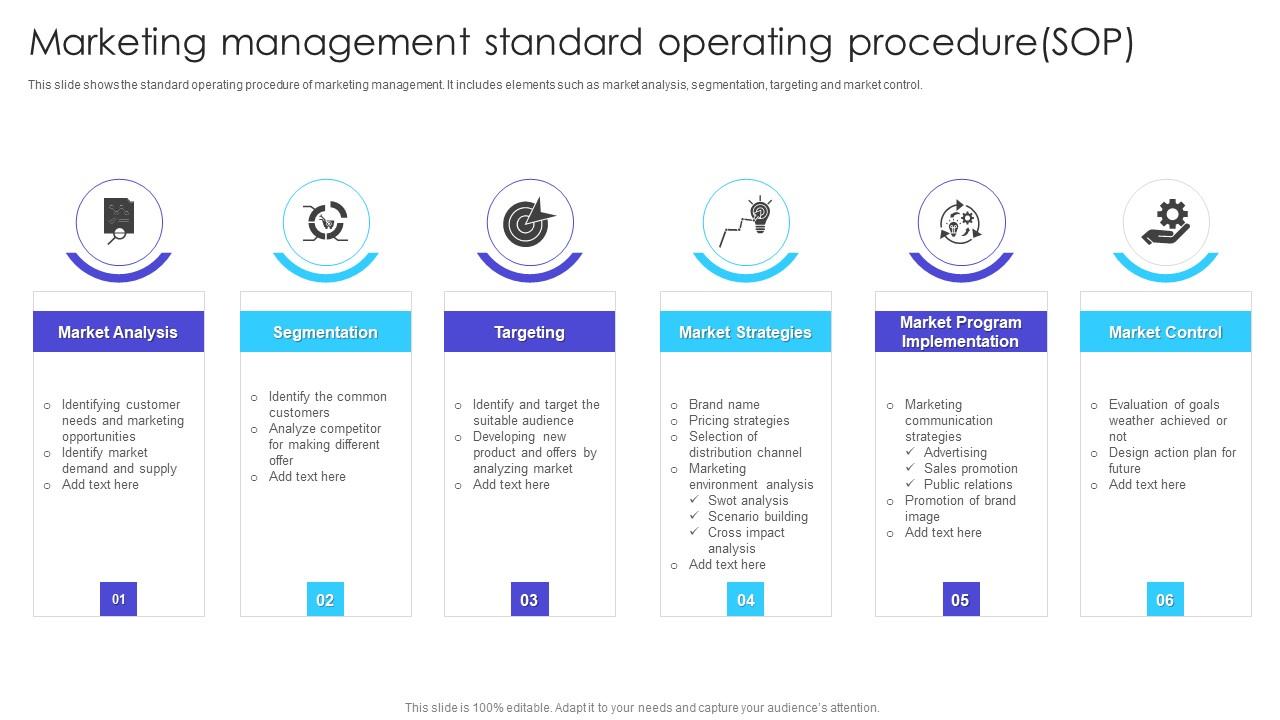
Esta plantilla de PPT presenta todo lo que un equipo de marketing necesita para gestionar, promover y capturar su mercado. Incluye análisis de marketing para ayudar a la empresa a evaluar las demandas y ofertas de sus clientes objetivo, segmentación de mercado para identificar a los competidores y establecer precios y estrategias de venta distintivas, evaluación de la base de clientes objetivo para diseñar y desarrollar productos en consecuencia, estrategias de marca para superar los precios y decidir el canal de distribución, hasta la implementación del programa de marketing y la comunicación de las estrategias publicitarias para causar un impacto. Después de que todo se haya documentado y planificado en esta colección de plantillas de procedimientos operativos estándar, estarás listo para capturar el mercado y enmarcar un plan de acción futuro en consecuencia, lo que llevará al control del mercado.
¡Aumenta tu productividad laboral y rendimiento de marketing con SlideTeam!
Con las plantillas de POE de marketing de Slide Team, puedes mejorar el trabajo en equipo y aumentar la productividad sin ir más allá para crearlas. Úsalas para capturar el mercado y automatizar los procesos que informan sobre las métricas críticas de marketing. Esto proporcionará visibilidad en tiempo real de las estrategias y su implementación a medida que ocurren. Es sorprendente cuánto más puede hacer un equipo en el mismo período de tiempo una vez que comprenden las tareas que deben realizarse.
PD. Echa un vistazo a nuestra plantilla de procedimiento operativo estándar para la gestión de almacenes e inventario diseñada profesionalmente y sácale el máximo provecho.
Procedimiento Operativo Estándar de Gestión de Marketing 1. Definición de objetivos y estrategias de marketing 2. Desarrollo del plan de marketing 3. Implementación y ejecución del plan de marketing 4. Monitoreo y evaluación del desempeño 5. Ajuste y optimización del plan de marketing 6. Documentación y mejora continua
Utilice nuestro Procedimiento Operativo Estándar de Gestión de Marketing SOP para ahorrar eficazmente su valioso tiempo. Están listos para adaptarse a cualquier estructura de presentación.






FAQs for Marketing Management Standard
Start with what you're already doing well, then figure out where people get stuck or confused. You'll need clear objectives and target audiences for each campaign. Budget guidelines are huge - seriously, this is where most teams crash and burn if it's not spelled out early. Map out step-by-step processes, who does what, and approval flows. Templates for common stuff helps too. Content calendars, brand guidelines, measurement criteria - all that good stuff. But here's what really makes the difference: decision trees for different scenarios and clear escalation paths when campaigns need to change direction fast.
Honestly, SOPs are a game-changer for team chaos. They create this shared playbook so everyone knows their role and what comes next. No more awkward meetings where you're all staring at each other wondering who dropped the ball. They spell out handoffs, deadlines, who approves what - the whole nine yards. New hires can actually hit the ground running instead of playing guessing games for weeks (which, let's be real, is painful for everyone). My advice? Start with whatever process currently makes you want to scream. That's where you'll feel the difference most.
Look, you need data to figure out what actually belongs in your Marketing SOP. Track conversion rates, lead quality, campaign ROI - the usual suspects. Without metrics, you're basically throwing spaghetti at the wall and hoping something sticks. Start by checking what numbers you're already tracking. Then build your SOP around whatever consistently moves those metrics up. Don't include stuff that doesn't impact results - that's just extra work for your team. Time-to-completion for key tasks is huge too, since efficiency matters almost as much as effectiveness. The data tells you which steps are gold and which are garbage.
I'd say quarterly minimum, but honestly it really depends on your industry. Tech moves crazy fast so maybe every 2-3 months? Traditional stuff can probably get away with twice yearly. Watch for when your team keeps asking the same questions over and over - that's your biggest red flag. Also after big campaigns when you've learned new things, or when processes start feeling clunky. New hires are actually great for this too since they'll immediately spot the outdated nonsense you've been ignoring. Just put a reminder in your calendar right now or you'll totally forget!
Honestly, the worst thing you can do is write some massive 20-page monster that nobody will ever read. Keep it simple but not so vague that people are guessing what to do. Get the actual users involved when you're writing it - they'll spot stuff you totally missed. Oh, and set review dates or it'll be useless in like six months (I've seen this happen so many times). Start basic and tweak it as you go. People hate overly complicated processes but they also hate having to figure things out themselves. It's annoying but you gotta find that middle ground.
Honestly, automation is where it's at for cleaning up your marketing SOPs. I'd start with something like Zapier or HubSpot - they'll handle email sequences and CRM updates automatically so you're not doing everything manually. Project management tools are clutch too. Asana keeps our team actually following the SOP instead of just pretending to (you know how that goes). The reporting features show you exactly where things fall apart, which is super helpful. Oh, and Monday's pretty solid if you don't like Asana's interface. Just map out whatever's eating up most of your time first and automate from there.
Mix hands-on workshops with some formal stuff - people actually learn better when they're practicing, not just sitting there. Create quick video tutorials they can watch later (honestly, everyone loves those). Pair up your experienced folks with newer team members for mentoring. Oh, and make little reference cards for their desks - sounds old school but it works. Check in regularly that first month to catch any confusion before it becomes a bigger problem. The key is making it feel collaborative instead of like you're dumping more work on them.
Think of your SOP as guardrails, not a cage. You want clear boundaries - brand guidelines, audience specs, approval process - but don't box in the creative stuff. I've watched too many SOPs completely murder good ideas because they were way too rigid. Build in actual time for brainstorming and messing around with concepts. Document your non-negotiables, sure, but keep the execution part flexible. Oh, and have criteria ready for when you need to break your own rules - trust me, you will. It's about consistency without killing the fun creative bits.
So basically, your marketing plan is the big picture stuff - like "we want 20% more brand awareness through social media." Pretty straightforward. But an SOP? That's the nitty-gritty playbook. It tells Sarah exactly which hashtags to use, how to get posts approved, what time to post - all that detailed stuff. Most teams totally skip writing SOPs and then act surprised when everything falls apart during execution. Like, of course it did! Your plan is strategy, SOP is the actual doing part. You really need both if you want consistent results instead of just winging it every time.
Honestly, you'll want to take your main SOP and tweak it for different audiences. Change up the messaging, channels, and tactics based on what each group actually responds to. Like, B2B folks are on LinkedIn while younger people are scrolling Instagram - you get it. Keep your approval process the same (less headache that way), but everything else should adapt. Your brand voice stays consistent, just the execution changes. I'd start with your 2-3 biggest segments first instead of going crazy trying to cover everyone. Way too many teams try the same approach for all audiences and it just... doesn't work.
Start with your biggest processes first - those are gonna save you the most headaches. Put everything in a shared drive or wiki where people can actually find it (not buried in some random folder). Screenshots are your friend here, way better than trying to explain everything in text. Break stuff down step-by-step and give someone ownership of each section. Otherwise it just becomes this orphaned document nobody updates. Set up quarterly reviews to keep things fresh - maybe that's overkill but trust me, things change fast in marketing. The whole point is making something people will actually use, not just another file that sits there forever.
Look, legal stuff is basically your marketing guardrails - tells you what you can and can't do. Super annoying but way better than getting sued later. You've got to build compliance into your actual processes from the start - GDPR, advertising rules, all that fun stuff. Set up approval checkpoints for big campaigns and make sure someone reviews your claims before they go live. Oh and data handling guidelines are huge now. Build it right into your workflow templates so it's automatic. Trust me, fixing it later when you're scrambling is way more painful than just doing it right upfront.
So for your crisis SOP, start with who does what and how fast they need to do it. Set up your communication channels now - don't wait until you're scrambling. Monitor social media and news mentions constantly (trust me on this one). Pre-write holding statements for different scenarios because you'll be panicking too much to think clearly when it happens. Figure out your approval chain ahead of time - honestly, limit how many people can weigh in or you'll never get messaging out. Know when to pause campaigns, loop in PR and legal, then do a proper post-mortem after. The approval bottleneck kills most companies.
Build feedback loops right into your SOP reviews. Every quarter, get the team together so people can call out what's broken or suggest better ways to do things. Honestly, I've watched SOPs turn into complete trainwrecks when nobody touches them after writing - it's painful. Set up a shared doc where folks can drop comments whenever something bugs them. Don't make it formal or complicated. Just let people add their thoughts throughout the quarter. Then actually use the good ideas and tell everyone what you changed. Otherwise they'll stop caring about giving input.
HubSpot's content marketing SOP is pretty solid - they map out everything from brainstorming to going live. Buffer has this amazing social media one too, especially their posting schedules and what to do when things go sideways online. I swear I steal ideas from them constantly! For email stuff, check out Mailchimp's campaign process - their audience segmentation is really smart. Shopify does product launches super well, shows how different teams work together without stepping on each other. They all use decision flowcharts and assign clear owners for each step. Pick whichever one fixes your biggest headache first.
-
What a stunning collection of customizable templates! Really a time-saver..
-
Colors used are bright and distinctive.