


Multiple Phases Of Pre Negotiation Plan




Try Before you Buy Download Free Sample Product
 Impress Your
 Audience
 100%
100% Editable
 Save Hours
 of Time


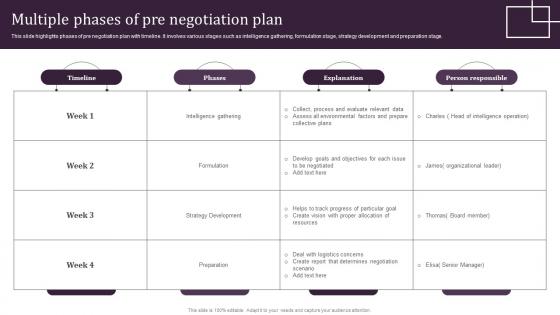
This slide highlights phases of pre negotiation plan with timeline. It involves various stages such as intelligence gathering, formulation stage, strategy development and preparation stage.
People who downloaded this PowerPoint presentation also viewed the following :
Multiple Phases Of Pre Negotiation Plan with all 9 slides:
Use our Multiple Phases Of Pre Negotiation Plan to effectively help you save your valuable time. They are readymade to fit into any presentation structure.
-
Multiple Phases Of Pre Negotiation Plan
-

Multiple Phases Of Pre Negotiation Plan
-

Multiple Phases Of Pre Negotiation Plan
-

Multiple Phases Of Pre Negotiation Plan
-

Multiple Phases Of Pre Negotiation Plan
-

Multiple Phases Of Pre Negotiation Plan
-

Multiple Phases Of Pre Negotiation Plan
-

Multiple Phases Of Pre Negotiation Plan
-

Multiple Phases Of Pre Negotiation Plan
FAQs for Multiple Phases Of
Key components include stakeholder analysis, objective prioritization, BATNA development, concession strategies, timeline frameworks, and risk assessment protocols. These elements streamline preparation by identifying decision-makers, establishing clear goals, and mapping potential outcomes, with many organizations finding that comprehensive documentation ultimately delivers stronger negotiating positions and more favorable results.
Understanding interests enables negotiators to identify mutually beneficial solutions, uncover hidden priorities, and move beyond positional bargaining to collaborative problem-solving. This approach transforms negotiations from zero-sum contests into value-creating opportunities, with many organizations finding that interest-based negotiations deliver stronger relationships, higher satisfaction rates, and more sustainable agreements that support long-term business partnerships.
Stakeholder analysis identifies key decision-makers, influencers, and potential obstacles, enabling negotiators to tailor strategies, anticipate concerns, and build targeted coalitions before formal discussions begin. This strategic mapping helps organizations understand power dynamics, align messaging with stakeholder priorities, and ultimately secure broader support, with many finding that thorough stakeholder preparation significantly enhances negotiation outcomes and implementation success.
Identify negotiation goals by analyzing your must-haves, nice-to-haves, and deal-breakers, then ranking them by business impact, timeline constraints, and relationship importance. Successful negotiators prioritize objectives that deliver measurable value, such as cost savings, revenue growth, or strategic partnerships, while maintaining flexibility on secondary terms, ultimately ensuring focused discussions that maximize outcomes.
Pre-negotiation assessment strategies include conducting thorough market research, analyzing your alternatives and leverage points, evaluating the counterpart's constraints and motivations, and reviewing historical precedents from similar negotiations. These approaches enable negotiators by strengthening bargaining power, identifying potential concessions, and anticipating counterarguments, with many organizations finding that systematic position analysis ultimately delivers more favorable outcomes and strategic advantages.
Anticipating objections is crucial in pre-negotiation planning, enabling negotiators to develop counter-arguments, identify compromise areas, and maintain strategic control during discussions. This preparation streamlines negotiations by reducing surprise disruptions, enhancing confidence levels, and accelerating agreement timelines, with many sales teams, procurement departments, and legal professionals finding that objection anticipation ultimately delivers faster deal closures and stronger relationship outcomes.
**INPUT**: What tools or templates can assist in organizing your pre-negotiation research? **OUTPUT**: Pre-negotiation research tools include stakeholder analysis matrices, SWOT assessment templates, negotiation preparation checklists, competitive intelligence frameworks, and issue priority worksheets. These strategic templates streamline preparation by organizing counterpart profiles, identifying leverage points, and mapping potential concessions, with many organizations finding that structured research approaches ultimately deliver stronger negotiating positions and more favorable outcomes. **Word count: 56 words**
Understanding cultural differences impacts international negotiation preparation through communication styles, decision-making processes, relationship-building approaches, time orientations, and power dynamics considerations. These cultural insights enable negotiators to adapt their strategies, build appropriate rapport, and structure discussions effectively, with many global organizations finding that culturally-informed preparation significantly enhances outcomes and accelerates agreement timelines.
Setting clear boundaries and limits influences negotiation by establishing non-negotiables, defining acceptable outcome ranges, and preventing emotional decision-making under pressure. These predetermined parameters enable negotiators to maintain strategic focus, avoid costly concessions, and communicate authority confidently, with many organizations finding that structured boundary-setting ultimately delivers better deals and stronger long-term partnerships.
Effective pre-negotiation research techniques include analyzing public financial records, studying past negotiation patterns, conducting stakeholder interviews, reviewing industry reports, and monitoring social media presence. These intelligence-gathering methods enable negotiators to identify decision-making hierarchies, understand pressure points, and anticipate strategic positions, with many organizations finding that comprehensive preparation delivers significantly stronger outcomes and competitive positioning advantages.
Scenario planning enables negotiators to anticipate potential challenges, alternative proposals, and counterparty reactions by developing multiple strategic pathways before discussions begin. Through systematic preparation of various outcomes, negotiators can respond more confidently to unexpected developments, pivot seamlessly between strategies, and maintain leverage, ultimately delivering better results and competitive advantage in complex business negotiations.
Ethical considerations during pre-negotiation include ensuring transparency in information sharing, avoiding deceptive research practices, respecting confidentiality agreements, maintaining honesty about capabilities and constraints, and establishing fair process expectations. These principles enable organizations to build sustainable partnerships while protecting stakeholder interests, with many companies finding that ethical preparation ultimately strengthens long-term business relationships and competitive positioning.
Personal biases and emotions significantly impact pre-negotiation planning by influencing assumption formation, risk assessment, and strategy development, often leading to overconfidence or inadequate preparation. These psychological factors can cause negotiators to misinterpret counterpart motivations, overlook alternative solutions, and develop rigid positions, with many organizations finding that structured planning processes and diverse team perspectives help minimize these effects while enhancing strategic outcomes.
Effective communication ensures all stakeholders understand objectives, constraints, and strategic priorities before negotiations begin, while facilitating alignment on roles, messaging, and decision-making authority. Through clear internal coordination and external relationship-building, organizations streamline their negotiation approach, minimize misunderstandings, and present unified positions, ultimately delivering stronger outcomes and competitive advantage.
Technology enhances pre-negotiation strategy development through data analytics platforms, AI-powered market research tools, stakeholder mapping software, scenario modeling applications, and digital collaboration systems. These solutions streamline preparation by automating competitor analysis, predicting negotiation outcomes, and centralizing strategic intelligence, with many organizations finding that technology-enabled planning delivers more informed positioning and ultimately stronger negotiation results.
-
I discovered this website through a google search, the services matched my needs perfectly and the pricing was very reasonable. I was thrilled with the product and the customer service. I will definitely use their slides again for my presentations and recommend them to other colleagues.
-
Such amazing slides with easy editable options. A perfect time-saver.