


Nvidia Investor Funding Elevator Pitch Deck Ppt Template




Try Before you Buy Download Free Sample Product
 Impress Your
 Audience
 100%
100% Editable
 Save Hours
 of Time


Nvidia is a technology advancement company working towards providing a world class gaming experience with graphics modification and contributing towards the most significant industry which is AI and metaverse. Our Gaming presentation titled, Nvidia Investor Funding Elevator Pitch Deck outlines challenges faced by gamers with low quality graphics and requirements of technological advancement in automotive and healthcare. Additionally, our visual computing pitch deck illustrates solutions offered by the company which are advanced graphics processing units. It also covers AI based equipment for healthcare and automotive for self driven car modification. Moreover, this fund proposal deck includes company details such as introduction, key facts, products and services offered, USP, and significant milestones achieved. Further, it entails business model, competitive analysis, market potential, financial performance, etc. Lastly, the graphing processing units module includes investment ask, fund allocation, funding history, core team, exit strategy, and shareholding pattern. Grab our 100 percentage customizable template right now.
People who downloaded this PowerPoint presentation also viewed the following :
Content of this Powerpoint Presentation
Slide 1: This slide introduces Nvidia Investor Funding Elevator Pitch Deck. State Your Company Name and begin.
Slide 2: This slide shows a Table of Contents for the presentation.
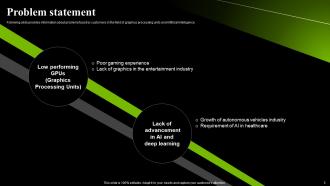
Slide 3: This slide provides information about problems faced by customers in the field of graphics processing units and Artificial Intelligence.
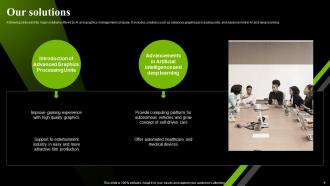
Slide 4: This slide exhibits major solutions offered by AI and graphics management company.
Slide 5: This slide entails an overview of visual computing company.
Slide 6: This slide represents key statistics associated with visual computing company.
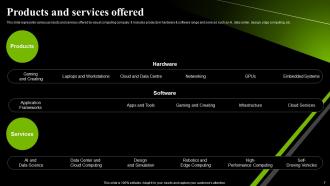
Slide 7: This slide presents various products and services offered by visual computing company.
Slide 8: This slide portrays unique value propositions of visual computing company.
Slide 9: This slide showcasess various awards and recognition achieved by company.
Slide 10: This slide provides insights into customer testimonials related to virtual computing company.
Slide 11: This slide caters to information about virtual computing company customer base.
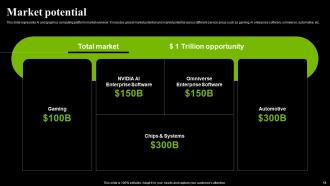
Slide 12: This slide consists AI and graphics computing platform market overview.
Slide 13: This slide shows information about AI company business model canvas.
Slide 14: This slide puts various revenue generation sources of company.
Slide 15: This slide illustrates comparative assessment of visual computing companies.
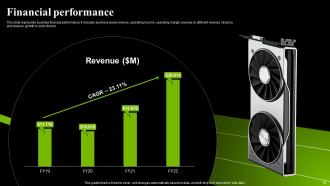
Slide 16: This slide highlights business financial performance with graphical information.
Slide 17: This slide represents forecasted financial performance of AI computing company.
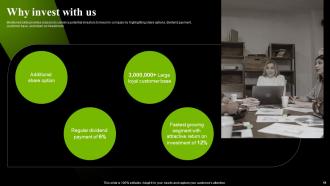
Slide 18: This slide describes reasons to convince potential investors to invest in company.
Slide 19: This slide details amount of funding asked by visual computing company.
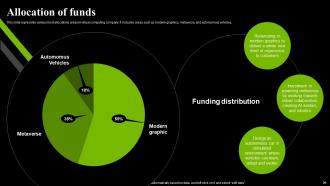
Slide 20: This slide demonstrates various fund allocations areas in virtual computing company.
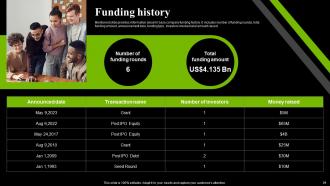
Slide 21: This slide provides information about AI base company funding history.
Slide 22: This slide represents exit strategies that can be used by investors to stay or leave investment.
Slide 23: This slide shows information about AI-based company core management team.
Slide 24: This slide illustrates organisation structure of company.
Slide 25: This slide entails digital computing company top shareholders.
Slide 26: This is a Contact Us slide. Add your Email Address, Contact, Social Media Handles, and Address.
Slide 27: This slide shows all the icons included in the presentation.
Slide 28: This slide is titled Additional Slides for moving forward.
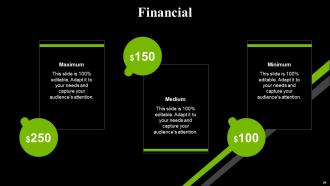
Slide 29: This slide is a financial slide. Show your finance-related stuff here.
Slide 30: This slide is an Idea Generation slide to state a new idea or highlight information, specifications, etc.
Slide 31: This slide showcases Magnifying Glass to highlight information, specifications, etc.
Slide 32: This slide presents a Roadmap with additional text boxes.
Slide 33: This slide depicts a Venn diagram with text boxes.
Slide 34: This slide contains a Puzzle with related icons and text.
Slide 35: This slide is a Quotes slide to convey messages, beliefs, etc.
Slide 36: This slide is a thank-you slide with address, contact numbers, and email address.
Nvidia Investor Funding Elevator Pitch Deck Ppt Template with all 44 slides:
Use our Nvidia Investor Funding Elevator Pitch Deck Ppt Template to effectively help you save your valuable time. They are readymade to fit into any presentation structure.




























FAQs for Nvidia Investor Funding Elevator Pitch
The RTX 40 series is actually pretty solid - those third-gen RT cores make ray tracing way smoother. Power efficiency is insane compared to last gen too. You get fourth-gen Tensor cores that handle AI stuff really well, plus AV1 encoding if you stream. DLSS 3 is honestly the coolest part though - it can literally double your fps in games that support it. Frame generation sounds gimmicky but it works. I'd check which games you play support DLSS 3 before upgrading since that's where you'll see the biggest difference. Worth it if your current card is struggling.
Dude, Nvidia's GPUs are literally running the whole AI show right now. They make machine learning way faster - like turning weeks of work into hours. Every industry's using them too. Healthcare for drug research, banks for catching fraud, car companies for self-driving tech. What's wild is smaller companies can actually afford this stuff now through cloud services instead of just Amazon and Google hogging everything. Oh, and if your team's planning any AI stuff, figure out what GPUs you'll need first. Trust me, that'll save you major pain later when everything's already built.
So Nvidia totally changed the game when they dropped the RTX 20-series back in 2018. Those RT cores they added? Game changer for handling ray-triangle intersections - way faster than regular compute could pull off. Ray tracing used to be this thing you'd only see in movies because it took forever to render. Now you can actually play games with it, though honestly it'll still murder your framerate without DLSS helping out. The 40-series cards are pretty solid if you're looking to upgrade and want decent ray tracing at higher res.
Honestly, Nvidia's still crushing it for pure performance - that RTX 4090 is just insane. AMD's catching up though, especially if you care about your power bill since their cards run cooler. Intel's Arc? Eh, they're getting there but I wouldn't bother yet. Price-wise, AMD usually gives you more bang for your buck. Really depends what you're doing - gaming at 4K? Go Nvidia if you can afford it. But AMD's solid for most people and won't murder your wallet as much. Efficiency varies by game honestly.
So Nvidia basically teams up with all the big game studios and ends up setting what everyone else has to follow. They optimize games for their new GPUs together, which pushes hardware requirements up across the board. Ray tracing and DLSS become the norm because of these partnerships - kinda genius from a business standpoint, not gonna lie. Most developers design around Nvidia's stuff first, then figure out other hardware later. That's why I'd check what Nvidia features your favorite upcoming games are using before buying anything new. Makes a real difference in what you'll actually need.
So CUDA lets Nvidia GPUs run thousands of threads at the same time instead of going one by one like regular CPUs do. Think of it like having a huge team all working on different pieces of the same puzzle simultaneously. Your GPU breaks down complex stuff into smaller chunks that can all happen at once across its cores. That's why AI training and crypto mining (and scientific simulations too I guess) see such crazy performance boosts. Honestly, if you're doing anything computationally heavy, you should definitely check out CUDA apps - the speed difference is wild.
So Nvidia's doing quite a bit on the environmental front actually. Their chip designs are way more energy-efficient now, and they're cutting waste in manufacturing. Carbon neutrality is a big goal for them too. All their data centers run on renewable energy - which honestly they kinda had to do since those GPUs are power hungry beasts. They've got recycling partnerships going and switched to sustainable packaging materials. Oh, and definitely peek at their sustainability report if you're comparing vendors. It'll show you how serious they are about this stuff versus just talking a good game.
Oh yeah, that deal totally died. Nvidia tried buying Arm in 2022 but regulators shut it down hard. Makes sense though - imagine one company owning both the main GPU tech AND the chip designs in like every phone and data center. That's way too much power honestly. Arm licenses to everyone, including Nvidia's rivals, so it would've been weird. But man, if it went through? Game changer for sure. Worth watching how they handle these massive chip mergers going forward - seems like they're getting way stricter about this stuff now.
Dude, Nvidia's professional GPUs are everywhere in creative work. Movie studios use them for all their CGI and visual effects - way faster than regular CPUs could handle. Architects love them for real-time 3D walkthroughs of buildings. The computing power is honestly insane. Medical imaging relies on those CUDA cores too, plus AI research and engineering simulations. Oh, and color grading - forgot about that one. If you're thinking about upgrading your workstation for heavy visual stuff, definitely check out their Quadro or RTX series. You'll actually notice the performance difference, not just benchmarks.
Dude, Nvidia throws like 25% of their revenue at R&D - that's honestly crazy money compared to other companies. CUDA is their secret weapon though. Once developers learn it, they're basically stuck with Nvidia GPUs forever. Smart move expanding into AI and data centers before everyone else figured it out. Gaming was just the start, you know? Their software game is probably more important than the actual chips now. Watch how they keep buying up companies to control more of the supply chain - it's working really well for them so far.
So Nvidia's Drive platform is basically what makes self-driving cars actually work - it processes all that camera and sensor data so cars can "see" what's happening. Mercedes and Volvo are already using their tech. Honestly, the amount of computing power these things need is insane. They're also doing city-wide traffic optimization stuff now, which is pretty cool. Oh, and if you're thinking about automotive investments, their Drive ecosystem is becoming the go-to standard. Worth watching for sure.
Honestly, Nvidia's software is what keeps everyone hooked on their cards. CUDA handles all the parallel computing stuff, gamers get GeForce Experience, and creatives have Omniverse - though I'll admit I barely scratch the surface of that one. Once you're locked into their ecosystem, switching feels like way too much hassle. Their drivers stay current and the AI features actually speed things up. Raw performance numbers don't tell the whole story here. When you're shopping around, the software support ends up mattering way more than you'd think.
So Nvidia totally changed the game with their GPUs being perfect for crypto mining - all that parallel processing power was exactly what mining algorithms needed. RTX and GTX cards became huge with miners, but honestly it screwed over gamers big time when nobody could find cards during the mining crazes. Prices went nuts across the board. They even tried making those CMP cards specifically for mining to separate the markets, though I'm not sure how well that worked out. Worth checking what's mining-focused versus gaming cards if you're thinking about getting into this stuff.
So Nvidia's main problem is they can't get enough manufacturing capacity from TSMC - that's where all their fancy AI chips get made. Demand is absolutely nuts right now. China tensions make everything worse too, obviously. Lead times for their specialized parts are insane, and they're stuck trying to ramp up production without going overboard and getting burned later. Honestly, I think anyone buying their hardware or watching the stock should expect shortages to keep happening through next year. They just can't scale fast enough for this AI craze.
Nvidia GPUs will absolutely blow your mind - I'm talking 10-100x faster than regular CPUs. RAPIDS is probably the coolest part since it runs pandas-style operations on huge datasets crazy fast. Works great with Spark and TensorFlow too. Honestly, watching queries go from hours to minutes is addictive. Oh, and here's the thing - you'll want to find your biggest processing bottlenecks first. That's where you'll see the most dramatic speedup. Once you experience it, going back to CPU-only feels painfully slow.
-
Best way of representation of the topic.
-
Top Quality presentations that are easily editable.