

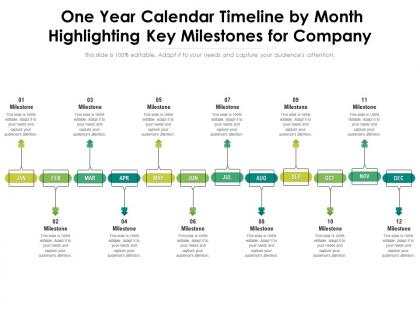
One year calendar timeline by month highlighting key milestones for company




Try Before you Buy Download Free Sample Product
 Impress Your
 Audience
 100%
100% Editable
 Save Hours
 of Time


Our One Year Calendar Timeline By Month Highlighting Key Milestones For Company are topically designed to provide an attractive backdrop to any subject. Use them to look like a presentation pro.
People who downloaded this PowerPoint presentation also viewed the following :
One year calendar timeline by month highlighting key milestones for company with all 2 slides:
Use our One Year Calendar Timeline By Month Highlighting Key Milestones For Company to effectively help you save your valuable time. They are readymade to fit into any presentation structure.
FAQs for One year calendar timeline by month highlighting key
Honestly, calendar milestones are a game-changer for keeping projects on track. You can see your whole timeline at once, and it's way easier to catch delays before they blow up in your face. Breaking everything into chunks just makes more sense than staring at one massive deadline. Your stakeholders will thank you too – they get the key dates without wading through all the boring details. I always pick 3-5 major milestones when I start a project (learned that the hard way). Those checkpoints become perfect spots to celebrate small wins or pivot if something's going sideways. Trust me, it makes everything so much clearer.
Dude, visual templates are a game changer for calendar stuff. People can actually see what matters instead of digging through endless emails or spreadsheets. I swear, half the project disasters I've witnessed happened because someone missed a deadline that was buried somewhere random. Color coding and clear layouts just work better - your brain processes it faster. Makes status meetings way less painful too since everyone's looking at the same visual. Oh, and Gantt charts aren't as scary as they sound. Start simple and add stuff as you go.
Oh man, don't do what I did and turn your timeline into milestone confetti! Seriously though, the biggest mistake is cramming in too many checkpoints. Your team will get overwhelmed and lose focus on what actually matters. Vague ones are the worst - like "make progress on the redesign" means absolutely nothing. Pick dates that line up with real deliverables, not random Wednesdays you circled. And honestly? Always pad your timeline because everything takes way longer than you think. Fewer milestones, crystal clear goals - that's what gets people excited to hit them.
It really depends on your industry's rhythm, you know? Retail lives and dies by shopping seasons - Black Friday, holidays, back-to-school madness. Tech companies time everything around product launches and those big conferences like CES (honestly, they treat those events like the Super Bowl). B2B is totally different though. They're all about fiscal year-ends and quarterly reports. Sometimes I think people just copy whatever marketing calendar they find online, but you've got to figure out what actually moves the needle in your specific space. Those generic dates everyone uses? They might not mean anything for your customers.
Honestly, your phone's probably the best thing that happened to milestone tracking. I dump everything into Google Calendar - birthdays, work stuff, random goals I'll probably forget about. The cool part is setting reminders like two weeks out, so you're not scrambling last minute. Plus it syncs everywhere, which is clutch when you switch between devices constantly. Notion's solid too if you want something fancier, but really any reminder app works. I still use sticky notes sometimes though - old habits die hard I guess. Just pick one system and actually use it consistently. You'll feel way more on top of things.
Honestly, you gotta assign one specific person to each milestone - not a whole team where everyone just assumes someone else will handle it. Weekly check-ins are clutch too. I learned this the hard way when our last project completely fell apart because nobody actually owned anything. Make sure you build in extra time for the big stuff since there's always some random issue that pops up. Oh, and keep progress visible - shared docs, quick updates, whatever works. Pick your top three milestones right now and get names attached to them. Trust me on this one.
Look at your actual data first, not just how you *feel* things went. Compare what you planned vs what really happened - I'm always way too optimistic about how long dependencies take, ugh. Get your team involved since they know what's actually realistic on the ground. Don't just push everything back equally though. Some stuff might be moving faster than expected, so you can steal that extra time for the bottlenecks. Oh and definitely pad your critical path items more next time - resource availability is never as good as you think it'll be.
Oh man, this is huge for project planning! Different cultures follow totally different calendars - like your Chinese teammates might be laser-focused on Lunar New Year while you're thinking January 1st. Makes no sense to push a big launch when half your team's mentally checked out for their actual new year, right? Western cultures get obsessed with individual stuff like birthdays, but collectivist cultures care more about community festivals or honoring ancestors. I learned this the hard way on a project once. Always figure out what calendar system your people actually follow and which dates matter to them personally.
Big picture dates first, then zoom into what's urgent right now. Trust me, people totally check out when you just rattle off dates - learned that one the hard way! Put everything visual on screen with a basic timeline. Call out what's changed since last time and why. The critical path stuff? That's what you really need to hammer home, especially dependencies that'll mess up other people's work. Oh, and don't forget the most important part - end by asking who needs what from who to actually hit these deadlines. That's honestly where all the real coordination happens.
Honestly, most people mess this up by setting random monthly goals that sound impressive but don't actually matter. Work backwards instead - figure out your big company goals first, then create milestones that directly feed into those. Like if you're trying to keep customers around longer, focus your milestones on product improvements or engagement campaigns, not just generic "increase sales by X%" stuff. Every milestone should connect to real metrics that move your business forward. I'd probably check in monthly too (maybe I'm paranoid but it's easy to drift off course). The key is making sure each one actually pushes you toward revenue or growth.
Track your progress velocity first - how much you're actually getting done each week vs what you planned. Don't just focus on completion dates. Quality metrics are huge too because rushing always means cutting corners (been there, trust me). Keep an eye on your team's stress levels. Burned out people can't hit realistic deadlines anyway. Weekly check-ins help you catch problems early instead of scrambling later. Oh, and resource allocation - make sure you've actually got the bandwidth for what you're promising. It's way easier to adjust milestones before they become disasters.
Figure out everyone who'll actually be affected by your deadlines - not just the obvious people. Send them a quick heads up about what you're planning so they don't show up confused. People get way more into it when they understand why each deadline matters, not just the dates themselves. Run workshops where they can complain about unrealistic timelines and suggest better ones based on their actual workload. This part's key though - don't just collect their feedback and vanish. Keep circling back with updates and be honest when things change. Make them feel like they own the timeline too.
Honestly, I'd go with timeline infographics - they're pretty foolproof. Visual icons for each milestone work really well. Animated progress bars are cool too if you want something interactive that fills up as you click through. The "year in review" carousel thing is my personal favorite though - each milestone gets its own card with images and stats. Interactive calendars let people actually see highlighted dates while you present. Before/after split screens show progress over time nicely. Just pick whatever feels right for your style, but definitely give each milestone a visual anchor so it sticks. People forget dates way too easily otherwise.
Honestly, I'd go with every 2-4 weeks for calendar milestones. Monthly is usually perfect to start with - keeps everyone motivated without burning people out on constant celebrations. Your team will get milestone fatigue if you're doing them too often (trust me on this one), but spread them too far apart and people lose steam between checkpoints. Short bursts work better than marathons anyway. Some teams love weekly check-ins though, others are more quarterly people. Start monthly and see how it feels - you can always adjust based on what actually works for your group.
Honestly, Gantt charts are clutch for milestone tracking. The visual timeline makes dependencies super obvious - you know, when one thing can't start until another finishes. Way better than staring at some boring spreadsheet trying to figure out what connects where. They're also weirdly satisfying to update as you hit each milestone (maybe that's just me?). Short sentences work great for showing delays too. I'd definitely use them when you've got multiple milestones that overlap or depend on each other, especially if you're presenting to people who hate data dumps.
-
Attractive design and informative presentation.
-
Much better than the original! Thanks for the quick turnaround.