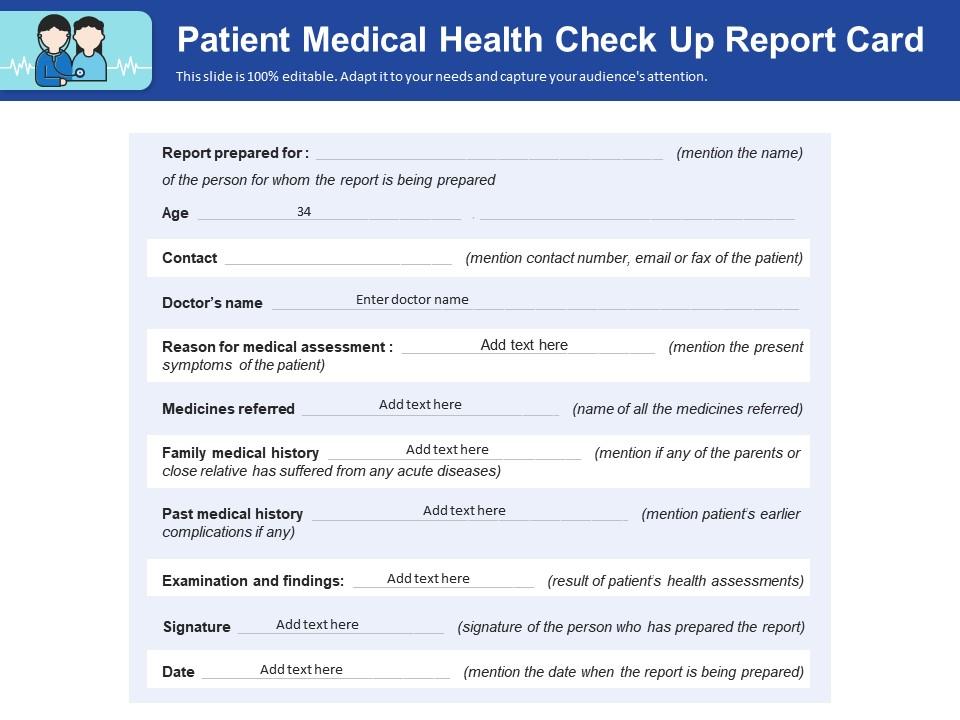
Patient medical health check up report card
Try Before you Buy Download Free Sample Product
Audience
Editable
of Time
Our Patient Medical Health Check Up Report Card are topically designed to provide an attractive backdrop to any subject. Use them to look like a presentation pro.
People who downloaded this PowerPoint presentation also viewed the following :
Patient medical health check up report card with all 2 slides:
Use our Patient Medical Health Check Up Report Card to effectively help you save your valuable time. They are readymade to fit into any presentation structure.
FAQs for Patient medical health check
So you'll need the basics first - demographics, chief complaint, medical history, current meds, and vitals. Allergies are huge, obviously don't mess that up. Physical exam findings and any test results like labs or imaging. I always think social history gets overlooked but it's actually super important for figuring out if they'll actually follow through with treatment. Document your assessment and plan, plus whatever patient education you gave them. Oh and follow-up instructions too. Honestly the whole point is just making it comprehensive enough that whoever sees them next doesn't have to play detective.
Look, these health reports are game-changers for talking with patients. You know how we always struggle explaining why someone's cholesterol matters? These things translate all that medical stuff into visuals people actually get. Patients can see their trends between visits too, which honestly keeps them way more invested than just hearing "your numbers are high." I've noticed people start asking way better questions when they can see what's happening. Oh and they follow through more - probably because they finally understand what they're working toward. Just don't dump data on them. Use the reports to start real conversations instead.
So EHRs are doing most of the work now - they pull lab results, imaging, clinical notes automatically. No more manual data entry, thank god. AI tools will flag weird results and suggest next steps too. Cloud stuff means you can check reports from anywhere and share them with other doctors or patients through portals. Everything actually talks to each other now instead of that copy-paste nightmare we used to deal with. Honestly, the integration is what makes it worth it. I'd check what systems you're already using first though - might have features you don't even know about.
Honestly, the biggest thing is matching your language to who you're talking to. Some patients want all the medical details, others need you to ditch the jargon completely. Cultural stuff plays a role too - different communities have totally different views on certain conditions. I'm a huge fan of visual aids like charts or infographics, especially when there's language barriers. Oh, and figure out if they want digital copies or old-school printed versions. Really though, just survey your patient demographics first. Then you can build templates based on education levels and cultural backgrounds you find.
Always get patient consent first, obviously. Only share what's absolutely needed - not their whole life story. Use encrypted systems, never regular email or texts. I messed this up my first week and nearly got fired lol. Share only with people who actually need to know for their job. Write down what you shared and with who. Double-check the recipient because accidentally hitting "reply all" with patient info will literally end your career. Oh, and our compliance team is super helpful if you're unsure about anything - don't be afraid to ask them.
Honestly, every 6 months minimum but quarterly is way better if you can manage it. Really depends on your patients though - chronic conditions or high-risk folks might need monthly updates to catch stuff early. Oh, and definitely update right after any major health events or treatment changes, that's huge. Static reports are basically worthless in healthcare since everything's always changing - meds, care plans, you name it. I'd set up automated reminders so you don't forget (trust me, you'll forget). The frequency thing really comes down to your patient mix.
Dude, these patient health reports are seriously a lifesaver for managing chronic conditions. Instead of guessing what's happening between visits, you get real data on how patients are doing day-to-day. Spot problems early, tweak treatments before things go sideways. Way better than playing catch-up after someone's already in crisis mode. You'll see trends that totally change how you prioritize care - some patients need way more attention than you'd think. I'd say check them weekly, maybe twice if you're swamped. Trust me, it beats those awkward "how have you been feeling" conversations where patients just shrug.
Honestly, throw them into real cases right away - obviously de-identified ones. Theory's boring and doesn't stick. Have them practice writing reports, then swap and try interpreting someone else's work. Role-playing feels ridiculous at first but it actually works really well. Get everyone using the same templates so you're not playing translation games later. Cover the usual mistakes - vague language, missing key details, that kind of thing. Oh and set up some kind of buddy system where your experienced people can guide the newbies. Regular practice sessions help too, otherwise people forget everything.
Ugh, it's honestly a nightmare. Legacy systems are the worst - hospitals all use different EMR platforms that basically hate each other. Then you've got data privacy laws varying by state and country, plus everyone's super territorial about their workflows. Each system has its own weird data fields and terminology that nobody wants to change (shocking, I know). The infrastructure overhaul costs are insane too. We're talking decades of built-up tech debt. My advice? Start with small pilot programs between places that actually want to work together instead of trying to fix everything at once.
Honestly, just make those health reports actually readable for once. Ditch the medical jargon and use charts that don't look like hieroglyphics. I swear, half the reports I've seen might as well be written in another language! What works is breaking everything down into normal words and showing people exactly what their numbers mean. Like, "your cholesterol dropped 20 points - that's huge for your heart." Give them something concrete to do right away too. "Add a 10-minute walk after dinner" hits different than vague lifestyle advice. When people can see their progress and actually understand it? They'll stick with the plan way better.
Look at engagement rates first - are people actually opening these things? Then check if health outcomes improve after patients get their reports. Most places forget about satisfaction scores, but those matter too. Treatment adherence is huge - see if patients stick to plans better. Also track whether they follow up on recommended actions (though honestly, this one's harder to measure). My favorite indicator? When patients start asking really good questions during appointments. That's when you know they're actually reading the reports and not just tossing them. It shows they're getting engaged with their own care.
So basically, patient health reports are like treasure troves of real-world data for researchers and public health people. They can spot disease trends, see what treatments actually work, and figure out which communities need more help. It's thousands of data points showing what's really going on instead of just educated guesses. The anonymized stuff helps create better treatments too - though I always wonder how truly anonymous it really is, you know? But yeah, when you're looking through those reports, you're actually part of this bigger web of health data that helps everyone.
Honestly, those health reports are game-changers for patient conversations. Show them their actual numbers and trends instead of just saying "you need this medication." People get it way better when they can see their own data - like, here's your blood pressure over six months, here's why we're worried. Makes the whole discussion feel collaborative instead of preachy. I've noticed patients actually follow through more when they've seen the evidence themselves (makes sense, right?). Walk through the reports together during visits. Way more effective than the old "trust me, I'm a doctor" approach.
Honestly, I'd start with whatever plays nice with your current EMR - Epic has decent reporting modules, Cerner too. Way less of a pain than trying to integrate something totally new. Crystal Reports works if you need basic templated stuff. The fancy AI options like AWS Comprehend Medical are actually pretty impressive for pulling insights from messy clinical notes, though maybe overkill depending on what you're doing. Tableau's solid for the visual dashboard route. But seriously, stick with something that won't create data headaches - you don't want to be the person explaining why reports are broken because systems don't talk to each other.
Honestly, charts and graphs are game-changers for health data. Patients can finally see what's going on instead of staring at confusing numbers. Blood pressure over time? So much better as a line graph. Bar charts work great for lab results too. You'll spot problems way faster than scrolling through notes - I swear doctors love their walls of text but nobody reads that stuff. Your patients get it immediately, plus you can make quicker decisions during appointments. Even basic visuals beat paragraphs of medical jargon every single time.
-
Perfect template with attractive color combination.
-
Much better than the original! Thanks for the quick turnaround.
-
Amazing product with appealing content and design.
-
The content is very helpful from business point of view.
-
Visually stunning presentation, love the content.