


People process product powerpoint template




Try Before you Buy Download Free Sample Product
 Impress Your
 Audience
 100%
100% Editable
 Save Hours
 of Time


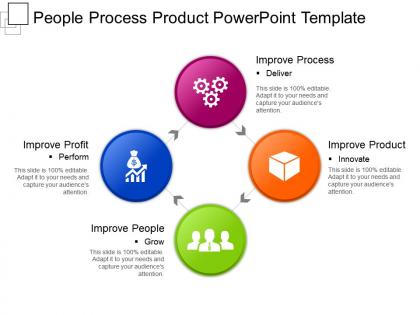
At the managerial level, you are in charge of formulating policies to ensure coordination among various parameters of your company to achieve profitable outcomes. We present this People Process Product PowerPoint Template which helps you sync the 3 key areas - people, process and product to gain profits. The 3P Model slide is a helpful tool for your company’s growth. This presentation with the use of specially designed vector icons makes your analysis attractive and understandable. Thus, it boosts your confidence and helps you to build a rapport with the audience. This People process product principle PPT can be implemented in the following ways such as identify ways by which the processes can deliver the required results, layout different ways to develop innovative products, outline measures to make your workforce grow within the organization and gain maximum levels of performance which will maximize profits. The 3 P’s of revenue growth slide is very important and is an unavoidable tool for you. Simply download, modify and present your analysis! Discover an array of goodies in our People Process Product Powerpoint Template. All you have to do is dip into the basket.
People who downloaded this PowerPoint presentation also viewed the following :
People process product powerpoint template with all 5 slides:
Bestow honor on brave individuals with our People Process Product Powerpoint Template. Extol heroic deeds.


FAQs for People process
So it basically comes down to three things working together - your people, your processes, and whatever you're actually building. Most teams I've worked with get obsessed with one piece and totally ignore the rest, which is honestly why so many projects crash and burn. Like, you can have the most talented team ever, but if your workflow is completely broken? Good luck. Same goes the other way around - perfect processes mean nothing with the wrong people involved. My advice? Figure out which of the three you're actually good at first, then work from there.
So basically, you break it down into three parts instead of trying to fix everything at once - people, processes, and products. Get your team on board first and make sure they have the right skills. Then redesign how things actually work day-to-day. Products come last. Most companies mess this up by jumping straight to changing their product without laying the groundwork. I learned this the hard way at my last job, honestly. You can measure progress as you go, which is nice. Just audit where your biggest problems are across all three areas, then tackle whatever will give you quick wins first.
Honestly, this framework is a game-changer for getting your team to stop the blame game. When stuff hits the fan, you can break it down: people problem (skills/motivation), process mess, or product just can't handle it. What's wild is how we always assume someone screwed up when usually it's just a terrible process nobody thought to fix. Having this shared vocab makes retrospectives way more focused - like, "okay is this actually a people thing or are we working with broken systems?" Definitely try the three-bucket approach next meeting. You'll be surprised how much clearer everything becomes.
So here's what works - grab a few metrics from each area and watch how they move together. Employee engagement scores, cycle times, error rates, that kind of stuff. Plus product quality and customer satisfaction data. Honestly, cross-functional surveys are clutch for getting the real picture. When you start seeing patterns like high turnover matching up with more product defects, that's your smoking gun right there. I'd set up monthly check-ins to see if your team's skills actually match what your processes need. Don't overthink it though - just pick 2-3 things from each bucket and track the trends.
Look, you can't just set up this people-process-product thing and hope it works itself out. Someone has to actually drive it - that's where leadership comes in. I've watched this fail so many times when managers just delegate and disappear. You're basically the one making sure these three pieces actually talk to each other instead of staying stuck in their own little worlds. Break down those department walls, get people collaborating across teams. Model that big-picture thinking you want everyone else to have. My advice? Pick one spot where the alignment is completely broken and fix it yourself first.
Honestly, remote work is all about the people stuff - that's where you'll struggle most since you lose all those random coffee chats. Document EVERYTHING now because those quick "hey what did you mean by..." moments are gone. You'll need new tools obviously, plus way more async communication. The actual product work? Pretty much the same, just expect feedback to take longer. My advice: go overboard with communication at first. Like, annoyingly detailed. Map out how your team currently connects, then figure out digital versions. Don't assume it'll just happen naturally - it won't.
Honestly, the worst thing you can do is fixate on just one piece - like buying fancy software but forgetting to train anyone how to use it. Most places treat it like a checkbox project instead of something ongoing, which is... not great. Leadership has to be on board everywhere, not just in one department, or you'll get these weird isolated improvements that don't really help. Each team's different too, so don't copy-paste the same approach. My advice? Figure out your biggest mess first, then tackle things one at a time. Don't try fixing everything simultaneously - you'll just burn out.
Okay so the People-Process-Product thing works because everything feeds into everything else, you know? Get your team feeling safe to try weird stuff first - that's huge. Most companies totally screw up the process part though, they make it super rigid when it should actually push people to iterate. Your product development starts becoming this living thing where user feedback shapes how you work, which teaches your team new skills. The real breakthrough happens when you're tweaking all three at once instead of treating them separately. I'd start by just mapping out how changing one piece could spark innovation in the others.
So for each piece, you've got tons of options. With people, try 360 feedback or employee surveys to see how everyone's doing. Process stuff? Lean Six Sigma is clutch - process mapping, cycle time measurements, that whole thing. Customer satisfaction scores work great for product evaluation, plus quality metrics obviously. Honestly picking just one tool per area is brutal since there's so much out there! I'd probably start with whatever's easiest to measure first - like, don't overcomplicate it right off the bat. Then you can build up your whole evaluation system from there once you get rolling.
Don't overthink this - just map it to what you're already doing. Look at your current stuff and see where it fits: talent programs = People, operational fixes = Process, new products = Product. Pretty simple honestly. Then spot the gaps - like maybe you're crushing innovation but your processes are a mess? Use it as a filter for decisions going forward. Oh and when you're doing quarterly planning (ugh, quarterly planning), just check that you're hitting all three areas. The whole point is they should work together, not exist in silos.
Toyota's probably the best example - they trained their people like crazy, built that whole Toyota Production System around continuous improvement, and churned out super reliable cars. Southwest Airlines did the same thing but for flying. Both companies figured out you can't just nail one piece and ignore the rest. The thing is, it's pretty straightforward but you gotta commit to all three pillars at once. People love to focus on just the product side (guilty of this myself sometimes), but the magic happens when workforce training, solid processes, and good products all work together. Worth studying how they balanced everything if you're trying to pull this off.
Ugh, this is such a common mess! Start with an honest look at what your team can actually do right now. What skills do you have? Which processes work vs just exist on paper? Map those real capabilities against what you're telling customers. If your stuff is manual and slow, stop promising fast delivery - it's setting everyone up to fail. Either fix your processes first or change how you position the product. Oh, and get product and ops talking regularly. Trust me, those alignment chats will save you so much pain later.
Dude, your employees are literally living your processes every day - they'll spot problems you'd never see from the top. People stuff? They know who's struggling, what skills are missing, team drama brewing. Process issues become obvious when you ask the folks actually doing the work. And product feedback from your own team hits different than customer surveys sometimes. Honestly, annual reviews are pretty useless for this. You need quick check-ins, maybe weekly pulse things, whatever works. Just make sure people aren't scared to tell you the truth. That's where the real gold is.
Honestly, employee engagement is what makes or breaks everything else. Engaged people don't just follow processes - they actually improve them and take ownership of quality. Disengaged workers? They'll go through the motions if you're lucky. But engaged teams spot problems, suggest fixes, and communicate way better across departments. That's where the real magic happens, I guess. I'd start by figuring out how engaged your team actually is right now. Then tie any improvements directly to how people interact with your main processes. It's pretty straightforward once you think about it.
What makes PPP different is how it balances all three things at once - people, processes, and products. Most frameworks pick favorites. Six Sigma goes crazy on processes. Agile's all about product iterations. But PPP won't let you ignore any piece because they're all connected. Change your process? Your team feels it, and so does product quality. It's messier than those step-by-step models, but honestly more realistic. When you're fixing something at work, just double-check you're not tunnel-visioning on the obvious issue while ignoring the ripple effects.
-
Content of slide is easy to understand and edit.
-
Unique research projects to present in meeting.