


Personal profile powerpoint slide deck




Try Before you Buy Download Free Sample Product
 Impress Your
 Audience
 100%
100% Editable
 Save Hours
 of Time


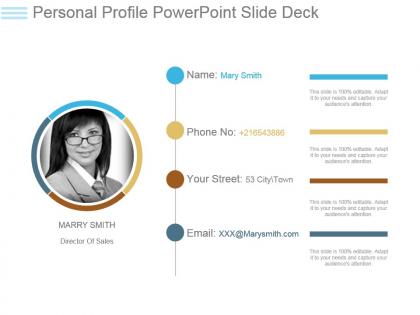
How you present yourself to others very much determines the way the other person sees you. Our personal profile PowerPoint slide deck is assistance from our end to help you present yourself in a professionally impressive manner. Personal introduction PPT presentation slide template allows you to display your profile picture along with your name, your phone number, your email and street address. With the help of our self introduction PPT PowerPoint slide, the team leaders or human resource personnel can train their subordinates and team members o how one should introduce oneself in a professionally proficient manner. The professional profile PPT model can also be used by project head to introduce his or her team members in a very appropriate manner. As per the need one can modify or and add other pointers too like personal hobby, education, career highlights and more in the same template. Be the guiding factor with our Personal Profile Powerpoint Slide Deck. They will benefit from your advice.
People who downloaded this PowerPoint presentation also viewed the following :
Personal profile powerpoint slide deck with all 7 slides:
Get folks to have a close grip on expenditure with our Personal Profile Powerpoint Slide Deck. Encourage a cost effective approach.
FAQs for Personal profile
Ok so first thing - you need a hook that actually grabs people, not some boring intro. Talk about your biggest wins and what makes you different from everyone else doing the same job. Mention where you're at now and where you're headed. Here's what most people mess up though - they sound like robots. Throw in something personal, maybe a hobby or weird skill. Makes you stick in their head way better. Just pretend you're explaining yourself to someone at a party, not giving a presentation. Oh and practice saying it out loud or you'll stumble through it.
Honestly, visuals beat bullet points every time - people actually remember stuff when they can see it. Throw in some project photos, maybe a simple timeline of your career moves, or screenshots of cool work you've done. I always think about what would help someone "get" my experience faster. Nobody's gonna sit there reading paragraphs about your accomplishments, you know? A clean chart showing problems you solved hits way harder than just listing them out. Oh and don't just slap random graphics everywhere - pick stuff that actually tells your story. Makes such a difference.
Honestly, you just gotta switch up your pitch depending on who you're talking to. Recruiters want numbers and results right away - they're skimming fast. But at networking stuff? Talk about what actually gets you excited about your work. People remember passion way more than fancy titles. Social media's different too - throw in some personality, maybe what you do outside the office. I keep like a main version with everything, then pull different pieces for different situations. Works pretty well. Just think about what each audience actually cares about and lead with that instead of the same generic intro every time.
Skip the boring list format and tell actual mini-stories instead. Like, explain WHY you switched careers or how that one disaster project actually made you stronger. Maybe a random coffee chat led to your whole data obsession - that stuff sticks with people way more than bullet points ever will. Each story needs setup, challenge, outcome. Keep 'em around 30 seconds max though, nobody's got time for novels. The whole point is showing how experiences shaped you, not just what happened. I'd start practicing with your biggest career change first - that one's usually got the most juice.
Okay so personal branding is just telling your story the same way everywhere - LinkedIn, resume, whatever. When people see your stuff, they should instantly know what you're about. Like how you recognize Netflix by that red logo, you know? Pick three words you want tied to your name, then make sure your profiles actually show those traits. Don't be fake about it though - just highlight the good stuff you already have going on. I honestly think most people overthink this part. The goal is just making yourself memorable in the right way.
Ditch the generic "good communicator" stuff - nobody cares. Talk about actual results instead, like "ran weekly team meetings that cut our project delays by 30%." Numbers are your best friend here, they make recruiters stop scrolling. Think about real problems you've solved, not just your boring daily tasks (trust me, there's a difference). Honestly, some of my favorite resume stories come from weird experiences that shouldn't matter but totally do. Tailor everything to match what they're actually looking for. You should start jotting down 3-4 solid examples tonight.
Depends what you're going for tbh. Infographics are clutch because people actually look at them - no one wants to press play on a random video from someone they barely know. Video shows your personality better but it's such a pain to make and update every time something changes. Slides feel kinda corporate unless you're literally presenting somewhere. I'd probably start with an infographic since you can use it everywhere - email, LinkedIn, events, whatever. Way more versatile. Then if you're in a super competitive field, maybe throw together a quick video later? But honestly the infographic will do most of the heavy lifting.
Okay so definitely lead with your professional stuff - skills, experience, what makes you good at your job. That's your bread and butter. Then throw in maybe one or two personal things, but make them actually relevant somehow? Like if you mention rock climbing, it's because it shows you're determined, not just random small talk. I learned this the hard way after rambling about my cat once. Anyway, avoid anything too personal or that might be controversial. You want people thinking "oh cool, interesting person" not "wow that was... a lot." It's basically finding that sweet spot between being memorable and professional.
Ugh okay so the biggest thing - don't make it all about YOU, focus on what you actually bring to them. Also people try to cram their whole life story in there which is... no. Pick relevant stuff that matters. Skip the boring buzzwords too! "Hard-working, team player" blah blah - literally everyone says that. Give specific examples instead that show your actual impact. Practice out loud beforehand so you're not just reading off a mental script. You want it to sound natural, not like you memorized some corporate speech. The timing matters way more than you'd think.
Get feedback from people who actually know your work - colleagues, mentors, even friends. They'll spot stuff you're blind to. Ask them straight up: "What's my biggest strength I'm not highlighting?" or "Where do I sound boring?" Here's the hard part though - don't get all defensive when they tell you (guilty as charged). Jot down what they say, then go back to your profile later. Most people collect feedback and then... do nothing with it. Actually make the changes. Swap out those weak examples. Your summary probably needs work too. Test the new version and see how it feels.
Honestly, just go with Canva - it's got tons of templates and you literally can't mess it up. Figma's solid if you want more customization options. I wouldn't bother with Adobe unless you already know how to use it (total overkill). LinkedIn has decent built-in tools for professional profiles, which is kinda nice. Oh, and don't overlook Google Docs for simple text bios - sometimes basic works. Start with Canva's personal branding stuff and tweak it. You'll probably have something that looks legit in like an hour, maybe less if you're not picky about fonts.
Dude, consistency across your profiles is huge - it's what makes people actually remember you. I mean, your LinkedIn shouldn't read like a totally different human than your website, you know? Pick maybe 2-3 main things about yourself professionally and thread them through everything. Honestly, most people's profiles are all over the place and it just confuses everyone. When your tone and messaging actually align, people get who you are way faster. Trust me on this. Start by looking at what you've got now and see where things don't match up - you'll probably spot the weird disconnects pretty quick.
Honestly, response rates are everything - if nobody's hitting you up after seeing your profile, something's off. I'd also watch your profile views and connection requests. Quality matters too though - like, are the opportunities coming your way actually what you want? That's huge. Click-through rates help if you're linking to your work or whatever. Oh, and track how many initial contacts turn into real conversations. Don't overcomplicate it - just pick 2-3 things that actually matter for your goals and check monthly.
Don't just throw "rock climbing" on there and call it a day. Connect your hobbies to actual skills - like how climbing teaches problem-solving and resilience. Photography? That's attention to detail. Gaming shows strategic thinking (yes, really). I'd pick 2-3 that either tie to the job or show who you are as a person. Honestly, even weird hobbies work if they get people talking. Volunteering demonstrates leadership pretty well too. The trick is spelling out the connection instead of making them guess what rock climbing has to do with anything.
Honestly, just be yourself but make it polished. Get a decent headshot - doesn't have to be fancy, just professional. Your headline should show what value you bring, not just "Marketing Manager at Company X." Write your summary like you're telling someone your story over coffee. I always throw in a hobby or side project because it makes you human, you know? Oh and keywords matter for showing up in searches. The biggest thing though? Actually engage with people's posts and share your own thoughts. Having an amazing profile means nothing if you're invisible.
-
Wonderful templates design to use in business meetings.
-
Unique design & color.