


Pitch deck slide gotomarket strategy roadmap presentation ideas




Try Before you Buy Download Free Sample Product
 Impress Your
 Audience
 100%
100% Editable
 Save Hours
 of Time


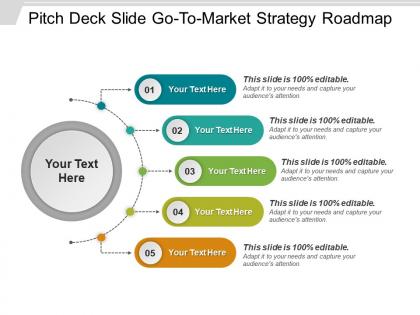
Get this Pitch deck slide go to market strategy roadmap presentation idea to help your marketing manager in successfully developing a strategy for promoting products and services to customers. Research, strategies, planning, and right steps of execution are the key elements of marketing strategy. Identify the target market for your products using our marketing strategy PPT slide. Evaluate and discuss the essential aspects of marketing strategy with your audience in this PowerPoint presentation. Determine the relationship between events involving an effective marketing strategy. Explain how the cycle is self-reinforcing using the subparts of this circular diagram for PowerPoint template. Depict how one step is related to another step. Show the stages of implementation of the efficient marketing plan using this professionally designed PPT slide. Such a visual representation is easy to understand as well as appealing to the eyes. Avail this PPT diagram to create an impressive PowerPoint presentation in less time. Our Pitch Deck Slide Gotomarket Strategy Roadmap Presentation Ideas enable you to cut down on compulsions. They ensure constraints fade away.
People who downloaded this PowerPoint presentation also viewed the following :
Pitch deck slide gotomarket strategy roadmap presentation ideas with all 5 slides:
Go by your intuition with our Pitch Deck Slide Gotomarket Strategy Roadmap Presentation Ideas. Impress folks with your impeccable choice.

FAQs for Pitch deck slide gotomarket strategy
Honestly, most people screw this up by trying to sell to everyone - don't do that. Pick your exact target market first, then build your messaging around the specific problem you're solving for them. After that, figure out pricing and whether you're doing direct sales, partnerships, or letting people sign up themselves. Oh and don't get caught up planning forever - just pick one sales channel and one clear message to start. You can always pivot once you see what's actually working. I've seen too many teams overthink this stuff when they should just be testing things out.
Dude, market research is literally the backbone of your entire GTM strategy. Skip it and you're just throwing money at the wall hoping something sticks. It shows you exactly who to target, how to position your stuff, and what messaging actually works. Plus where your audience hangs out online - which honestly saves you from wasting time on the wrong channels. I've watched so many launches crash because teams thought they could wing it. Customer interviews are huge, and don't sleep on competitor analysis either. Those two things will give you pretty much everything you need to not look like an idiot when you launch.
Look, everything in your GTM should revolve around your audience. Where they hang out online tells you where to focus your marketing - LinkedIn people vs TikTok people need totally different approaches. Pain points drive your messaging and pricing. How they buy stuff (impulse vs long enterprise cycles) shapes your whole sales process. Quick decisions need different timelines than committee approvals, obviously. I swear, so many companies create these elaborate strategies but completely whiff on where their customers actually spend time. Figure out their discovery-to-purchase journey first - that's your roadmap right there.
Look, competitive analysis is basically your sanity check before jumping into any market. You don't want to launch something blind, right? Start by checking out 3-5 direct competitors - their pricing, messaging, who they're targeting. Customer reviews are gold mines for spotting what they're screwing up. This whole process helps you figure out where you can actually stand out and position yourself differently. Honestly, most people skip this step and wonder why their launch flops. It'll also help you set realistic prices and pick the right channels to actually reach people.
Honestly, analytics will change everything about your go-to-market strategy. Instead of guessing, you'll actually know which customer segments convert and what channels work best. Track where people drop off in your funnel - that conversion data is pure gold. I've watched teams burn through months targeting completely wrong audiences because they ignored their data (painful to watch). Set up proper attribution tracking first so you can see what's driving real results. A/B test your messaging, keep an eye on competitor pricing, and definitely monitor acquisition costs by channel. The difference is night and day once you start using actual insights.
Don't launch until you really know who's buying this thing - I mean *really* know them. Most people try to appeal to everyone right off the bat, which never works. Also, your timeline is probably way too aggressive (trust me on this one). Teams always rush to market and skip testing, then wonder why everything falls apart. Make sure you've got your pricing figured out early, and actually train your sales people - they can't just wing it. Oh, and do your homework on competitors even if you think you're the next big thing. Start focused, test everything with real customers first, and base decisions on actual data instead of gut feelings.
Honestly, positioning is everything for your go-to-market. I've watched so many teams completely bomb their launches because they rushed straight into the fun stuff - ads, campaigns, whatever - without nailing this first. Here's the thing: if you can't clearly define who you're targeting and what makes you different, your sales team will fumble every pitch. Customers won't get it either. Once you lock down your positioning though, pricing and messaging decisions become way easier. It's like... everything just clicks into place. Don't skip this step - I'm serious.
Look for gaps the big players ignore - they won't touch "small" niches that are actually perfect for you. Talk to frustrated customers first, they'll literally tell you where the opportunity is hiding. Partner with other businesses to use their distribution instead of building from scratch (way smarter tbh). Sometimes you just gotta be scrappier than the slow-moving giants. Can't go head-to-head with them anyway. Different pricing models work too - maybe they're all expensive and you can find a cheaper angle. The key is owning one slice really well rather than trying to compete everywhere at once.
Honestly, cross-functional collaboration is a game-changer for go-to-market stuff. Sales, marketing, product, and customer success need to actually communicate instead of working in their own bubbles. You'll get way better customer insights and your messaging won't be all over the place. Plus the handoffs between teams become so much smoother. The product team can finally build features that help close deals - wild concept, right? Weekly standups are your friend here. Set shared goals so everyone's working toward the same thing. I've seen companies transform just by getting teams to sync up regularly. Start small with those weekly meetings and you'll notice the difference pretty quick.
Honestly, you need both the quick wins and long-term stuff. CAC and conversion rates are your bread and butter - track those religiously. Revenue metrics like MRR and churn rate obviously matter too. Your sales team's pipeline velocity is huge but people overlook it. Brand awareness is a pain to measure but you can't ignore it forever. Here's the thing though - don't go crazy with like 20 different metrics. Pick maybe 5-7 that actually move the needle for your business model. Throw them on a simple dashboard and check weekly. Otherwise you'll just drown in spreadsheets.
Digital marketing totally changed the game for product launches. Instead of those old-school blanket campaigns, you can actually target specific groups through social media and ads. Way more efficient. The best part? Real-time data. You'll see immediately if something's flopping and can adjust on the fly. I love that you can test your messaging on small groups first - saves you from embarrassing disasters later. Just figure out where your customers are hanging out online (Instagram, LinkedIn, whatever) and focus your launch there. Set up some metrics to track so you're not just guessing if it worked.
Honestly, customer feedback is like getting slapped with reality after you launch. All those assumptions about your messaging and pricing? They get tested immediately. Users will tell you straight up what they actually need vs. what you thought they wanted - and yeah, it usually hurts but they're right. I've seen teams completely flip their target audience or redo their whole sales pitch because of early feedback. The smart move is building those feedback loops from day one. Don't be stubborn about your original plan - pivot fast when customers are telling you something isn't working.
Honestly, most companies fall in love with their first plan and totally miss when things aren't working. You've gotta stay flexible and watch your numbers - acquisition costs, conversions, customer feedback, all that stuff. I'd set up quarterly check-ins where you can actually change things up. Maybe your messaging sucks, or pricing's off, or there's a better channel you haven't tried. The real trick? Talk to your customers and keep an eye on competitors. They'll usually tip you off to problems way before your spreadsheets do. Oh, and don't get stubborn about pivoting when the data's screaming at you.
Honestly, phased rollouts are a lifesaver. You get to test things out without blowing your whole budget if something goes sideways. Real feedback from actual customers beats guessing every time - you'll figure out what messaging hits and what falls flat. Resource-wise, it just makes sense instead of going broke on day one. The momentum thing is huge too. Early wins give you solid case studies that make selling to bigger segments way easier later. I'd say pick your best-bet audience first, get that process down cold, then expand from there. Way less stressful than launching everywhere at once.
Honestly, I'd start with a simple checklist of your 3-4 main brand values and score every message against them before it goes live. Does this actually sound like something we'd say? I see this all the time - companies get their brand identity perfect but then their GTM stuff sounds like a robot wrote it. Loop your brand team into reviewing materials early, not at the last second when everything's already locked. Oh and make it part of your standard launch process so people don't forget. Short version: if your messaging doesn't feel authentically "you," your audience will notice immediately.
-
Editable templates with innovative design and color combination.
-
Nice and innovative design.