Pitch deck slide marketing strategy presentation ideas
Try Before you Buy Download Free Sample Product
Audience
Editable
of Time
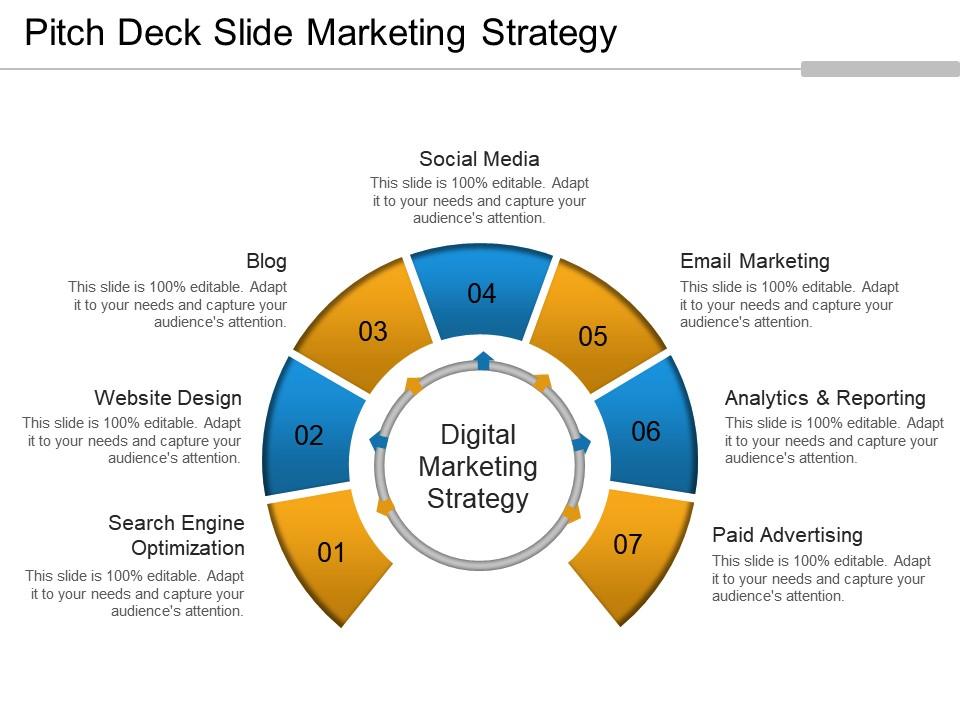
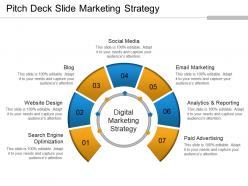
Pitch deck slide marketing strategy presentation ideas is a seven section diagram to show the different strategies of sales and marketing. This digital marketing strategy PPT model provides modern PowerPoint graphics which are attractive and easy to comprehend. The circular strategy presentation graphic design contains a self-explanatory note of digital or inbound marketing concepts. The marketing strategy of business PowerPoint PPT visual comprises of the company search engine optimization, website design, blog, social media, email marketing, analytics and reporting, and paid advertising. This PPT summarizes the competitive advantage a company has in its market. Company’s marketing strategies PPT presentation infographic encompass these value premises. Using marketing strategy PowerPoint diagram, one can show their developed strategies before their stakeholders and company staff. The PPT involves everything that a company can do to influence demand for its service or product. It is an instrument to help marketing planning and implementation. Build intensity of feeling with our Pitch Deck Slide Marketing Strategy Presentation Ideas. Increase the degree of devotion felt.
People who downloaded this PowerPoint presentation also viewed the following :
Pitch deck slide marketing strategy presentation ideas with all 5 slides:
Consider every aspect extensively with our Pitch Deck Slide Marketing Strategy Presentation Ideas. Indulge in detailed deliberations.
FAQs for Pitch deck slide marketing
Honestly, start with nailing what problem you're actually solving and why your approach is different. Big market size numbers make investors happy, so include that. Show your business model and any real traction - even early customer feedback counts. The team slide matters way more than people think. Sometimes investors care more about who's building it than the idea itself. Financial projections should be realistic but still exciting. Oh, and always end with exactly how much money you want and what you'll spend it on. Practice a 2-minute version first - if you can't explain it quickly, your deck's probably too complicated.
Honestly, visuals are everything in pitch decks. Data charts make your market size look huge, and before/after mockups really sell your solution's impact. I've sat through way too many boring text-heavy presentations that just drone on forever. Use consistent colors and lots of white space - it guides people through your story emotionally, not just with facts. Customer journey maps are great for showing pain points too. Here's what I'd do: storyboard your main points first, then figure out which visual format hits hardest for each one. Trust me, it makes a huge difference.
Dude, the worst thing you can do is jam every detail onto your slides - you'll just end up reading them word for word. Start with the problem, not your cool features. Nobody gives a shit about your solution until they get why they need it. Keep slides visual and simple. Also, those cheesy stock photos of business handshakes? Hard pass. Tell a story that actually flows: problem → solution → opportunity. Oh and practice your timing or you'll be speed-running through the good stuff at the end. Trust me on this one.
Honestly, you've gotta do your homework on who's sitting in that room. Investors? Hit them with the money stuff and market size right away. But customers just want to know how you'll fix their problems - I totally bombed a client pitch once by leading with boring revenue charts they couldn't care less about lol. Tech people though? They'll eat up all the product details and architecture stuff. Keep your main story the same but just shuffle things around depending on the crowd. I'd make like 2-3 different versions and practice so you don't sound awkward switching between points.
You want metrics that actually prove people want your product and you can get customers without burning cash. TAM/SAM numbers are good. Customer acquisition cost and lifetime value are crucial - that 3:1 LTV:CAC ratio makes investors happy. So many founders screw this up with useless vanity metrics, it's painful to watch. If you already have users, show conversion rates, MRR growth, and churn. Monthly recurring revenue growth especially. The whole point is proving you get your unit economics and aren't just hoping profitability magically happens. Keep it to 4-6 metrics that actually connect.
Pick your strongest numbers only - seriously, don't throw your entire research folder at investors. Charts work way better than walls of text. Each stat needs a "so what?" attached to it. I've watched so many founders kill their momentum by drowning people in random data points without explaining why anyone should care. Keep market size simple (TAM/SAM if you have to), show customer pain with real percentages, and make competitive comparisons crystal clear. You want them thinking "damn, this is huge" not checking their phones.
Look, investors need to see you actually get your market - saying "we have no competition" is basically screaming "I did zero research." Find your direct and indirect competitors, then figure out what makes you different. I've seen so many pitches tank right there. Map out the competitive landscape honestly but position your advantages confidently. Show them the gaps you're filling. Do your homework though - VCs probably already know these companies better than you think. The whole point is proving you understand where you fit and why you'll win.
Dude, get your USP on slide 2 or 3 max - don't make people hunt for it. Start with the problem, then BAM, here's how you're different from everyone else. So many founders waste like 10 slides dancing around before they actually say what makes them special (drives me nuts honestly). Skip the "innovative solution" garbage and show real stuff - customer wins, actual screenshots, whatever proves your point. Make it stupidly clear. Someone should be able to watch that one slide and explain your whole thing to their neighbor later.
Okay so first thing - grab them with something that actually hits their problem right away. Then mix up your pacing like crazy. Slow down when you're making big points, speed up when you're moving between stuff. Ask questions (even rhetorical ones) and pause for answers if it's not a huge crowd. Honestly? Your energy and eye contact matter way more than perfect slides. Stories beat data dumps every single time. Switch up your visuals or concepts every few minutes so people don't zone out. Oh and practice those transitions until they sound natural, not like you're reading a script.
Definitely set aside 1-2 slides just for social proof - honestly it's what sells investors more than anything else. Grab your best customer quotes with their logo and name (get permission first obviously). Case studies should have real numbers: "Company X boosted revenue 40% in 6 months." Use screenshots or simple graphs to show the results visually. Here's the thing though - don't just dump all testimonials in one section. Sprinkle them throughout your deck, especially after you explain features. Makes investors think "oh shit, people actually use this and love it."
Start with a problem that hits them right in the gut - something your audience actually deals with. I always tell people to use that hero's journey thing where your customer is the hero and your product helps them win. Personal stories are pure gold here. Seriously, I've watched founders get standing ovations just from one customer transformation story. Before/after visuals work great, and don't forget real numbers to back up the emotional stuff. Oh, and end each story bit with "imagine if..." - gets investors dreaming about what's possible. That's when you've got them hooked.
Split your marketing budget into specific chunks - ads, content, events, whatever you're planning. Show realistic ROI projections that you can actually back up with data. Investors are so tired of crazy optimistic numbers, honestly. Put together a simple chart showing monthly spending vs expected returns. Don't forget your assumptions like conversion rates and customer costs - they'll ask anyway. The whole thing needs to connect back to your revenue targets. One clean slide should tell the story without making them hunt around for info. Oh, and definitely explain how you'll measure if it's working or not.
Hook them hard on slide one, then hit the usual suspects: problem, solution, market size, business model, traction, team, money, and your ask. Don't go past 12 slides - honestly, most investors zone out after that anyway. Your problem slide needs to make them go "ugh, yeah, I hate that too." Tell a story instead of just throwing numbers at them. Benefits first, features later. Practice until you can nail the pitch in 8-10 minutes because the real magic happens during Q&A. Oh, and smooth transitions between sections - don't just jump around randomly.
Start by gathering all your current stuff - website copy, social media posts, marketing materials, whatever you've got. Look for the main themes in your messaging. Now here's where people totally screw this up: they write their pitch deck like it's completely separate from everything else. Don't do that. Your deck should match the tone and key points prospects already know you for. Same value props, similar visual style - the whole thing should feel cohesive. Oh, and definitely do a quick comparison before you present. Nothing's worse than accidentally contradicting yourself because your deck says something totally different than your website.
Build your follow-up right into the final slides, honestly. Throw in a "What happens next" slide with real dates - like "I'll send the investor memo Friday" or whatever. Multiple contact options work better since some people hate email, others won't pick up calls. Here's what really works though - create reasons to reach back out. Mention case studies or detailed numbers you can share later. Boom, now you've got natural excuses to reconnect in a few days instead of letting weeks pass. Oh and always try scheduling that next convo before you walk out. Way easier than the back-and-forth email dance later.
-
Awesome presentation, really professional and easy to edit.
-
Excellent design and quick turnaround.