

Project portfolio roadmap powerpoint slide





Try Before you Buy Download Free Sample Product
 Impress Your
 Audience
 100%
100% Editable
 Save Hours
 of Time


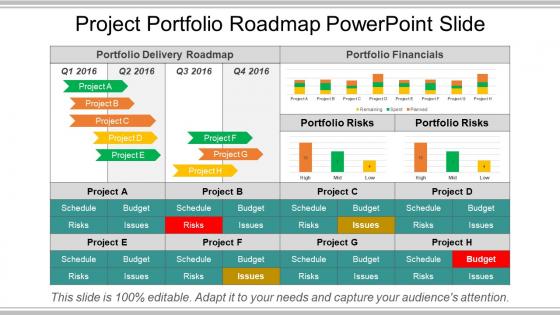
Monitor the progress of your business projects with our project portfolio roadmap PowerPoint slide. You can easily manage the rate of progress so that to meet your client’s deadline with this project portfolio management PPT layout design. This PPM PowerPoint diagram design further allows your management personnel’s to execute the right company project at the right time with the right resources. It allows you to deliver the consistent results while providing the maximum value to your organization. Other than this, it also results in taking a competitive benefits in the market over your rivals. And your management can also use this project roadmap Presentation layout to measure the effectiveness of their company resources in meeting their projects deliverables levels. You can also define the elements which may affect your project design or plan such as the insufficient funds etc. with this Project management PowerPoint layout slide. Thus, click on the download tab given below to simply start working over this technical PPT image. Enhance the impression folks have of you with our Project Portfolio Roadmap Powerpoint Slide. It helps boost your credentials.
People who downloaded this PowerPoint presentation also viewed the following :
Project portfolio roadmap powerpoint slide with all 5 slides:
Create healthy conditions with our Project Portfolio Roadmap Powerpoint Slide. Emphasize the importance of cleanliness.
FAQs for Project portfolio
Honestly, start by mapping what you're already working on against your actual business goals - I bet you'll find some weird disconnects there. Three big things to focus on: making sure projects align strategically (not just pet projects that seem fun), tracking where your people and money are actually going, and having solid processes for deciding what lives or dies. Performance tracking matters obviously, but so does looking at risk across everything you've got running. Portfolio reviews should happen regularly so you can see what's actually moving the needle. Oh, and having clear criteria for when to pull the plug on something - that's harder than it sounds but super important.
Start with 4-6 criteria max - financial impact, strategic fit, risk, urgency. Score everything 1-5. Seriously, don't go crazy with some 20-point matrix that'll just collect dust. I made that mistake once and nobody used it. Rank your projects, then draw a hard line where you run out of people/budget. The tough part? Actually saying no to the stuff below that line, even when it sounds cool. Review quarterly since things change. Oh, and be ruthless about sticking to your scoring. Otherwise you'll end up like my last team - drowning in "quick wins" that weren't quick or wins.
Look, strategic alignment is what keeps your project portfolio from turning into total chaos. You need clear business goals first, then filter every project against those objectives. Resources go to stuff that actually moves the needle forward. Otherwise you're just juggling random projects - and trust me, that gets messy fast. The whole point is making each project serve your bigger strategy. Honestly, most companies skip this step and wonder why their portfolio feels scattered. Set your criteria upfront, then be ruthless about what makes the cut.
So PPM tools are basically your control center for juggling multiple projects at once. You'll finally see where your budget's bleeding out and which timelines are about to crash and burn. Real talk - most companies are just winging it without this stuff. Having everything in one dashboard means you can actually compare projects side by side instead of guessing which ones deserve more resources. Plus you can catch those sneaky projects that eat up tons of money but never seem to deliver anything useful. It's honestly a game-changer for stopping the constant firefighting mode.
Oh man, you're gonna deal with so much chaos. Resource conflicts everywhere, priorities that make zero sense, and scope creep on literally every project. Stakeholders will change their minds constantly - drives me nuts honestly. Communication falls apart between teams, creating these weird bottlenecks. Then you're stuck managing different methodologies and timelines that don't play nice together. It's exhausting. Start with solid governance processes though, that'll save your sanity. Good portfolio management tools help too - at least you can see what's actually happening across everything.
Risk management needs to be built right into how you pick and evaluate projects. Don't just look at returns - check the risk profile too. High-risk stuff should jump through more hoops or have solid backup plans. I've watched entire portfolios crash because teams ignored how risks add up across multiple projects (honestly, it's painful to see). Set up portfolio-level risk check-ins, not just project ones. You'll catch patterns and dangerous concentrations that way. Start simple - throw a risk-adjusted scoring model into your next review and see what shakes out.
ROI and NPV are your bread and butter for financials. Check resource utilization so you know if people are drowning. Schedule performance index catches delays before they blow up - honestly wish I'd learned that one earlier. Strategic alignment scores are huge but everyone ignores them for some reason. Risk exposure and benefits realization round out the essentials since they actually predict whether stuff will succeed. Start with those six core ones. You can get fancy with specialized metrics later once you've got the basics down and your PMO isn't scrambling.
So basically, regular project management is just handling one project at a time - hitting deadlines, staying on budget, that stuff. Portfolio management is way different though. You're looking at ALL the projects your company has going and deciding which ones actually matter. Like, should we put more money into Project A or kill Project B because it's not really helping us anymore? It's more strategic I guess - you're trying to make sure everything works together instead of just... I don't know, hoping for the best? Way more big picture thinking involved.
Look, stakeholder engagement is make-or-break for portfolio success. You need them involved early to figure out which projects actually matter to the business. Without their input, you'll waste months building stuff nobody wants - been there, it sucks. Regular check-ins keep you from going off track too. On the flip side, if you ignore stakeholders, you get scope creep and conflicting priorities everywhere. Honestly, I've seen projects crash and burn just because leadership wasn't aligned. Map out your key players upfront and schedule consistent touchpoints. Trust me on this one.
Honestly, try the 70/20/10 split - most of your stuff stays routine operations, then 20% for incremental improvements, 10% for the crazy experimental stuff. I see so many teams just stick with safe projects because they're easier to defend to leadership. Don't use the same criteria to judge everything though - comparing day-to-day maintenance work to some wild AI experiment makes zero sense. Check your mix every few months or you'll drift back to playing it safe. Worth doing a quick audit of what you're actually working on right now... might be eye-opening how little innovation is happening.
You'll want a steering committee with people who can actually approve budgets - not just advisors who nod along. Set up monthly reviews using consistent scoring criteria to rank projects. The hard part? Actually killing the dead ones (most places chicken out here). Document who decides what and when, because nothing's worse than project managers running in circles. Use the same evaluation process every time so you're comparing apples to apples. Oh, and make sure your committee aligns with whatever strategic goals you've got this quarter. Start by mapping out how decisions get made now - you'll probably find some weird gaps.
Honestly, portfolio management is a game-changer for getting your resource chaos under control. You'll finally see where everyone's actually spending their time instead of just guessing. Like when Sarah's drowning in three projects while Tom's basically bored out of his mind - super common problem. Map out who's doing what first, then you can shuffle people around way smarter. It helps you catch skill gaps early too, which saves your butt later. Plus you'll know which projects to hit pause on when things get crazy. Start simple though - just list everything out and look for the obvious disasters.
Honestly, digital transformation turns your whole project portfolio upside down. Everything becomes about enabling digital stuff - analytics, customer experience, that kind of thing. Traditional operational projects? They take a backseat. The speed is insane too, you're constantly switching to shorter, more agile cycles. I'd start by looking at what you've got now and figuring out which projects actually help your digital strategy. You'll be shuffling priorities and resources way more often than before. It's exhausting but necessary - most portfolios end up way more tech-focused with this constant reassessment cycle.
Yeah, totally doable! Think of your portfolio like a product backlog - prioritize projects by value instead of locking into some rigid annual plan. Do quarterly reviews to reassess everything. The tricky part is staying flexible with resources and actually killing projects that aren't working (teams get weirdly attached to stuff). Story mapping helps visualize how projects connect. Run retrospectives on your portfolio choices too - honestly, this part gets overlooked but it's super useful. Don't try to change everything at once though. Pick one Agile practice and roll it out portfolio-wide first.
Monthly reviews are honestly a game changer - they help you spot the projects that are bleeding money before it gets ugly. You can shift resources around based on what's actually working instead of just hoping things improve. Dependencies between projects? You'll catch those conflicts way earlier (learned this the hard way lol). Business priorities change constantly, so these check-ins keep everything aligned with whatever direction leadership is heading this quarter. The data you collect makes future planning way less of a guessing game. Even just 30 minutes with your key people monthly makes a huge difference.
-
great
-
Illustrative design with editable content. Exceptional value for money. Highly pleased with the product.
-
Awesomely designed templates, Easy to understand.