


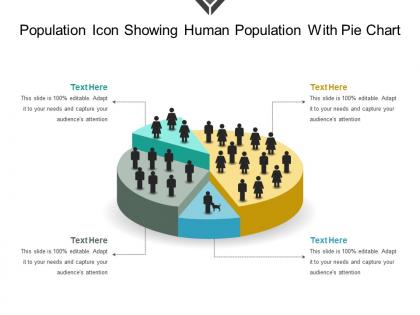
Population icon showing human population with pie chart




Try Before you Buy Download Free Sample Product
 Impress Your
 Audience
 100%
100% Editable
 Save Hours
 of Time


Initiate action to improve infrastructure with our Population Icon Showing Human Population With Pie Chart. Be an enabler for industry.
People who downloaded this PowerPoint presentation also viewed the following :
Population icon showing human population with pie chart with all 5 slides:
Our Population Icon Showing Human Population With Pie Chart create brand consciousness. They are experts at advertising goods.

FAQs for Population icon showing human population
Demographics play a crucial role in shaping marketing strategies by informing audience segmentation, product positioning, messaging tone, channel selection, and pricing approaches. Through demographic analysis, companies can tailor campaigns to specific age groups, income levels, and geographic locations, with retail brands, financial services, and healthcare organizations finding that targeted demographic strategies significantly enhance customer engagement and conversion rates.
Demographic data influences product development by revealing user preferences, accessibility needs, cultural considerations, and behavioral patterns across different age groups, income levels, and geographic regions. Companies like Apple designing intuitive interfaces for older users, automotive manufacturers creating family-friendly vehicles, and retailers developing culturally relevant products leverage these insights to enhance market appeal, improve user experiences, and ultimately deliver competitive advantages in increasingly diverse consumer landscapes.
Key demographic trends impacting global economies include aging populations, declining birth rates, urbanization acceleration, workforce skill gaps, and increasing migration patterns. These shifts reshape labor markets, consumer demand, and economic structures across developed and emerging nations, with many countries finding that strategic workforce planning and immigration policies ultimately determine their competitive advantage in an increasingly interconnected global marketplace.
Aging populations create skills gaps in traditional industries while younger workers bring digital expertise, reshaping training needs, knowledge transfer programs, and workplace flexibility demands. Organizations increasingly leverage multi-generational teams to balance institutional knowledge with technological innovation, with many finding that strategic age diversity enhances problem-solving capabilities and drives competitive advantage.
Demographics inform public policy by revealing population age structures, income distributions, geographic concentrations, educational levels, and health needs across communities. This data enables policymakers to strategically allocate resources, design targeted programs, and anticipate future demands, with many municipalities finding that demographic insights streamline budget planning and ultimately deliver more effective services to constituents.
Businesses can leverage demographic information by segmenting audiences based on age, income, location, lifestyle preferences, and purchasing behaviors to create personalized advertising campaigns. Through data analytics and customer profiling, companies in retail, financial services, and healthcare deliver more relevant messaging, reduce advertising costs, and increase conversion rates, ultimately enhancing customer engagement while maximizing marketing ROI across diverse market segments.
Key demographic shifts impacting tech include an aging workforce requiring knowledge transfer, younger generations driving mobile-first expectations, increasing diversity demands, and growing global talent distribution through remote work. These shifts are reshaping how tech companies recruit, develop products, and serve customers, with many organizations finding that embracing demographic diversity enhances innovation, expands market reach, and ultimately delivers competitive advantage.
Cultural demographics significantly influence consumer behavior through varying values, traditions, purchasing power, communication preferences, and lifestyle choices across regions. These differences shape product preferences, brand loyalty patterns, and shopping habits, with companies like Unilever and McDonald's adapting their offerings regionally, ultimately enabling businesses to deliver more targeted marketing strategies and enhanced customer experiences.
Demographic data collection methods include surveys and questionnaires, census records, customer databases, social media analytics, and focus groups. These approaches enable organizations to gather comprehensive insights by combining quantitative metrics with qualitative feedback, ultimately delivering targeted marketing strategies and enhanced customer experiences, with many businesses finding that multi-source approaches provide the most reliable demographic intelligence.
Urbanization significantly reshapes demographic distribution by concentrating populations in cities through rural-to-urban migration, creating dense metropolitan areas while depopulating rural regions. This demographic shift enables countries to streamline infrastructure development, enhance economic opportunities, and deliver more efficient services, with many developing nations finding that strategic urban planning ultimately drives industrial growth and competitive advantage.
Aging populations present both significant challenges and opportunities for healthcare systems, including increased demand for chronic disease management, specialized geriatric services, long-term care facilities, and preventive health programs. These demographic shifts enable healthcare organizations to streamline resource allocation, enhance specialized care delivery, and develop innovative service models, with many hospitals and health systems finding that strategic planning ultimately delivers improved patient outcomes and operational efficiency.
Small businesses can utilize demographic insights by analyzing customer age, income, location, and buying behaviors to identify target markets, optimize product offerings, and personalize marketing campaigns. These insights enable retailers to stock relevant inventory, restaurants to tailor menus for local preferences, and service providers to adjust pricing strategies, ultimately delivering higher customer satisfaction and revenue growth while competing more effectively against larger competitors.
Non-profits should consider age distribution, income levels, education backgrounds, geographic location, cultural diversity, language preferences, and digital accessibility needs when planning outreach programs. These demographic insights enable organizations to tailor messaging, select appropriate communication channels, and design culturally sensitive programs, ultimately delivering more effective community engagement and maximizing program impact across diverse populations.
Migration patterns significantly reshape regional demographics by altering age structures, ethnic compositions, skill levels, and population densities through both in-migration and out-migration flows. These demographic shifts create new market opportunities and workforce dynamics, with cities like Austin and Dubai experiencing rapid growth that transforms their economic landscapes, consumer bases, and infrastructure demands, ultimately delivering competitive advantages for businesses that adapt quickly.
Understanding demographics enhances social research by providing crucial context for participant selection, enabling researchers to identify patterns across age groups, income levels, geographic regions, and cultural backgrounds, while ensuring representative sample populations. These demographic insights allow researchers to uncover correlations between social behaviors and population characteristics, ultimately delivering more accurate findings and actionable recommendations for policy development.
-
Graphics are very appealing to eyes.
-
Great designs, really helpful.