

Porter Five Forces Analysis Of Netflix Marketing Strategy For Promoting Video Content Strategy SS V





Try Before you Buy Download Free Sample Product
 Impress Your
Audience
 100%
Editable
 Save Hours
of Time


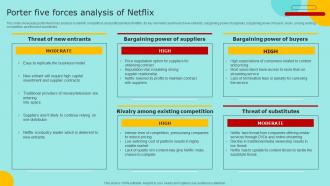
This slide showcases porter five forces analysis to identify competitors and profit potential of Netflix. Its key elements are threat of new entrants, bargaining power of suppliers, bargaining power of buyers, rivalry among existing competition and threat of substitutes.
People who downloaded this PowerPoint presentation also viewed the following :
Porter Five Forces Analysis Of Netflix Marketing Strategy For Promoting Video Content Strategy SS V with all 9 slides:
Use our Porter Five Forces Analysis Of Netflix Marketing Strategy For Promoting Video Content Strategy SS V to effectively help you save your valuable time. They are readymade to fit into any presentation structure.








FAQs for Porter Five Forces Analysis Of Netflix Marketing Strategy For Promoting Video Content
So Porter's Five Forces breaks down like this: competitive rivalry, supplier power, buyer power, threat of substitutes, and new entrants threatening to jump in. Competitive rivalry is just how cutthroat things get between existing companies. Supplier and buyer power? That's whether vendors or customers can basically dictate your prices. Substitutes are products that could replace yours entirely - think how Netflix killed Blockbuster (showing my age here lol). New entrants are wannabe competitors sizing up your market. It sounds overwhelming but it's actually pretty useful. You can figure out where your industry's weak spots are and plan around them.
So Porter's Five Forces is basically figuring out where you're strong vs. where you're getting screwed over. You look at five things: how much power your suppliers have, buyer power, how cutthroat your competition is, whether people can easily switch to something else, and how hard it is for new players to jump in. Maybe you'll find out your suppliers are all over the place (sweet!) but customers have a million other options. That sucks but at least you know. Then you can play up your strengths and fix the weak spots. Just don't lie to yourself about where you actually stand - I've seen that backfire.
Basically, new competitors can jump into your market anytime and steal customers if there's nothing stopping them. Low barriers mean anyone with a decent idea and some cash can challenge you - which sucks but also keeps businesses from getting lazy. Profit margins usually take a hit because everyone's fighting harder for the same customers. Companies end up spending more on marketing, dropping prices, or scrambling to improve their products just to stay relevant. Honestly, I've seen some businesses completely caught off guard by this. Bottom line: figure out what makes it hard for others to copy what you do, then double down on those advantages.
Look, powerful buyers basically force you into aggressive pricing. They can switch easily or buy massive volumes, so they'll squeeze you hard on price. You're stuck justifying every dollar and handing out discounts left and right. The worst part? When they start merging - suddenly you're dealing with fewer customers who have way more clout. But weak buyers? That's your sweet spot for pricing freedom. Honestly, just map out what it would cost your customers to switch and what alternatives they actually have. That tells you everything about how much you can push prices.
So supplier power basically determines how much they can jack up your costs. Few alternatives? High switching costs? They've got you by the throat and can demand whatever they want. Look at Intel - they control so much of the chip market that computer companies just have to deal with their pricing. It's like a constant battle over who gets the bigger cut of profits. Map out your main suppliers and honestly ask yourself: could I dump them tomorrow if I had to? Because if the answer's no, they probably know it too and will act accordingly.
Here's how I'd tackle substitute threats: make switching a real pain for customers. Build tight relationships and add features competitors can't easily copy. Keep innovating so you're always a step ahead. Honestly? Most companies that get blindsided just aren't watching what's happening in related industries - that's where the real threats come from. Bundle your stuff with other services they need. Create an ecosystem that's so woven into their daily work that leaving feels like ripping out half their operations. Start by listing what alternatives your customers might actually consider switching to.
Okay so rivalry gets nasty when there's too many companies going after the same customers - especially if the market's not really growing much. When the pie stays the same size, everyone's scrambling for their piece. It gets worse when products are basically the same (like, what's the difference between gas stations really?). Low switching costs make it brutal too since customers can easily jump ship. High fixed costs are another killer because companies have to keep pushing volume no matter what. Oh and industries where it's hard to exit? Total bloodbath since weak players just stick around making things worse for everyone.
Porter's Five Forces is pretty limited tbh - it only shows you what's happening right now, not how fast everything's shifting. Markets move constantly but the framework treats them like they're frozen in time. Also, it assumes everyone's out to destroy each other when sometimes teaming up makes way more sense. Look at how Uber just completely ignored traditional taxi industry rules and steamrolled everything. The model would've missed that disruption entirely. Don't get me wrong, it's useful for getting started. Just don't make it your only tool - you'll miss too much of what actually matters in strategy.
Okay so Porter's Five Forces is basically your cheat sheet for scoping out a new market. First, look at how nasty the competition is - are they cutting each other's throats or just chilling? Check out supplier and buyer power next to see if you can swing better deals than whoever's already there. The substitutes thing is tricky because sometimes you're competing against stuff that doesn't seem related at all. Then barriers to entry - what's gonna make your life hell getting in? Once you've mapped all that out, you just find the weak spots and hit those while dodging the brutal areas. Pretty straightforward really.
Retail, airlines, and basic manufacturing get crushed the most by buyer power. Why? Customers can bail super easily when there's tons of alternatives and switching doesn't cost much. Grocery stores are like the worst case scenario - people literally walk to the competitor next door if your prices suck. Same with airlines on busy routes where everyone's fighting for the same passengers. I mean, booking a different flight takes what, five minutes online? The real test for any business is figuring out how hard it actually is for customers to ditch you. Easier switch = they control your pricing way more.
Tech disruption completely flips Porter's Five Forces on its head. Apps lowered entry barriers massively - suddenly anyone can start a business from their laptop. Buyers and suppliers get way more power because they have better info now. Plus you're dealing with substitutes that literally didn't exist five years ago, which is kinda crazy when you think about it. New competitors can enter markets that used to need millions in upfront investment. I'd say the biggest change is how fast everything moves now. You can't just analyze your competitive landscape once and call it done - you've got to keep revisiting it whenever major tech shifts happen in your space.
Yeah, Porter's Five Forces plays really well with other frameworks. I'd start there to map out your competitive landscape, then layer on stuff like SWOT - the Five Forces analysis actually feeds right into your threats and opportunities. You can also pair it with value chain analysis to see where competitive pressures hit hardest. Honestly, I think it's way more useful when combined than on its own. Once you've got that foundation, add PESTLE for the macro stuff or Blue Ocean if you're looking at strategic positioning. Just don't try to use everything at once - pick what fits your specific questions.
Honestly, brand loyalty is huge - get customers attached to you and they won't switch easily. Patent stuff if you can, especially in tech. I'd also try locking down exclusive deals with suppliers before competitors get there. Heavy R&D investment works too since most newcomers can't match that upfront cost. Scale matters a ton - once you're big enough, new guys can't compete on pricing. This might sound sketchy but regulatory barriers actually help sometimes... lobby for industry standards that accidentally make entry harder. Really depends on your field though. Make it expensive enough and most people will just find easier markets to crack.
Yeah so basically when the economy's doing well, there's enough business to go around and companies don't really need to get cutthroat with each other. But once things slow down? That's when it gets ugly. Companies start slashing prices, running crazy marketing campaigns, whatever it takes to steal customers from competitors. I've seen it happen so many times - suddenly everyone's fighting over scraps instead of just growing their own piece of the pie. The real question is whether your industry's demand is keeping up with how many new players are jumping in. That ratio tells you everything about how brutal things are gonna get.
Track your market share and whether you can bump prices without customers bailing - that's huge. Customer switching costs matter way more than most people think, honestly. Keep an eye on how often new competitors show up and if your supplier relationships stay solid. Profit margins by division will tell you everything about competitive pressure. The real proof? Whether your moves actually strengthened your position after 12-18 months. I'd check quarterly and tweak your analysis when the numbers show you missed something. Oh, and don't forget barriers to entry - are they getting weaker?
-
I am really satisfied with their XYZ products. Used their slides for my business presentations and now I am taking their help for my son's high-school assignments. Super satisfied!!
-
The designs are super attractive. Me and my team love using SlideTeam’s presentations.