


VRIO Framework To Analyze Netflix Comprehensive Marketing Mix Strategy Of Netflix Strategy SS V




Try Before you Buy Download Free Sample Product
 Impress Your
 Audience
 100%
100% Editable
 Save Hours
 of Time


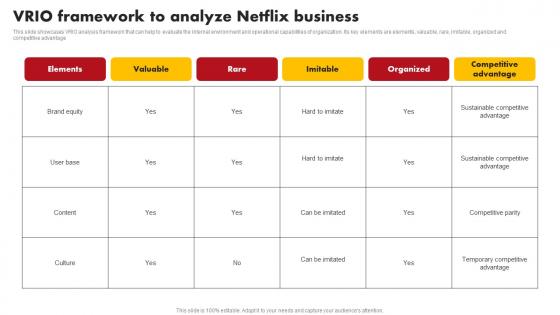
This slide showcases VRIO analysis framework that can help to evaluate the internal environment and operational capabilities of organization. Its key elements are elements, valuable, rare, imitable, organized and competitive advantage.
People who downloaded this PowerPoint presentation also viewed the following :
VRIO Framework To Analyze Netflix Comprehensive Marketing Mix Strategy Of Netflix Strategy SS V with all 9 slides:
Use our VRIO Framework To Analyze Netflix Comprehensive Marketing Mix Strategy Of Netflix Strategy SS V to effectively help you save your valuable time. They are readymade to fit into any presentation structure.








FAQs for VRIO Framework To Analyze Netflix Comprehensive Marketing Mix Strategy Of Netflix
So VRIO breaks down into four questions you ask about any resource or capability your company has. Does it create value for customers? Is it rare compared to what competitors have? Can others easily copy or replace it? And here's where people mess up - is your company actually organized to use this thing properly? I've seen companies with incredible resources just sitting there because they can't figure out how to capitalize on them. Anyway, just list your key resources and run through those four questions for each one. It's pretty straightforward once you get the hang of it.
List out what makes you different, then run each thing through the VRIO test - valuable, rare, hard to copy, and organized to actually use it. That last part about being organized? Super overlooked but honestly makes or breaks everything. Can your competitors easily replicate what you're doing? Be brutal here. Do this every quarter with your team since things change crazy fast. The stuff that checks all four boxes - that's where you should put your money and energy. Most companies think they have more advantages than they actually do, so don't sugarcoat it.
So VRIO basically makes you ask four key questions about each resource you have. Does it create real economic value? Is it rare compared to your competitors? Can others easily copy it? And can you actually capture that value organizationally? Start with your most promising assets and run them through all four tests. Honestly, most resources fail at least one - which is why this framework is so useful. It stops you from wasting time on stuff that feels important but won't give you an edge. Think of it like filtering out the noise. Only invest heavily in resources that check all four boxes.
If you're doing a startup, focus hard on the "rare" and "valuable" parts - you need something unique to even get in the door. Established companies? They should worry more about "inimitable" and "organized" since they've already got customers but need to keep competitors away. Most startups I see waste time obsessing over organization when they haven't even proven anyone wants their product yet. Your VRIO should be more like educated guesses about the future. Bigger companies can actually use real data from what's already working. Just pick your one main differentiator first, then test it against each piece to see if it'll actually last.
Culture is honestly huge for the "O" part of VRIO. You can have brilliant people and sick technology, but if your culture sucks at collaboration or getting things done, you're basically wasting those resources. Plus culture is super hard for competitors to copy - like, good luck replicating Google's vibe or Southwest's energy, right? I've seen companies with mediocre resources absolutely crush it because their culture was dialed in. When you're doing VRIO analysis, really dig into whether your culture actually helps you use your valuable stuff or if it's getting in the way.
So VRIO is this framework that helps you figure out which company resources actually matter competitively. You ask four questions about each one: Valuable? Rare? Hard to copy? And can your org actually use it well? Honestly, most people think way too highly of their "amazing" assets until they run this test. It's kinda brutal but super useful. Shows you exactly where to spend money and what needs work. I'd definitely try it before making any big resource decisions - saves you from throwing cash at stuff that doesn't really differentiate you.
Yeah, totally works for non-profits! Just swap out "competitive advantage" for "mission impact" since you're not chasing profits. Map out your top resources first - maybe your volunteer base or community connections. Then ask the VRIO questions: valuable? Rare compared to other orgs? Hard to copy? Can you actually use it well? Honestly, most non-profits I've seen don't realize how unique some of their assets are. Your board connections might be way more valuable than you think. Run through maybe 5 key things your org has going for it. Pretty eye-opening exercise.
Honestly, VRIO and SWOT are perfect together. Start with your SWOT analysis - let's say it shows you've got strong brand recognition. Cool, but is that actually giving you a real edge? That's where VRIO comes in. Run it through the four tests: valuable, rare, hard to copy, and well-organized. If it passes all four, boom - you've got sustainable competitive advantage. Think of SWOT as your overview and VRIO as your microscope. You can flip it too - use VRIO results to beef up your SWOT strengths section. Next time you do this, grab your top 3 strengths and put them through VRIO. Game changer.
Honestly, Apple's the perfect example - their whole ecosystem just works together so well that competitors can't touch it. Southwest Airlines does something similar with their culture and keeping costs down. Disney's brand is basically magic at this point, and don't even get me started on Amazon's delivery network - it's insane how fast they are now. When you're looking at your own company, focus on what you have that's actually rare. Most businesses have valuable stuff, but the real question is whether competitors can easily copy it. That's where the money is.
Honestly, just look around at your competition and see who else has what you've got. Map out your direct competitors first - do they have the same skills or resources? If everyone and their mom has it, then yeah, it's not rare. Don't forget about companies that could substitute what you do either. Industry reports help, but customer surveys are where you get the real tea. I'd also check out potential threats, not just current ones. The tricky part is being brutally honest with yourself about what actually makes you special versus what just feels important from the inside.
Honestly, the trickiest part is that it's so subjective - what you think is valuable might be totally off from what customers actually care about. Plus you'll have a hard time figuring out if your resources are truly "rare" without decent competitive intel, which is annoying to gather. Most advantages can be copied eventually anyway, so the "inimitable" thing is rough. But the real pain? Your internal teams will definitely overestimate how unique they are. I've seen this happen so many times. Get outside perspectives and actual customer feedback when you do this analysis - otherwise you're just lying to yourself about your capabilities.
VRIO's solid for industries where you can actually hold onto advantages long-term. Tech companies, pharma, luxury brands - they've got patents, proprietary stuff, reputations that took forever to build. Commodity markets? Eh, not so much since everything's basically identical there. High barriers to entry help a lot too. I'd start by listing your key resources first though. If competitors can easily copy what you've got, VRIO won't tell you much you don't already know. Works best when differentiation actually means something to your customers.
VRIO framework is perfect for this - basically ask if your tech is Valuable, Rare, Inimitable, and if your Organization can actually pull it off. Most companies crush the first two but totally bomb execution (seen this way too many times). The "Inimitable" part is where you really want to focus though. Patents help, but network effects or proprietary data work even better. Like, your tech might be cool but if Amazon can copy it in 6 months, you're screwed. Just go through your current tech stack tomorrow and honestly rate each piece on all four. You'll probably find some surprises.
So the "I" means inimitability - can competitors easily steal your advantage? Take Coca-Cola's secret recipe or how Apple does design. That stuff's nearly impossible to copy, which is why those companies stay on top. Your competitors will definitely try replicating whatever you do well. Short-term wins are easy to copy. What you want are those complex processes, weird proprietary knowledge, or relationships that took years to build. Honestly, most advantages don't last long these days. But if you've got something truly hard to replicate? That's your goldmine right there.
VRIO works great for small businesses - you just need to flip the script. Big companies are stuck with tons of red tape while you can change direction overnight. Your customer relationships? Way more personal than theirs. That niche thing you know inside and out? Good luck training 500 employees on that. Honestly, most small businesses undersell their advantages. Map out what you actually do differently (not what sounds good on paper). Maybe it's how fast you respond to problems or some weird expertise you've built up over time. Find those things competitors would struggle to copy, then go all-in on them.
-
Amazing product with appealing content and design.
-
The PPT layout is great and it has an effective design that helps in presenting corporate presentations. It's easy to edit and the stunning visuals make it an absolute steal!