


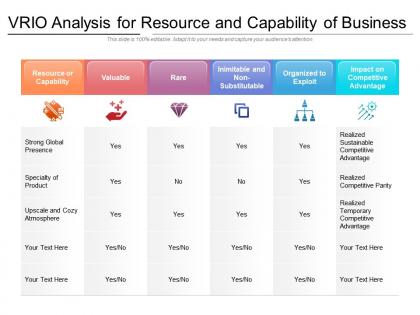
Vrio analysis for resource and capability of business




Try Before you Buy Download Free Sample Product
 Impress Your
 Audience
 100%
100% Editable
 Save Hours
 of Time


Advocate green with our VRIO Analysis For Resource And Capability Of Business. Encourage everyone to be eco-friendly.
People who downloaded this PowerPoint presentation also viewed the following :
Vrio analysis for resource and capability of business with all 2 slides:
Our VRIO Analysis For Resource And Capability Of Business believe in green. Enjoy the benefits of being eco-friendly.
FAQs for Vrio analysis for resource and
So VRIO is basically four questions you ask about your company's resources. First - is it **V**aluable? Does it actually help with opportunities or threats? Then **R**are - do your competitors have the same thing? **I**nimitable comes next (yeah, weird word) - can others easily copy it? Finally **O**rganized - can you actually use it to make money? Think of it like a filter that gets tighter each time. Lots of stuff is valuable, but finding something that's also rare AND hard to copy? That's where you hit gold. Just list what you've got and run each thing through those four filters. The ones that pass all four tests are your real competitive advantages.
Start with a resource audit - map out your physical stuff, money, people, and intangible assets like brand value or patents. Think beyond the obvious here. Your best capabilities might be staring you in the face. Company culture, core processes, even weird organizational habits can be competitive advantages. Different departments will see things you miss, so make it collaborative. Send surveys or run workshops - honestly, the most valuable stuff usually doesn't show up on balance sheets anyway. Oh, and don't just focus on what you have. Sometimes it's about how you use it that matters.
VRIO's different because it only looks inward at what you've actually got - your resources and capabilities. Porter's Five Forces? That's all about external market stuff. SWOT gives you the big picture but VRIO gets specific with four questions: is it Valuable, Rare, hard to Imitate, and are you Organized to use it? Way more focused than those broad frameworks. I actually like how it cuts through the BS - forces you to be honest about which capabilities are legit competitive advantages versus just... nice things you happen to do well. Perfect when you're trying to figure out where to actually put your money.
So VRIO starts with "value" - basically asking if your resource actually helps customers or cuts your costs. No value? Don't even bother with the rest of the analysis. It's like the foundation test: does this thing we have/do actually move the needle for business performance? You want resources that help customers solve problems better, faster, or cheaper than what's out there. Here's the thing though - if something doesn't create value, being rare or hard to copy won't matter anyway. Pretty pointless, right? Start by honestly figuring out if your resource actually impacts customers or your profits.
So rarity is basically step two in VRIO - it's what separates the winners from everyone else. Having something valuable doesn't mean much if your competitors can easily get it too. You've gotta ask yourself: how many other companies actually have this resource? If it's just you or maybe one or two others, that's gold. But if everyone and their mom has access to it, well, you're back to square one. Think of it like this - valuable but common resources just become the minimum you need to play the game. Nobody gets ahead that way. The real trick is spotting what makes you genuinely different in your space.
Yeah totally! VRIO works well for nonprofits, you just flip the focus. Instead of "does this make us more profitable," ask "does this help us nail our mission better than other orgs?" Your donor relationships are gold. Volunteer networks too. Plus any specialized knowledge your team has - that stuff matters just as much as it does for regular businesses. Actually, trust and reputation might be even more crucial in nonprofit world since people are literally giving you money for nothing tangible back. Just swap out the profit angle for mission impact and you're good.
So you wanna know if competitors can actually copy your stuff? Start with complexity - can they reverse-engineer all the messy skills and relationships you've built up? Then there's causal ambiguity (sounds pretentious but whatever) - basically, do outsiders even understand WHY your thing works? Time matters too. Some resources just take forever to develop, no shortcuts. Company culture and stakeholder relationships are huge here - that social stuff is nearly impossible to replicate. If competitors would hit roadblocks on any of these, you're golden.
Look, the biggest mistake? You'll think your stuff is way more special than it actually is. Everyone does this. Compare yourself to real competitors, not some fantasy version in your head. Don't just count equipment and patents either. The stuff that actually matters - like how your team works together or those customer relationships you've built - that's where the magic happens. Focus on what drives actual revenue and makes customers choose you. I mean, who cares if you have some cool internal process if it doesn't move the needle, right?
VRIO analysis is basically a reality check for your startup - it stops you from fooling yourself about what actually makes you special. You score each asset on four things: Valuable, Rare, Inimitable, and whether your Organization can actually execute on it. Most founders think their "we hustle harder" mentality is unique, but spoiler alert: it's not. That's neither rare nor impossible to copy. Focus on stuff that genuinely scores high across all four areas - like exclusive data you've collected, some tech nobody else has, or partnerships that'd be tough to replicate. Then pour your limited cash and time into those areas instead of spreading thin everywhere.
Honestly, I'd start by sitting down with your department heads and mapping out what you actually have - that's your foundation. Then hit up some market research to see how you compare to competitors. Your employees are gonna be clutch here though - they usually know better than executives where the real advantages are hiding. Customer surveys give you the outside perspective too. Oh, and if you're in tech or manufacturing, definitely dig into patent searches and IP stuff. The whole point is getting data from different angles so you're not just making educated guesses about whether your resources actually matter or if everyone else has them too.
Do it at least once a year, but honestly that's just the baseline. Fast-moving industry? Quarterly makes way more sense. I'd also trigger it whenever big stuff happens - new competitors pop up, tech changes, internal shake-ups, whatever. Companies get burned all the time sticking to those rigid annual schedules while everything shifts around them. Your competitive advantages aren't just sitting there unchanged, right? So why analyze them like they are. Set those calendar reminders but also watch for market signals. Way more effective than being super rigid about timing.
So beyond just your VRIO stuff, you gotta check out what's happening in the market too. Regulatory changes can mess everything up. Same with tech disruptions - honestly, I've seen companies get blindsided by this constantly. Your resources might be amazing today but worthless tomorrow if customer behavior shifts or new competitors jump in. Economic conditions matter a lot here, plus things like supplier power and entry barriers. I'd map all these external forces against whatever resources you're looking at. The internal analysis is only half the story, you know? Market trends can flip your whole competitive advantage overnight.
Tech totally flips the script on VRIO analysis. What used to be your secret sauce can become basic overnight when new technology drops. Cloud computing is a perfect example - suddenly everyone could access enterprise-level IT instead of just big companies. But honestly, digital stuff also creates new ways to stay ahead. Data analytics, AI tools, proprietary algorithms - these can become your new competitive edge. The tricky part? You've got to keep reevaluating because the digital world moves ridiculously fast. Today's advantage might be everyone's baseline tomorrow.
Look, VRIO breaks down your competitive advantages by checking if your resources are valuable, rare, hard to copy, and actually supported by your organization. Honestly, most companies think they know their strengths but get a reality check when they dig deeper. You'll spot which assets give you real sustainable advantage versus just basic industry requirements. It's pretty eye-opening tbh. Plus you'll see where competitors have stuff you can't touch. Focus your energy on what you're genuinely good at and stop throwing money at battles you can't win.
So VRIO helps you figure out what you're actually good at versus what you think you're good at - big difference. Look for stuff that hits all four boxes (valuable, rare, hard to copy, and you're organized around it). That's where you dump your money and build walls so competitors can't steal it. Honestly, most companies lie to themselves about their strengths though. If something doesn't score well, either fix it or find workarounds. The whole point is doubling down on what makes you special while not ignoring the gaps that could kill you.
No Reviews