


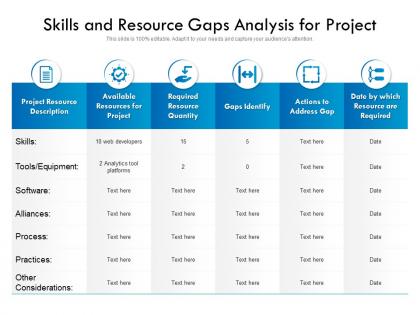
Skills and resource gaps analysis for project




Try Before you Buy Download Free Sample Product
 Impress Your
 Audience
 100%
100% Editable
 Save Hours
 of Time


Feel chuffed with our Skills And Resource Gaps Analysis For Project. They will raise some chuckles in the audience.
People who downloaded this PowerPoint presentation also viewed the following :
Skills and resource gaps analysis for project with all 2 slides:
Our Skills And Resource Gaps Analysis For Project will get your thoughts to circulate. They will give them a glowing introduction.

FAQs for Skills and resource gaps
Key indicators of a skills gap include declining productivity, increased project timelines, higher employee turnover, difficulty filling open positions, and frequent reliance on external consultants. These warning signs often manifest through missed deadlines, quality issues, and reduced innovation capacity, with many organizations finding that proactive skills assessments enable strategic workforce planning and competitive advantage.
Organizations can effectively identify skills gaps through employee assessments, performance reviews, competency mapping, manager feedback sessions, and strategic workforce planning analysis. These methods enable companies to compare current capabilities against future business requirements, with many finding that regular skills audits across departments reveal critical gaps in digital literacy, leadership development, and technical expertise, ultimately delivering targeted training strategies and competitive workforce advantages.
Employee feedback provides critical insights into skill deficiencies, training needs, learning preferences, and workplace challenges that managers might overlook. Through surveys, interviews, and performance discussions, organizations can identify specific competency gaps, understand barriers to skill development, and prioritize training investments, ultimately delivering more targeted professional development programs and enhanced workforce capabilities.
Skills gap impact can be quantified through performance metrics analysis, productivity measurements, revenue per employee calculations, customer satisfaction scores, and project completion rates. These methods enable organizations to measure decreased efficiency, increased training costs, and delayed deliverables, with many companies finding that systematic tracking reveals specific areas where skills deficiencies directly correlate with reduced competitive advantage and operational effectiveness.
Technology assists in identifying skills gaps through AI-powered assessments, data analytics platforms, learning management systems, and performance tracking tools that analyze current capabilities against future needs. These solutions streamline workforce planning by automating skill mapping, personalizing training recommendations, and measuring development progress, with many organizations finding that integrated tech approaches reduce time-to-competency while enhancing strategic talent alignment.
Effective prioritization involves assessing business impact, urgency of need, resource requirements, and alignment with strategic goals. Organizations typically focus on critical operational gaps first, followed by future-readiness skills, with many companies finding that combining high-impact training with mentorship programs delivers faster capability building and better retention outcomes.
**INPUT**: What strategies can be implemented to ensure a continuous assessment of skills gaps? **OUTPUT**: Continuous skills gap assessment strategies include regular competency evaluations, performance analytics, employee feedback surveys, industry benchmarking, and predictive workforce modeling. These approaches streamline talent development by identifying emerging skill needs, tracking capability trends, and aligning training investments with business objectives, ultimately delivering enhanced organizational agility and competitive advantage.
Skills gap analysis aligns with business goals by identifying workforce capabilities needed for strategic initiatives, competitive positioning, and operational excellence. Through systematic assessment of current versus required competencies, organizations can prioritize training investments, guide recruitment strategies, and enhance resource allocation, ultimately delivering improved performance and sustainable growth in an increasingly competitive business environment.
Common challenges include incomplete data collection, resistance from employees, lack of standardized assessment methods, difficulty measuring soft skills, and insufficient leadership support. Organizations often struggle with defining clear competency frameworks, ensuring accurate self-assessments, and translating findings into actionable development plans, with many finding that inadequate communication and resource constraints ultimately limit the analysis's strategic impact.
Leadership engagement in skills gap analysis involves establishing clear governance structures, allocating dedicated resources, and championing strategic workforce development initiatives across organizational levels. Through executive sponsorship and regular progress reviews, leaders can drive accountability, facilitate cross-departmental collaboration, and ensure alignment with business objectives, ultimately delivering sustainable talent strategies and competitive advantage in an increasingly skills-focused marketplace.
Tools for conducting effective skills gap analysis include competency frameworks, employee assessment platforms, performance management systems, learning management systems, and skills inventory databases. These resources streamline evaluation by automating data collection, benchmarking against industry standards, and identifying training priorities, with many organizations finding that integrated platforms deliver comprehensive insights while reducing analysis time and enhancing strategic workforce planning.
Data analytics enhances skills gap assessment accuracy by analyzing performance metrics, learning patterns, competency frameworks, and industry benchmarks to identify precise skill deficiencies. Through predictive modeling and real-time data visualization, organizations can quantify gaps more objectively, track skill development progress, and align training investments with strategic needs, ultimately delivering targeted workforce development and improved competitive positioning.
Workforce planning enables organizations to systematically identify current capabilities, forecast future talent needs, and develop targeted strategies to bridge identified skills gaps. Through strategic recruitment, upskilling programs, and succession planning, companies can proactively address deficiencies before they impact operations, ultimately ensuring competitive advantage and organizational resilience.
Training programs can be tailored by conducting role-specific assessments, creating personalized learning paths, incorporating hands-on simulations, and establishing mentorship partnerships with experienced professionals. Organizations in manufacturing and healthcare increasingly use blended approaches combining online modules with practical workshops, enabling employees to develop targeted competencies while maintaining productivity, ultimately delivering faster skill acquisition and improved performance outcomes.
Success metrics for skills gap interventions include performance improvements, productivity increases, retention rates, internal promotion rates, and time-to-competency for new skills. These measurements enable organizations to track ROI through reduced recruitment costs, faster project completion, and enhanced employee satisfaction, with many companies finding that systematic tracking ultimately delivers competitive advantage and measurable business growth.
No Reviews