


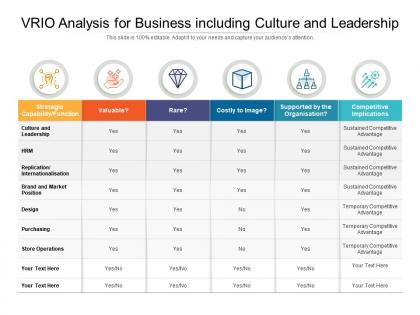
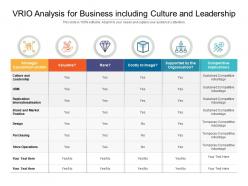
Vrio analysis for business including culture and leadership




Try Before you Buy Download Free Sample Product
 Impress Your
 Audience
 100%
100% Editable
 Save Hours
 of Time


Folks focus on growth with our VRIO Analysis For Business Including Culture And Leadership. They feel encouraged to be creative.
People who downloaded this PowerPoint presentation also viewed the following :
Vrio analysis for business including culture and leadership with all 2 slides:
Expose them to the craft with our VRIO Analysis For Business Including Culture And Leadership. Give them a glimpse of your expertise.
FAQs for Vrio analysis for business including
VRIO breaks down into Value, Rarity, Imitability, and Organization. So you're checking if your resource matters to customers, if it's scarce, if competitors can copy it easily, and whether you can actually use it well. Organization trips up most companies, honestly. Like, they'll have this incredible rare asset but their internal systems are such a mess that it doesn't help them compete at all. Each part builds on the last one - you need all four working together. I'd start by writing down your main resources, then just go through each one systematically against those criteria. Takes forever but it's worth it.
VRIO framework is pretty straightforward - you basically ask four questions about each resource you have: Is it Valuable? Rare? hard to Imitate? and can your Organization actually use it well? Go through everything - your brand, tech, people, whatever. Most companies think all their stuff is amazing (spoiler alert: it's usually not). But this forces you to be brutally honest about what actually sets you apart. The cool thing is it shows you where to spend your time and money. Don't waste energy on resources that are just baseline requirements. Focus on the ones that check all four boxes - those are your real competitive advantages.
So VRIO starts with resource valuation - you're basically figuring out if your resources actually create competitive advantage. Does this thing add real economic value to customers and your bottom line? It's like the first filter that weeds out stuff that seems important but doesn't actually move the needle. I mean, we've all been there with those pet projects that look impressive on paper. Without decent valuation, you'll waste time analyzing resources that don't generate real value. Start by honestly looking at what directly contributes to revenue or saves you money.
Map out everything you've got first - equipment, facilities, brand rep, patents, whatever specialized knowledge you have. Here's the thing though: just because you own something doesn't make it valuable. I see this mistake constantly. Check your financial data to see which resources actually boost revenue or cut costs. Different departments will catch stuff you missed too, so ask around. Honestly, most companies think way too many things are "strategic assets" when they're just... things. Be ruthless about what truly drives results vs. what just makes you feel good about having it.
Honestly, I'd start with some good old competitor stalking - see what patents, tech, or talent they've got that you don't (or vice versa). Industry reports help too, though they can be pretty dry. Ask yourself: could our biggest rivals copy this easily? If not, you're onto something. I usually try to put numbers on it when I can - like "only 2 out of 12 competitors can do this." Market research isn't glamorous but it'll show you who has what. Sometimes the rarest stuff is hiding in plain sight.
So VRIO basically makes you play detective with your own stuff. You go through each resource and ask "can competitors copy this easily?" Look for things like messy internal processes that took years to build, or situations where even you're not totally sure why something works so well. Honestly, most companies think their resources are way more special than they actually are. Short answer: if rivals can replicate it cheaply and fast, it's imitable. The tricky part is being brutally honest about what you've got. Focus your energy on the resources that would genuinely make competitors sweat to copy.
Don't just make a list of what you're good at - actually work on making those things stronger and harder to copy. Your company culture, specialized knowledge, weird internal processes that somehow work perfectly? Those are gold. Map out what you have now using VRIO, then spot the gaps. Here's the thing though - capabilities get rusty if you ignore them (learned this the hard way). Figure out which ones actually give you an edge vs the basic stuff everyone needs to survive. Pour money into the valuable, rare capabilities. Oh, and make sure your org structure doesn't accidentally block you from using what you've built. That happens more than you'd think.
Honestly, most companies think their stuff is way more special than it actually is - that's the big one. Don't just let one team handle this either, you need people from different departments or you'll miss obvious things. Also, I see this mistake all the time where people treat it like homework they do once and forget about. Markets change constantly! Some places get so caught up debating definitions they never actually DO anything with their findings. Be harsh about what you're really good at, get different viewpoints, and actually make decisions based on what you find instead of just... filing it somewhere.
So VRIO is way more targeted than SWOT. Instead of looking at everything under the sun, it zeroes in on your resources through four specific questions: Value, Rarity, Imitability, and Organization. SWOT honestly gets pretty scattered - you end up with these broad categories that don't tell you much. But VRIO? It actually helps you figure out if competitors can just copy your stuff tomorrow. Plus it checks whether you've got the setup to actually use your advantages. I mean, most people automatically reach for SWOT, but VRIO's better when you're specifically trying to understand your competitive edge.
Absolutely! VRIO actually works great for service businesses. Maybe even better in some ways. You can run your team's expertise, customer relationships, or unique processes through the same four questions. Like, a consulting firm's specialized knowledge or a restaurant's amazing atmosphere - those can totally be valuable, rare, and hard to copy. The main difference? Your competitive advantages are usually more intangible stuff. Think company culture, delivery methods, or proprietary knowledge instead of equipment. I'd start by writing down what makes your service special, then just work through each VRIO criterion. It's honestly pretty straightforward once you get going.
Do it once a year minimum, but that's honestly pretty bare bones if you're in tech or retail or whatever fast-moving space. I'd say quarterly makes more sense when things get crazy competitive. The whole point is catching when your advantages start slipping before competitors notice. Check if your old strengths still matter and scout for new ones. Market shifts happen fast these days - like, remember when everyone thought brick-and-mortar was dead? Put recurring reminders in your phone so you don't just forget about it for two years.
Tech disruption can totally wreck your VRIO analysis - like, practically overnight sometimes. Remember when cloud computing made those huge server farms basically worthless? Companies spent millions on IT infrastructure that suddenly became just... boring commodity stuff. Your "rare" advantages aren't rare anymore when new tech drops. Honestly, I'd probably check your VRIO setup at least once a year, maybe more if your industry moves fast. The tricky part is spotting which tech trends will actually matter versus the overhyped nonsense. Stay sharp about what's coming.
VRIO analysis is basically a reality check for figuring out what actually makes your company competitive. You run each resource through four questions: Valuable? Rare? Inimitable? And can your Organization capture the value? Honestly, most companies think they're way more special than they are. This framework stops you from throwing money at stuff competitors can easily copy or that customers don't even care about. Perfect for deciding where to spend your budget, what skills to build up, or whether you're ready to expand into new markets. It's surprisingly straightforward once you get the hang of it.
VRIO works best when companies have stuff that's actually hard to copy. Tech firms love it for patents and algorithms. Luxury brands use it for reputation analysis. Consulting companies? They're all about evaluating talent and unique methods. Manufacturing can work too if you've got proprietary processes - though honestly, a lot of manufacturers think they're more special than they actually are. Any industry where being the cheapest isn't your only path to winning will find it useful. You need resources that genuinely create competitive advantage, not just the basic operational things every company already has.
So here's what I'd do - start with VRIO to figure out what you're actually good at internally. Then throw SWOT on top to see how that lines up with external stuff. Porter's Five Forces is clutch after that for understanding competition (seriously saved my butt in so many leadership meetings). VRIO results also work great for informing your strategy canvas positioning. Or honestly, use them to prioritize capabilities in your balanced scorecard - whatever makes sense for your situation. The whole point is VRIO gives you that solid foundation of what you can actually deliver, then you build everything else around it.
No Reviews