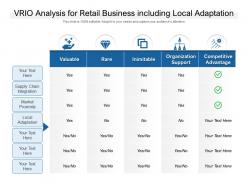
Vrio analysis for retail business including local adaptation
Try Before you Buy Download Free Sample Product
Audience
Editable
of Time
Our VRIO Analysis For Retail Business Including Local Adaptation are like a designer collection. They create an air of exclusivity.
People who downloaded this PowerPoint presentation also viewed the following :
Vrio analysis for retail business including local adaptation with all 2 slides:
Create an air of exclusivity with our VRIO Analysis For Retail Business Including Local Adaptation. They all come from a designer collection.
FAQs for Vrio analysis for retail business
So for VRIO analysis in local retail, you've got five main things to nail down. Local consumer habits matter way more than people think - seriously, what kills it in Denver might bomb in Miami. Check out your competition and what regulations you're dealing with in that specific area. Supply chain stuff gets tricky when you're going local too. Cultural vibes are huge for how you position products and write your marketing copy. Economic conditions like income levels will make or break your value prop. I'd start by mapping these against what resources you actually have right now, then you can see where the gaps are before jumping in.
Your VRIO analysis totally depends on what locals actually want. That efficient supply chain? Means nothing if customers here care way more about getting personal attention than fast delivery. You've got to figure out what your specific market values first - maybe it's prime real estate in a culture obsessed with foot traffic, or killer digital features where everyone shops online. Honestly, I see too many businesses assume the "V" in VRIO is the same everywhere. It's not. Map out your resources against real buying patterns in your area, not some generic retail playbook.
Look for partnerships that check all the VRIO boxes - exclusive deals with local artisans, co-branded events, joint loyalty programs with businesses that complement yours. They're valuable because they actually drive sales. Rare since competitors can't just copy your specific local network. Hard to imitate too, honestly, because real relationships take time to build. But here's the thing - you need proper systems to make these partnerships actually work for you. Otherwise you're just collecting business cards. Start by looking at your current connections and figure out which vendors could become real strategic partners instead.
Look, cultural adaptation totally changes your VRIO game. You'll hit Value by actually getting what locals want - stuff competitors completely miss. Takes forever to build that real cultural insight though, which makes it Rare. Can't just show up and pretend you know the market, you know? Those authentic community connections become Inimitable because they're genuinely yours. Then organize everything around what you learned - your merchandising, who you hire, how you market. Honestly, I'd start by just figuring out which cultural factors matter most in your specific area. It's way more powerful than people think.
So basically, tech gets valuable in VRIO when it helps you read local customers way better than your competition. Think POS systems tracking neighborhood buying habits, or apps that actually predict what people in your area want. Here's the thing though - generic tech is pretty useless. What matters is how you tweak it for your specific market. Your custom inventory system or those weird social media tools you've built? That's gold if competitors can't copy them easily. Honestly, focus on whatever gives you the best local insights. That's where you'll win.
Look at McDonald's - they've got rice burgers in Taiwan and way more veggie stuff in India. Smart move since it's tough for competitors to copy that kind of local adaptation at their scale. Walmart does something similar with those smaller neighborhood stores in cities, using their crazy good supply chain but tweaking the format. IKEA had to get creative too - those tiny London stores still feel like IKEA but actually fit in the space they could afford. Oh, and Starbucks basically invented drinks I'd never heard of before moving to different countries. Green tea frappuccinos are apparently huge in Asia. The trick is figuring out what you're already good at and just... adjusting it instead of starting over.
Your supply chain totally changes what matters in VRIO analysis. Got access to suppliers your competitors don't? That's gold. Same with faster delivery - I've seen companies crush it just because they get fresher stock while everyone else is stuck with generic distributors. Those local relationships are way harder to copy than standard retail stuff too. Like, anyone can set up a basic store, but building real supplier connections takes years. Honestly, start by figuring out where your supply chain actually gives you an edge, then work backwards from there. Makes the whole framework way more useful.
Local regulations mess with your VRIO analysis big time. What's rare in one market might be totally common somewhere else because of licensing rules or entry barriers. Compliance costs can kill resources that seemed valuable - like those data practices that work fine until Europe's GDPR smacks you down. Labor laws hit the hardest though, since you'll need completely different operational setups for each region. Safety standards, tax stuff, all of it varies. Honestly? Just run separate analyses for each major market. Don't assume your resources work the same everywhere - learned that one the hard way.
Track your key metrics monthly - stuff like customer retention, local market share, and profit margins for each spot. What crushes it in downtown Manhattan will probably bomb in suburban Ohio, so break down your data by location. Honestly, competitors move way faster than they used to. Do quarterly check-ins to see if your advantages are still hard to copy. Pick 3-4 metrics that connect directly to your VRIO strengths and watch how they trend over time. The whole point is catching when your edge starts slipping before it's too late.
Honestly, you can't just do VRIO once and call it done. Check your stuff quarterly - what's still valuable and rare in your area? Customer tastes change way faster than we want them to, which is annoying but true. Monthly check-ins help you spot new local trends early. Build things that can actually adapt quickly: train your staff regularly, get tight with local suppliers, keep your inventory flexible. I'd focus on those dynamic capabilities since they're harder for competitors to copy. Treat the whole thing like an ongoing conversation with your market, not some checkbox exercise.
Dude, customer feedback is like your sanity check for VRIO analysis when you're going local. What you think gives you an edge might totally fall flat with actual customers in that market. I've watched retailers crash and burn assuming their winning formula works everywhere - spoiler alert, it doesn't. Local insights show you which resources actually matter there, if competitors are already doing it better, and whether you're really capturing value. Oh, and start collecting feedback super early. Use it to keep tweaking your VRIO assessment as you go.
Look, competitor analysis basically saves you from fooling yourself with VRIO. You'll see what other stores actually offer versus their marketing BS. Map out like 3-5 direct competitors first. Then honestly ask - if customers can get the same thing next door, does your "valuable" resource even matter? I've seen so many retailers think their store layout is revolutionary when it's pretty much identical to everyone else's. The real question isn't whether something's theoretically rare - it's whether it actually gives you an edge in your specific area. Most "unique" approaches are just slight tweaks of the same basic formula anyway.
Yeah, brand loyalty totally works for VRIO analysis! It's valuable since loyal customers keep buying even when competitors offer better deals or prices. Pretty obvious competitive advantage there. The hard part? Figuring out if your loyalty is actually real or just people being lazy about switching. Look at whether competitors have the same level of loyalty, what creates that emotional connection (and if others can copy it), plus whether you're actually capitalizing on it well. Honestly, I'd start with retention rates and customer lifetime value to put some numbers on it. That'll give you a clearer picture of what you're working with.
Look, you gotta track the obvious stuff first - revenue per store, market share, same-store sales growth. That's your baseline. But here's the thing: customer satisfaction scores and brand perception surveys matter just as much, maybe more? They show if locals actually get what you're doing. Social media engagement is huge too - people either vibe with your local approach or they don't, and it shows online. Oh and retention rates, obviously. Pick like 3-4 metrics that actually match your strengths and check them monthly. Don't overthink it.
So VRIO basically lets you reality-check if your retail game will actually translate to a new market. You're looking at whether your stuff is Valuable, Rare, Inimitable, and Organized - but specifically for THAT market, not just in general. Like your supply chain back home might be killer, but if there aren't local suppliers? You're screwed. The cultural stuff trips people up constantly. Run through VRIO to figure out what advantages you can actually bring over versus what you'll have to build fresh. Then spend your money accordingly - don't blow your budget assuming everything transfers.
No Reviews