

Porter Five Forces Analysis Of Netflix Netflix Strategy For Business Growth And Target Ott Market




Try Before you Buy Download Free Sample Product
 Impress Your
 Audience
 100%
100% Editable
 Save Hours
 of Time


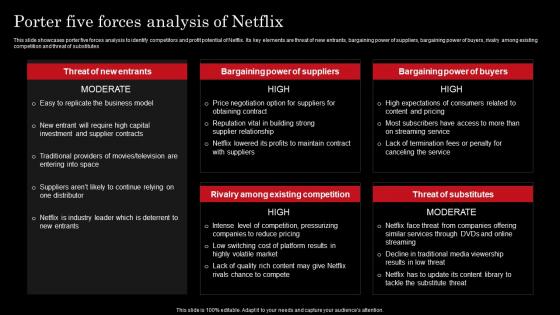
This slide showcases porter five forces analysis to identify competitors and profit potential of Netflix. Its key elements are threat of new entrants, bargaining power of suppliers, bargaining power of buyers, rivalry among existing competition and threat of substitutes
People who downloaded this PowerPoint presentation also viewed the following :
Porter Five Forces Analysis Of Netflix Netflix Strategy For Business Growth And Target Ott Market with all 6 slides:
Use our Porter Five Forces Analysis Of Netflix Netflix Strategy For Business Growth And Target Ott Market to effectively help you save your valuable time. They are readymade to fit into any presentation structure.





FAQs for Porter Five Forces Analysis Of Netflix Netflix Strategy For Business Growth And
So Porter's Five Forces breaks down like this: competitive rivalry (how cutthroat your industry is), supplier power (can they jack up prices on you?), buyer power (do customers control what you charge), threat of substitutes (other products that do the same thing), and barriers to entry (how hard is it for newbies to jump in). Honestly, it's like figuring out all the ways your business might get screwed over. Each one hits your profits differently. You gotta look at which forces are strongest in your specific market, then work on protecting yourself from those. Some are way more brutal than others depending on what you're selling.
So basically, new entrants are about how easily competitors can waltz into your market and steal customers. Low barriers mean anyone can jump in - cheap startup costs, no red tape, that kind of thing. Competition gets brutal fast and prices drop. High barriers though? That's your friend. Think massive upfront investment or customers who are obsessively loyal to existing brands. Honestly, most people don't check this stuff enough, but you should. It totally affects whether you can charge premium prices or if you're stuck in a race to the bottom.
Suppliers get power when they're concentrated or sell something unique that's hard to replace. High switching costs kill you too - like if changing suppliers means retraining staff or overhauling systems. Intel's a perfect example - they basically owned chip pricing for years because who else could you go to? Also matters if your industry isn't their main customer. They won't stress losing you if it's only 2% of their revenue. For your analysis, count how many real supplier options exist and what switching would actually cost. Oh and check how specialized their stuff is - generic products mean less power.
So buyer power is basically how much your customers can push you around on pricing. When they've got options or buy huge volumes, they'll demand lower prices and squeeze your margins. Big retailers like Walmart are notorious for this - they just bulldoze suppliers because they can. This gets really brutal in commodity markets where your product isn't that different from competitors'. You need to figure out how concentrated your buyers are compared to your industry. Short switching costs? You're screwed. Try creating something unique or making it harder for them to jump ship.
Honestly, you've gotta make switching away from your product feel like a huge pain. Lock customers in with contracts or loyalty programs - whatever works. Keep innovating like crazy so substitutes can't catch up. I learned this the hard way at my last job actually. Build serious brand loyalty too because people hate change when they trust something. Short version: make customers think "ugh, switching sounds awful" instead of just trying to beat everyone on price. That's where most companies mess up.
When your industry has tons of competitors going after the same customers, that's when things get nasty. Slow growth makes it worse - everyone's fighting over scraps. Plus if companies can't easily leave (like when they've got expensive equipment they can't dump), they'll stick around and keep the bloodbath going. Same thing happens when fixed costs are huge so everyone needs volume to survive. Honestly, commodity businesses are the worst for this. Price wars break out when no company's clearly winning and products all look the same. Sounds familiar?
So yeah, regulatory changes totally mess with Porter's five forces - sometimes in crazy ways you wouldn't expect. They usually make it harder for new companies to break in (pharma approvals are brutal). Plus they shift who has power between suppliers and buyers. Competition can get way more intense or weirdly calm depending on the rules. Banking regs actually pushed tons of people to fintech, which is kinda ironic. When big regulatory stuff hits your industry, don't just worry about compliance costs. You've got to step back and see how it changes the whole game for everyone.
Airlines are probably the worst - you'd need like hundreds of millions just for planes, forget about getting all those safety approvals. Pharma's brutal too because of all the FDA stuff and R&D costs. Telecom companies have to build entire networks before they can even get customers. Auto manufacturing is insane with the factories and supply chains... honestly makes you appreciate why there aren't new car companies popping up every year. Oil refining and utilities are similar - massive infrastructure investments plus you're dealing with government regulations at every step. For your Porter's analysis, basically look for anything where you can't just rent an office and start tomorrow.
So basically, you want to turn Porter's Five Forces into your own little fortress. Patents and exclusive deals block new players from jumping in. Keep suppliers spread out - don't let one get too much control over you. Make it super expensive for customers to switch to competitors (think Apple ecosystem). Honestly, the substitute threat is probably the scariest one these days. Everything gets disrupted so fast. Either buy the disruptors or out-innovate them before they steal your lunch. Oh, and actually audit this stuff regularly - most companies just do it once and forget about it. Smart leaders treat it like ongoing surveillance.
Tech basically flips Porter's Five Forces on its head - and yeah, it happens crazy fast. Cloud computing suddenly lets tiny startups go head-to-head with massive corporations. New products pop up that can wipe out entire industries (RIP Blockbuster). Power between suppliers and buyers gets completely shuffled around. Sometimes your whole competitive landscape just... disappears overnight. Honestly, if you're in anything tech-related, you should probably run your Porter analysis every quarter instead of once a year. Things change too quickly to trust last year's assumptions - learned that one the hard way.
Honestly, globalization just makes Porter's five forces way more intense. You'll have competitors from everywhere suddenly jumping into your market - which sucks, but your customer base also gets huge. Supply chains become this whole global mess where power dynamics flip constantly. Substitutes? Forget about it - someone in Estonia probably just invented something that'll replace your product tomorrow. New companies can enter markets easier digitally, but then they need massive scale to actually compete. It's weird how it makes barriers both lower AND higher at the same time. Best thing you can do is really think through how each force hits your specific industry differently.
Honestly, just start with basic industry research - hit up competitor websites, industry reports, that kind of stuff. Customer surveys work great too if you've got time. I'd probably mix in some stakeholder interviews since people love sharing insider dirt about their industries lol. Competitive benchmarking helps you see where everyone stands. Scenario planning's useful for those "what if" moments. Don't overthink it though - grab some hard data, then balance it with the qualitative stuff you pick up from conversations. Pick maybe 2-3 approaches that won't break your budget, then turn it all into something your team can actually use.
Porter's Five Forces is actually pretty useful for finding weak spots in markets. Hunt for industries where suppliers can't push you around and customers aren't super picky. Few substitutes? Even better. New entrants are weird though - you need low enough threat that you won't get demolished, but high enough that you can actually get in. Honestly, fragmented competition is your friend here. Map out each force and find where several work for you at once. Oh, and complacent competitors? Gold mine.
So here's the thing - you can't just do one Five Forces analysis for a whole industry. Different segments have totally different competitive dynamics. Like, luxury cars vs economy cars? Completely different suppliers, customers, competitors, everything. We made this mistake once in a retail project and basically wasted weeks painting everything with the same brush. Pretty embarrassing honestly. You've got to break your market into actual segments first, then run separate analyses for each one. Way more useful than some generic overview that misses all the important stuff.
Look, the Five Forces thing is basically your cheat sheet for figuring out where your business is actually vulnerable. You can see if suppliers have you by the throat, whether customers control your pricing, or if some startup could waltz in and steal your lunch. Instead of just winging it, you're mapping out real threats. Like, are new competitors gonna flood in easily? Do buyers have tons of options besides you? I honestly think most people skip this step and regret it later. Just rate how intense each force is in your industry - then you'll know where to focus your energy and budget.
-
I joined SlideTeam last month and there’s no doubt that I tend to find our bond only strengthening over time. Best place to find world-class themes, templates, and icons.
-
Love the template collection they have! I have prepared for my meetings much faster without worrying about designing a whole presentation from scratch.