

Pre And Post Training Evaluation Form Implementation Of Training Ppt Sample DTE SS





Try Before you Buy Download Free Sample Product
 Impress Your
Audience
 100%
Editable
 Save Hours
of Time


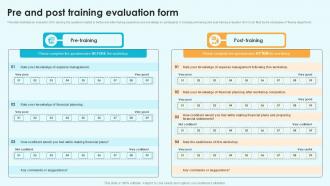
This slide illustrates an evaluation form carrying the questions related to before and after training experience and knowledge on participants. It includes pre training and post training evaluation form to be filled by the employees of finance department.
People who downloaded this PowerPoint presentation also viewed the following :
Pre And Post Training Evaluation Form Implementation Of Training Ppt Sample DTE SS with all 9 slides:
Use our Pre And Post Training Evaluation Form Implementation Of Training Ppt Sample DTE SS to effectively help you save your valuable time. They are readymade to fit into any presentation structure.








FAQs for Pre And Post Training Evaluation Form Implementation Of Training Ppt
So basically, pre-training evals show you where people are starting from - their current knowledge and skills. Post-training ones measure what they actually learned after going through your program. It's like a before/after thing but for learning stuff. You need that baseline from the pre-test to prove your training actually worked. Otherwise you're just guessing if people improved or not. The post results show your actual ROI and impact - honestly, without both you can't really demonstrate squat. Oh and the pre-training data helps you spot knowledge gaps too, so you can adjust your content. Always do both.
Work backwards from your end goals - that's the trick. Figure out what skills or knowledge gaps you're trying to fix first. Then build assessment questions that actually test those specific areas. I learned this the hard way after using boring generic surveys that told me nothing useful. Your pre-training questions should mirror whatever you're planning to teach, whether it's technical stuff, people skills, or processes. This way you get a real baseline instead of just... guessing where everyone's at. It's honestly like making a custom diagnostic test for each person before you start.
So you want to actually know if your training worked, right? Use Kirkpatrick's four levels - reaction, learning, behavior, and results. Most people totally skip tracking behavior changes, which is honestly the most telling part. Get baseline data first, then mix surveys with interviews and performance checks. I'd do follow-ups at 30, 60, and 90 days because that's when you see if people actually apply what they learned or just forget everything. Don't rely only on test scores - get feedback from managers and coworkers too. The real magic happens when you track long-term job performance, not just immediate knowledge gains.
Honestly, pre-training assessments are a game changer. They show you what people actually know vs. what you think they know. Skip the basics if they've got those down already. Focus on their real weak spots instead. You can group people by skill level, pick better teaching methods, set goals that make sense - all that good stuff. I learned this the hard way after wasting time on a workshop where half the room was bored out of their minds. Without knowing where people start, you're just guessing. Do the assessment first and thank me later!
Track behavioral stuff first - skill assessments, performance reviews, whether people actually use what they learned. Business metrics matter too like customer satisfaction or error rates if it was customer-facing training. Getting managers to consistently measure this is honestly such a pain, but it's worth it. Employee engagement and retention can show if training really stuck. Oh, and don't go crazy with metrics - pick maybe 2-3 that actually connect to what you were trying to achieve. Give it 3-6 months minimum to see real results. Some changes take forever to show up.
Dude, those post-training surveys are seriously worth reading through - don't just glance at the star ratings. I always block out like 30 minutes after each session to actually dig into the comments. You'll be shocked at what bombs vs. what hits. That module you're super proud of? Might totally confuse people. Look for trends across multiple trainings, not just random one-off complaints. Jot down three concrete tweaks for next time - maybe slow down that rushed section, clarify the confusing part, or add more of whatever activity they loved. It's honestly the best way to get better at this stuff.
Honestly, automation saves so much time here. Start with something like SurveyMonkey for your pre-training stuff, then connect it to your LMS so you're not manually tracking everything. Learning dashboards will catch problems early - way better than finding out later people didn't get it. Set up those follow-up surveys to go out automatically at 30, 60, 90 days. I learned this the hard way but don't go crazy implementing everything at once. Pick one tool first or you'll just stress everyone out. The time you'll save is ridiculous though.
Your pre-training evaluations are only as good as how engaged people are when taking them. Rushed assessments? Useless data. When employees actually care, they'll be honest about knowledge gaps instead of just clicking through. Here's what works: tell them upfront why you're doing the evaluation and how it'll make their training better. Most people think these are just bureaucratic nonsense (and honestly, sometimes they are). But transparency changes everything. Engaged employees see pre-training evals as actually helpful rather than another box to check. They'll think through questions properly. Short version - buy-in equals better data.
Super important, honestly. You can't tell if training actually worked without that connection. Think about it - measuring knowledge retention when you really need better customer satisfaction scores? Waste of time. Your baseline measurements have to tie directly to the performance gaps you're trying to fix. Otherwise you'll end up with tons of training data that tells you absolutely nothing about business impact. I'd start with figuring out your key performance indicators first. Then build the evaluation around those specific metrics. Makes way more sense that way.
Honestly, the biggest mistake is overcomplicating your pre-assessment - people will bail before you even get to the real training. Focus on measuring just the stuff your training actually covers, not random knowledge. Use the same question format for both pre and post tests or you can't compare anything (learned that one the hard way). Don't skip measuring confidence and attitudes either, not just what they know. Oh, and definitely test it with a few people first because what makes sense to you might confuse everyone else. Keep it short and tied directly to what you're teaching.
Basically, qualitative data tells you the "why" behind your numbers. Test scores look great, but then you interview people and find out they're still scared to actually use the new skills at work. Those random comments during feedback? Pure gold honestly. People will share stories about which concepts totally clicked versus what left them confused. You get to see if the training actually transferred to their day-to-day stuff or just lived in their head for the test. Oh, and definitely collect open-ended feedback alongside your regular metrics - that's where the real insights hide.
Skip the generic "rate your skills 1-10" stuff - honestly, those tell you nothing useful. Give people actual scenarios they'd face on the job instead. Like if you're training on Excel, don't ask them to rate themselves. Have them work through a real spreadsheet problem. The key is matching your evaluation to what you're actually trying to teach them. Don't make it too easy or crazy hard either. You want that middle ground where you can actually see improvement later. Real workplace examples beat theoretical questions every time.
Getting everyone in on training evaluations is a game changer, honestly. You want managers, peers, and the actual trainees all giving feedback - that way you're not just seeing what looks good on spreadsheets but what's actually happening day-to-day. The cool thing is when managers help evaluate, they're way more likely to back up the training later. I've seen this work so well because you get the real story from multiple angles. Just set up easy ways for everyone to share what they think before training starts and after it wraps up. Makes everything so much more targeted.
Start with the big wins and major gaps, then throw in your supporting data. Charts work way better than walls of text - people's eyes just glaze over otherwise. Different audiences need different angles though. Executives only care about ROI and bottom line impact. Managers want to know what to actually do about their team's weak spots. Don't just dump data and call it done. Give them clear next steps and real recommendations they can act on. Oh, and here's what I always do - send a one-page summary first. Most people won't read past that anyway, but you'll look thorough when you offer the full report to whoever wants more detail.
Honestly, I'd check those evaluations every 6-12 months - or whenever you make big changes to your training stuff. I always forget though, so definitely set a phone reminder! The data itself? Look at that quarterly. If something seems off or results are consistently trash, don't wait around. Your team changes, the industry shifts, so your evaluations should too. Oh, and first thing - make sure your current questions actually measure what you want from the training. Sometimes we ask the wrong stuff entirely.
-
Wonderful templates design to use in business meetings.
-
Really like the color and design of the presentation.