

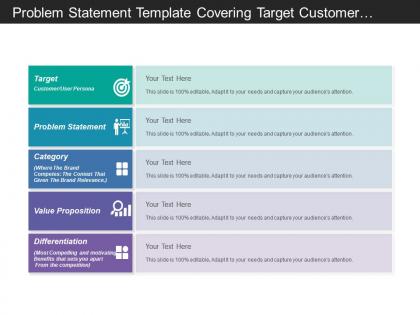
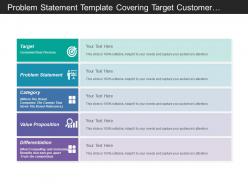
Problem statement template covering target customer and value proposition





Try Before you Buy Download Free Sample Product
 Impress Your
 Audience
 100%
100% Editable
 Save Hours
 of Time


Function effectively across countries with our Problem Statement Template Covering Target Customer And Value Proposition. You will acquire a glocal advantage.
People who downloaded this PowerPoint presentation also viewed the following :
Problem statement template covering target customer and value proposition with all 5 slides:
Elaborate on the job with our Problem Statement Template Covering Target Customer And Value Proposition. Include every detail imaginable.
FAQs for Problem statement template covering target customer
Look, you need five things in your problem statement if you want stakeholders to actually care. What's happening right now? That's your starting point. Next, spell out the real problem - not just surface stuff, but what's actually broken. Who gets hurt by this and how bad is it? Numbers are your friend here if you have them. Here's what people always miss though - explain why this can't wait another six months. What changed? Finally, paint a picture of what winning looks like. Oh, and keep each part super short or nobody's gonna read past the first paragraph. Trust me on that one.
Honestly, nailing your problem statement upfront is huge. It keeps everyone on the same page and prevents that awful scope creep situation. Your team won't go chasing random solutions, and stakeholders actually know what they're signing up for. Plus you'll have a clear way to measure if you actually solved anything - which sounds obvious but you'd be surprised how many projects miss this. I've watched so many teams dive straight into building stuff without really defining the problem first. Bad move. Spend the extra time here, trust me. It's the difference between delivering something useful vs just... delivering something.
Honestly, the biggest mistake is being way too vague about what's actually broken. Don't jump straight into solutions either - just describe the problem first. Like instead of saying "communication issues" (which tells me nothing), try "sales team finds out about product updates 3 days after we release stuff." Way more helpful. Oh, and don't bury the real issue under a bunch of background story. I see people do this all the time. Start with one solid sentence about what's messed up, then add details from there. Broad problems are basically impossible to solve anyway.
Honestly, problem statement templates are a game changer. Your team will finally stop talking past each other in meetings - you know how that goes, everyone thinks they're solving the same thing but they're totally not. The template makes you nail down the actual problem, who you're building for, and how you'll know if it worked. When scope creep inevitably happens (because it always does), you've got this shared doc to point back to. I started using them for kickoffs and the alignment happens so much faster. Fill out those boxes together and suddenly everything just clicks.
Honestly, visuals can be a game-changer for problem statements. Like, instead of writing three paragraphs about a broken process, just throw in a flowchart. Way easier to follow. Graphs work great for showing trends too. I'm obsessed with before/after comparisons - they're so much more convincing than just describing what's wrong. Your stakeholders won't have to wade through walls of text either. Quick tip though: don't go overboard with fancy graphics. Keep it simple and stick to what actually helps explain your problem. One solid visual beats five confusing ones every time.
Honestly, figuring out your audience is like half the battle with problem statements. Executives? Hit them with business impact and ROI stuff. Technical people want specs and constraints - they eat that up. End users just care about what's actually bugging them day-to-day. You're basically translating the same problem into whatever language each group speaks. Match their expertise level and what they actually prioritize when making decisions. I always start by jotting down who's gonna read this thing and what keeps each group up at night. Makes the whole writing process way easier.
Honestly, the trick is building your template around basics that work everywhere - current situation, what you want instead, who gets hurt if nothing changes, that stuff. Then just swap out the questions for each situation. Like, manufacturing problems? Ask about production numbers. SaaS issues? Focus on how users actually behave. I've seen teams waste so much time rebuilding templates from zero when they could just keep the same bones and change the details. The framework stays put, but you're tweaking the prompts inside each section. Way easier than starting over every single time.
Honestly, I just make a simple grid - impact vs urgency. Customer complaints are pure gold since they show what's actually breaking in the real world. Hit the stuff that's hurting the most users first. But here's the thing - sometimes you gotta fix boring backend issues before tackling the sexy user problems, which is annoying but necessary. Quick wins are amazing too. Like if one fix solves three smaller headaches? Chef's kiss. List everything out first, then be brutal about ranking by business value. Don't overthink it.
Yeah, totally doable! Break those problem statements into bite-sized pieces that match your sprints instead of writing some giant document upfront. I always stick with the user story format - "As a [user], I need [solution] because [problem]" - it just works better than overthinking it. Keep them visible on your board and actually look at them during retros. The whole point of agile is adapting as you go, so your problem statements should evolve too when you get new feedback. Start simple with a basic template, then tweak it each sprint. Way better than trying to nail everything perfectly from day one.
So the main thing is being super specific about who's hurt and by how much. Like instead of "users seem frustrated," say "support tickets jumped 40% after the UI change, creating 2-hour delays." Numbers make people actually care. Bad problem statements are so wishy-washy - they read like someone was afraid to point fingers. Good ones hit you immediately with the "oh crap, we need to fix this" feeling. You'll want context too - why does this matter right now? What would winning look like? Honestly, most teams skip this part and wonder why nobody prioritizes their issue.
Honestly, problem statement templates are game-changers because they force everyone to pump the brakes instead of jumping straight into "solutions." Your team actually has to dig into the real root cause and figure out who's genuinely affected. You know those meetings where people just blurt out random ideas? This kills that chaos completely. Each section builds naturally, so everyone develops deeper understanding together - instead of talking past each other. The structure makes you ask harder questions upfront, like what does success actually look like here? I'd definitely try it at your next project kickoff. Way clearer than the usual mess.
Problem statements are pretty much the same everywhere, just dressed up differently. Business folks love the "[X] problem causes [Y] impact on [Z] stakeholders" thing. Research papers go for "Despite knowing [this], we still don't understand [that specific thing]." Healthcare focuses on patient outcomes and budgets - makes sense I guess. Engineers stick with "System [A] can't do [B] so [C] bad stuff happens." They're all basically current situation → what we want → what's missing. Honestly? Just find a template from your industry since using their buzzwords gets people on board way faster.
Start getting feedback on your problem statement right away - don't wait until it's "perfect." I always share rough drafts with stakeholders and users first because honestly, we miss so much obvious stuff when we're too close to it. Build check-ins throughout the whole process, not just at the end. Quick surveys or casual interviews work great to test if your framing actually makes sense to people dealing with the problem. Oh, and definitely bake revision time into your timeline from day one. You'll thank yourself later when you're not frantically trying to fix everything at the last second.
Your problem statement is basically your project's GPS - every decision should trace back to "does this solve what we actually defined?" Without one, teams just wander around aimlessly (I've seen this happen way too many times). It keeps everyone on the same page about what you're trying to accomplish. Plus it's your best defense against scope creep. When someone suggests adding features, you can point to it and ask if that really addresses the core problem. Keep it somewhere visible during planning meetings. Short sentences work. Reference it constantly.
Honestly, just start by talking to your actual users first - that's where the gold is. Do some interviews and surveys to figure out what's really bugging them. I'd also dig into any existing data you have, like complaints or metrics that show where things are breaking down. Watching people use current systems is super revealing too, way more than focus groups (though those can be helpful, just... unpredictable sometimes). Oh, and don't skip doing a lit review to see what others have tried and failed at. The real problems are usually hiding in plain sight once you start asking the right questions.
-
Top Quality presentations that are easily editable.
-
Wonderful templates design to use in business meetings.