


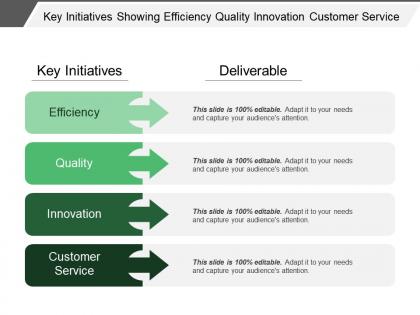
Key initiatives showing efficiency quality innovation customer service




Try Before you Buy Download Free Sample Product
 Impress Your
 Audience
 100%
100% Editable
 Save Hours
 of Time


It becomes a joy to bond due to our Key Initiatives Showing Efficiency Quality Innovation Customer Service. Introduce folks in a friendly environment.
People who downloaded this PowerPoint presentation also viewed the following :
Key initiatives showing efficiency quality innovation customer service with all 5 slides:
Examine the cause for incorrect calculations with our Key Initiatives Showing Efficiency Quality Innovation Customer Service. It helps address invalid claims.

FAQs for Key initiatives showing efficiency quality
Honestly, it usually comes down to three big things: how you're using your people and resources, whether your workflow actually makes sense, and if you're using the right tech. Half the time there's some weird old process everyone just follows without questioning why. Communication breakdowns between teams will absolutely wreck your efficiency too. Make sure people know what they're supposed to be doing - confused employees work super slowly. Oh, and don't forget training. I'd start by mapping out what you're currently doing and finding the biggest bottlenecks first. That'll show you where you're bleeding time.
Honestly, there are some solid tools that'll cut your prep time way down. Gamma and Beautiful.AI will auto-generate slides from just your outline - it's pretty wild how good they've gotten. Canva's templates are clutch too if you suck at design like me. ChatGPT helps when I'm stuck brainstorming key points. Mentimeter keeps people engaged without you doing extra work, which is nice. Oh, and cloud platforms beat those painful email feedback chains every time. I'd start with whatever bugs you most - usually it's either making slides look decent or figuring out what to actually say.
Honestly, training is a total game-changer for getting work done faster. Your team won't waste time stumbling around trying to figure stuff out. Confident employees move quicker - no more of that painful hesitation where people second-guess everything. Everyone starts using the same processes too, which cuts down on confusion big time. The cool part? Once someone's trained well, they'll naturally help teach others without you even asking. I'd focus on whatever's slowing you down most right now and train around that first. Way better ROI than trying to fix everything at once.
Honestly, good time management is a game changer for projects. Methods like time-blocking or that Eisenhower thing help you focus on what actually matters instead of spinning your wheels on busy work. You'll catch resource problems before they blow up, and your team stays on the same page with deadlines. The best part? When everyone uses similar approaches, coordination gets so much easier. I'd pick one method and stick with it for like two weeks - you'll definitely notice the difference. Also works way better than just winging it every day.
Honestly, just match the metrics to what each team actually does. Sales should track conversion rates and revenue per rep. Customer service? Response times and satisfaction scores work well. Manufacturing teams need throughput and defect rates - that stuff's pretty straightforward. HR gets tricky though, they love their abstract metrics but stick to time-to-hire and retention rates. Marketing can focus on cost per acquisition and campaign ROI. Don't get sucked into vanity metrics that look impressive but tell you nothing useful. Pick maybe 2-3 solid ones per department and actually stick with tracking them consistently.
Honestly, good design is like a shortcut for your brain. People process visual stuff way faster when you've got clear hierarchy and consistent layouts going on. Compare reading a dense paragraph versus looking at a clean infographic - no contest, right? Bad design makes everyone work twice as hard just figuring out what matters. I've sat through too many presentations where I'm squinting at messy slides instead of actually listening. Bottom line: organize your content visually upfront. Your audience will thank you because they can focus on your message instead of decoding visual chaos.
Honestly, getting different teams to work together from day one is a game changer. No more of that annoying back-and-forth where marketing doesn't know what engineering is doing (been there, it's painful). You'll cut out so much duplicate work and catch issues before they become disasters. Different perspectives actually help you solve stuff faster too. Set up a quick kickoff with everyone involved - sounds boring but trust me, it saves hours later. Oh, and make sure each team has one go-to person instead of playing telephone with five different people.
Ugh, the worst thing you can do is cram 47 bullet points on slides - literally no one reads that mess. Also test your tech! Can't tell you how many times I've watched someone fumble with the projector for 10 minutes. Don't try covering everything either - stick to 3 main points max. Reading straight off slides kills the vibe too. Have an actual conversation with people. I'm terrible about going off on random tangents (whoops), but you gotta find your way back somehow. Practice those transitions and definitely have a backup plan because tech will fail you.
Oh man, feedback loops are game-changers. Instead of finding out your project's totally off track three weeks later, you catch stuff early with regular check-ins and quick syncs. I learned this the hard way on a project that went completely sideways lol. Make feedback specific and frequent - don't wait for those dreaded quarterly reviews. Your team gets way better at fixing things themselves when everyone knows what's actually working. Honestly? Just start with a 15-minute "what's blocking us" meeting each week. You can always add more later.
Honestly, start with yourself - your team's watching how you handle deadlines and priorities. Give them clear expectations but also the actual tools to meet them (training matters more than people think). Check in regularly without being that annoying micromanager we've all had. When someone finds a clever shortcut or cuts out stupid processes, make a big deal about it. Recognition works way better than you'd expect. Oh, and create an environment where people can speak up about improvements without getting shut down. Nobody suggests anything when they're scared of looking dumb.
Dude, visual storytelling is a game changer for presentations. People absorb images crazy fast - like 60,000 times faster than text, which honestly blows my mind. But here's the thing: when you mix visuals with a story, your audience actually remembers what you said AND stays awake during your talk. No more glazed-over faces or awkward "wait, what?" moments. You'll cut down on those painful follow-up meetings too because people will get your point the first time around. My advice? Ditch the bullet points. Use simple diagrams or show before/after examples instead.
Dude, you gotta try Canva or Beautiful.ai - their templates are honestly magic. Just dump your content in and boom, looks professional. Gamma and Tome are wild too, they'll build entire presentations from like a bullet point list. I'm still kicking myself for not having this stuff during my brutal consulting years lol. Oh, and PowerPoint's Designer thing is actually decent now if you're already trapped in Microsoft hell. Pick one tool though and really learn it. Then make yourself 2-3 solid templates for different situations. Trust me, you'll never want to stare at a blank slide again.
So you know all that mindless clicking and copy-pasting you do every day? Workflow automation just takes care of that stuff automatically. Set it up once for things like data entry, email responses, moving files around - whatever's eating your time. I'd honestly start with just one super annoying task that drives you crazy, then build from there. Don't try to automate everything at once (learned that the hard way). Once you see how much time you actually get back, you'll probably kick yourself for not doing it sooner. Pretty life-changing honestly.
Test your tech first - trust me on this one. Mute everyone by default or you'll get that awful feedback loop. Send materials ahead of time so people aren't struggling to read your tiny shared screen. Honestly, attention spans are terrible online, so throw in polls or breakout rooms to wake everyone up. Record everything because someone always misses it. Actually, here's the real lifesaver: leave gaps between your back-to-back meetings. You'll feel way less frazzled jumping from call to call.
Slow decisions are productivity killers, honestly. Your team ends up sitting around waiting for approvals while projects just... stall out. I've watched entire weeks get wasted over basic decisions - it's painful to see. Here's what works: make reversible decisions fast, even if they're not perfect. You can always fix things later. The big, can't-undo-it decisions? Those deserve more time. But most choices aren't that serious. Set deadlines for decisions and actually stick to them. Otherwise you'll lose momentum while competitors sprint past you.
-
Professional and unique presentations.
-
Very unique, user-friendly presentation interface.