


Key pillars of total quality management




Try Before you Buy Download Free Sample Product
 Impress Your
 Audience
 100%
100% Editable
 Save Hours
 of Time


Our Key Pillars Of Total Quality Management are topically designed to provide an attractive backdrop to any subject. Use them to look like a presentation pro.
People who downloaded this PowerPoint presentation also viewed the following :
Content of this Powerpoint Presentation
Description:
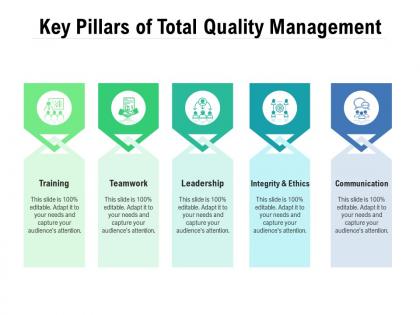
The image displays a PowerPoint slide titled "Key Pillars of Total Quality Management," which illustrates the fundamental components that underpin the Total Quality Management (TQM) approach. TQM is a comprehensive and structured approach to organizational management that seeks to improve the quality of products and services through ongoing refinements in response to continuous feedback.
Each pillar is represented by an icon and title:
1. Training:
Symbolized by a group of people and a bar chart, it emphasizes the need for continuous learning and improvement of skills within the organization.
2. Teamwork:
Depicted by a handshake, it underscores the importance of collaboration and working together to achieve quality objectives.
3. Leadership:
Illustrated by a person in front of a group, highlighting the role of leaders in driving quality initiatives and fostering a quality culture.
4. Integrity & Ethics:
Represented by a balance scale, stressing the importance of ethical practices and integrity as the foundation of quality.
5. Communication:
Indicated by speech bubbles, signifying the essential role of clear and effective communication in TQM.
Use Cases:
The principles of TQM are universally applicable across many industries:
1. Healthcare:
Use: Enhancing patient care and safety.
Presenter: Quality Assurance Manager
Audience: Medical staff, hospital administrators
2. Manufacturing:
Use: Improving product quality and production efficiency.
Presenter: Operations Manager
Audience: Production teams, quality control engineers
3. Education:
Use: Elevating teaching standards and student satisfaction.
Presenter: Academic Director
Audience: Educators, institutional leaders
4. Hospitality:
Use: Delivering exceptional service and guest experience.
Presenter: Service Quality Trainer
Audience: Hotel staff, management teams
5. Information Technology:
Use: Ensuring software and service quality.
Presenter: Quality Assurance Lead
Audience: IT professionals, project managers
6. Automotive:
Use: Driving quality across the supply chain and vehicle manufacturing.
Presenter: Quality Control Supervisor
Audience: Assembly line workers, suppliers
7. Retail:
Use: Providing high-quality customer service and product offerings.
Presenter: Retail Operations Manager
Audience: Store managers, customer service teams
Key pillars of total quality management with all 2 slides:
Use our Key Pillars Of Total Quality Management to effectively help you save your valuable time. They are readymade to fit into any presentation structure.
FAQs for Key pillars of
Look, TQM is pretty straightforward once you get past all the corporate jargon. Customer focus is huge - literally everything revolves around what they want. Then you've got continuous improvement and getting your whole team involved. I know it sounds like management speak, but the "everyone owns quality" approach honestly works better than you'd think. Process mapping, fact-based decisions, integrated systems - all that matters too. Leadership has to be all-in from day one or it falls apart. Oh, and communication can't suck. Start by figuring out your current processes, then ask customers what they actually care about. That's your baseline right there.
Look, you gotta get everyone bought into caring about quality - from you down to whoever just started last week. Work backwards from what customers actually want instead of guessing. Track metrics that tell you something useful, not just pretty dashboards that make you feel important. Here's the thing though - small businesses can actually change direction way faster than big companies when stuff isn't working. Do regular check-ins with your team about what's going well and what sucks. Oh, and don't forget to celebrate small wins or people burn out.
Dude, leadership makes or breaks TQM - no question. Your leaders can't just preach quality, they need to actually live it when making decisions and budgeting. Create an environment where people feel safe calling out problems without getting thrown under the bus. Middle management will probably push back hard since TQM messes with their traditional power structure (been there). But once leaders start joining quality circles and celebrating process wins instead of just end results? That's when things click. Oh, and train your leadership team first - like, before anyone else. Otherwise you're setting everyone up to fail.
So TQM really works when your employees actually give a damn about quality, not just management preaching about it. Give people the power to fix stuff when they see problems - they're the ones doing the work daily anyway. Honestly, micromanaging kills motivation faster than anything. Your frontline team spots issues way before executives do, and they usually have decent ideas for solutions too. The trick is giving them both responsibility AND the actual authority to make changes. Oh, and don't forget the tools/training they need. Start by asking what's frustrating them most.
You'll want to grab a few key tools - start with SPC charts and Pareto analysis. Control charts track how your process changes over time, which is super helpful. Pareto charts? They show you exactly which problems are worth fixing first (honestly wish I'd learned these sooner). Check sheets work great for collecting data, and histograms help you see patterns in everything. Scatter diagrams are clutch for spotting correlations too. Oh, and fishbone diagrams - perfect for digging into root causes when things go sideways. Don't try using all of them right away though. Pick maybe 2-3 to start with or you'll just confuse everyone.
So customer satisfaction is like your compass for TQM - tells you exactly where to focus. Their feedback shows you which processes are broken and need fixing first. Honestly, customers don't sugarcoat anything, which is actually helpful even when it stings. You'll want to set up real systems to collect their input, then use that data to figure out your quality standards and priorities. The trick is actually doing something with the feedback instead of just filing it away somewhere. It becomes this cycle where unhappy customers point you toward the improvements that'll make the biggest difference.
So TQM flips the whole "inspect and reject" thing on its head. You're preventing problems instead of catching them later, which honestly makes way more sense. Everyone gets involved, not just the quality team. Old methods were super reactive - something breaks, you fix it. This approach is proactive across your whole company. Yeah, it's more work upfront, but you'll actually save time long-term. Focus shifts to continuous improvement rather than just hitting bare minimum standards. Customer satisfaction becomes huge. Start by figuring out where your quality issues actually come from - that's your roadmap right there.
Honestly, the resistance to change is brutal - people hate giving up their old ways. Cultural shifts take forever too. Training costs will hit you hard upfront, plus all the process redesigns and new systems. Leadership has to stay committed for years, which gets tricky when they're worried about next quarter's numbers. Oh, and the paperwork... so much documentation and measuring everything. I'd probably start with just one department first? See if it actually works before going crazy with the whole company. Way less risky that way.
Data analytics tools are your best friend for catching quality issues early. Automated monitoring tracks everything in real-time, which honestly saves so much headache later. Those digital dashboards? Total game-changer for meetings - way better than drowning in spreadsheets. Workflow automation cuts down on human error big time. Cloud systems let everyone access docs from anywhere (super helpful if you've got remote team members). Oh, and don't try to do everything at once - pick one thing like automated data collection first, then expand from there.
TQM without continuous improvement is like having a car that never gets tune-ups - you're just waiting for it to break down. Small tweaks beat massive overhauls every time. Your processes stay fresh, problems get caught early, and honestly? It's way less stressful than scrambling to fix things after they fall apart. Pick something your team does every single day and figure out how to make it just 1% better this week. That's literally it. Those tiny changes stack up faster than you'd think. It's the difference between coasting and actually moving forward.
Honestly, cross-functional teams work so well for TQM because they smash those department walls that always seem to get in the way. You grab people from production, sales, engineering, quality - whoever - and suddenly you're getting perspectives you'd never think of otherwise. They can spot root causes and actually fix stuff across departments without waiting forever for approvals. It's pretty cool when your marketing guy finally gets why manufacturing has to do things a certain way, you know? Oh, and don't try to overhaul everything at once - just start small teams focused on specific problems.
So TQM flips your whole company culture - everyone stops settling for "good enough" and starts obsessing over improvement. People actually take ownership instead of just dumping problems on their boss. Departments quit fighting each other since they're all chasing the same quality goals. Your team gets addicted to data instead of making random decisions based on office politics (which honestly is refreshing). They'll constantly ask "how do we make this better?" The trick? Leadership has to go first. Culture shifts always trickle down from the top.
Yeah, TQM totally works for services! Map out your customer's whole experience first - find where things go wrong. Then train your staff to actually fix issues themselves instead of passing everything up to managers. This restaurant I know lets servers comp meals right away if there's a problem, which is honestly brilliant. Since you're not dealing with physical products, you'll track stuff like how fast you respond to customers and satisfaction scores rather than defect rates. Get feedback from customers AND your frontline people. The real game-changer is giving your team authority to solve problems immediately.
Honestly, focus on customer satisfaction scores, defect rates, and how engaged your employees are - those three paint the real picture. Cycle times and cost savings matter too, obviously. But here's what I've noticed: companies get way too caught up in measuring every little thing and lose sight of what actually matters. The best part is when continuous improvement just becomes second nature - people start suggesting fixes on their own, departments actually work together (crazy concept, right?), and complaints drop off. My advice? Pick maybe 3-4 metrics that align with your goals instead of drowning in data.
So TQM and sustainability actually work super well together. Both focus on continuous improvement and thinking about all your stakeholders. You're already looking at waste reduction and process efficiency with TQM - that's basically sustainability 101. The customer-first approach? It naturally expands to considering your environmental impact on the community too. Honestly, I think companies miss this connection way too often. Short sentences work. The trick is building sustainability metrics right into your quality tracking from day one. That way you're improving both traditional quality stuff and environmental performance at the same time.
-
It saves your time and decrease your efforts in half.
-
Professional and unique presentations.
-
Great designs, Easily Editable.
-
Really like the color and design of the presentation.
-
Awesome use of colors and designs in product templates.