


Project quality management ppt picture





Try Before you Buy Download Free Sample Product
 Impress Your
 Audience
 100%
100% Editable
 Save Hours
 of Time


Face the gale calmly with our Project Quality Management Ppt Picture. They can take the brunt of the force.
People who downloaded this PowerPoint presentation also viewed the following :
Content of this Powerpoint Presentation
Description:
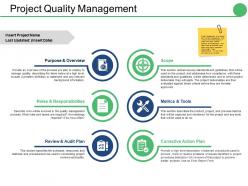
The image provided appears to be a slide from a presentation template for Project Quality Management. The template is designed to guide project managers or teams in establishing quality management protocols for their projects.
The template is divided into several key sections:
1. Purpose & Overview:
Here, the user is prompted to detail the high-level process for managing quality within the project, including problem definitions and background information.
2. Roles & Responsibilities:
This section is intended to outline the key stakeholders involved in the quality management process, detailing their specific roles and responsibilities, and specifying the requirement and frequency of meetings.
3. Scope:
In this segment, the user must reference the applicable standards and guidelines, explain how compliance will be assured, how these standards will apply to different project deliverables, and the criteria for their evaluation.
4. Metrics & Tools:
Users need to describe the metrics for the product, project, or process that will be monitored, as well as the tools that will be used for this monitoring.
5. Review & Audit Plan:
This part of the template specifies the schedule, resources, and methods that will be used to conduct project reviews and audits.
6. Corrective Action Plan:
Here, the user must provide a description of the procedures planned for addressing any issues that arise during project quality reviews, including preventive measures and resolutions.
Use Cases:
Given the comprehensive nature of this project management template, it can be utilized across various industries to ensure the quality standards of projects are upheld.
1. Construction:
Use: Quality control of construction projects.
Presenter: Quality Assurance Manager.
Audience: Construction project team.
2. Software Development:
Use: Maintaining software quality standards.
Presenter: Lead Software Engineer/Project Manager.
Audience: Developers and Quality Assurance professionals.
3. Manufacturing:
Use: Implementing quality checks in production.
Presenter: Production Manager.
Audience: Production staff and supervisors.
4. Healthcare:
Use: Ensuring quality of healthcare service delivery.
Presenter: Healthcare Administrator/Quality Manager.
Audience: Medical staff and hospital management.
5. Education:
Use: Quality management for educational programs.
Presenter: Academic Director.
Audience: Educators and administrative staff.
6. Automotive:
Use: Quality assurance for automotive design and manufacturing.
Presenter: Quality Control Engineer.
Audience: Engineering team and production line workers.
7. Aerospace:
Use: Managing quality in aerospace project deliverables.
Presenter: Aerospace Quality Assurance Specialist.
Audience: Project team, including engineers and technicians.
Project quality management ppt picture with all 5 slides:
Our Project Quality Management Ppt Picture will draw everyone to you for advice. You will emerge as a go to consultant.



FAQs for Project quality
Key components of a Project Quality Management plan include quality planning, quality assurance, quality control, quality metrics, stakeholder requirements, and continuous improvement processes. These components work together by establishing clear standards, monitoring deliverables throughout project lifecycles, and ensuring stakeholder expectations are met, with many organizations finding that structured quality frameworks ultimately deliver reduced rework costs and enhanced client satisfaction.
Quality standards for a specific project are defined through stakeholder requirement analysis, industry compliance research, performance benchmarking, acceptance criteria development, and measurable quality metrics establishment. These standards enable project teams to streamline deliverable assessments, enhance stakeholder satisfaction, and minimize rework costs, with many organizations finding that clearly defined quality parameters ultimately deliver faster project completion and stronger competitive positioning.
Stakeholder feedback provides essential insights into quality expectations, identifies gaps between deliverables and requirements, and ensures alignment with business objectives throughout the project lifecycle. Through regular feedback loops, project teams can address issues early, minimize costly rework, and enhance final outcomes, with many organizations finding that structured stakeholder engagement ultimately delivers higher satisfaction rates and competitive advantage.
Measuring project deliverables quality involves establishing clear acceptance criteria, conducting systematic reviews, implementing testing protocols, tracking defect rates, and gathering stakeholder feedback throughout development cycles. These quality assurance methods enable organizations to identify issues early, reduce rework costs, and enhance customer satisfaction, with many project teams finding that consistent measurement frameworks ultimately deliver higher success rates and stronger competitive positioning.
Quality assurance techniques include quality audits, process checklists, peer reviews, statistical sampling, and compliance assessments. These methods enhance project outcomes by identifying defects early, standardizing workflows, and ensuring adherence to requirements, with many organizations finding that systematic quality assurance reduces rework costs while accelerating delivery timelines.
Risk management intersects with project quality management by identifying potential quality threats, implementing preventive controls, and establishing contingency measures to maintain standards. Through proactive risk assessment, project teams anticipate quality failures, allocate resources strategically, and develop mitigation strategies, ultimately delivering consistent outcomes while minimizing costly rework and delays.
Continuous improvement in project quality ensures systematic enhancement of processes, deliverables, and outcomes throughout the project lifecycle, ultimately reducing defects, minimizing rework, and strengthening client satisfaction. This approach enables organizations to identify inefficiencies early, implement corrective measures proactively, and build robust quality frameworks, with many companies finding that iterative refinements deliver competitive advantage and operational excellence.
Integrating quality management into Agile involves embedding continuous testing, regular code reviews, automated quality checks, and cross-functional collaboration throughout each sprint cycle. These practices enhance product reliability by catching defects early, streamlining deployment processes, and maintaining consistent standards, with many software development teams finding that this integration accelerates delivery while significantly reducing post-release issues.
Quality control tools include statistical sampling, inspection checklists, control charts, Pareto analysis, and cause-and-effect diagrams. These techniques streamline defect identification, enhance process monitoring, and minimize rework costs, with many project teams finding that systematic quality control delivers faster project completion, reduced operational expenses, and significantly improved stakeholder satisfaction.
Cultural differences impact project quality management through varying communication styles, quality standards interpretations, decision-making processes, and feedback approaches across global teams. Organizations increasingly address these challenges by implementing standardized quality frameworks, cultural awareness training, and collaborative platforms, with many multinational companies finding that diverse perspectives ultimately enhance quality outcomes while requiring strategic cross-cultural coordination and clear communication protocols.
Large-scale project quality challenges include resource coordination across multiple teams, maintaining consistent standards throughout extended timelines, managing complex stakeholder expectations, ensuring effective communication channels, and scaling quality control processes. These projects require strategic quality frameworks, automated monitoring systems, and standardized protocols, with many organizations finding that early quality investment ultimately delivers reduced costs, faster delivery, and stronger competitive positioning.
Ensuring compliance involves establishing clear quality frameworks, conducting regular audits, implementing standardized processes, maintaining detailed documentation, and training team members on regulatory requirements. Through systematic quality controls and continuous monitoring, organizations in healthcare, finance, and manufacturing streamline compliance verification, reduce regulatory risks, and deliver consistent project outcomes, ultimately achieving operational excellence while meeting industry standards.
Essential project quality metrics include defect density rates, customer satisfaction scores, requirement compliance percentages, rework costs, and delivery accuracy measurements. These metrics enable project managers to identify performance gaps, optimize resource allocation, and enhance delivery standards, with many organizations finding that systematic quality tracking reduces costs while improving client relationships and competitive positioning.
Training and development enhance project quality management by equipping teams with quality assurance methodologies, risk assessment techniques, and standardized processes for consistent deliverables. Through targeted programs, organizations streamline quality control workflows, reduce defect rates, and accelerate project timelines, with many teams finding that structured training ultimately delivers improved client satisfaction and competitive advantage in project execution.
Common pitfalls in project quality management include inadequate quality planning, insufficient testing protocols, poor communication between teams, lack of stakeholder involvement, and reactive rather than proactive quality control measures. These challenges can be avoided by establishing clear quality standards early, implementing continuous monitoring systems, and fostering cross-functional collaboration, with many organizations finding that integrated quality frameworks ultimately deliver reduced rework costs and enhanced project outcomes.
-
Unique design & color.
-
Professional and unique presentations.