


Quality management system objective manual procedure guideline




Try Before you Buy Download Free Sample Product
 Impress Your
 Audience
 100%
100% Editable
 Save Hours
 of Time


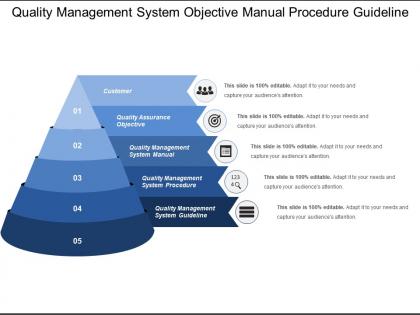
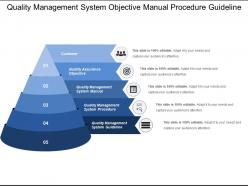
Introducing Quality Management System Objective Manual Procedure Guideline slideshow. You can describe the quality management system of the organization by using this PPT layout. Showcase the information which should be included the QMS such as organization's goals, expectations, policies, and more with the aid of this quality manual PowerPoint slideshow. Also, present the seven quality management principles. Showcase the strategies that determine the place of the company's products on the market. Demonstrate the activities of quality management which include quality planning, quality control, quality improvement, etc. Help to coordinate and direct an organization's activities to meet customer and regulatory requirements with this QMS PPT template. Create a strategic and systematic approach to management with the aid of the quality assurance PowerPoint infographic. If you wish to decrease your workload it is highly recommended that you download and use this set of slides and grab the attention of everybody who views it. Hence, without any further delay download, this professionally designed quality improvement PPT presentation.
People who downloaded this PowerPoint presentation also viewed the following :
Quality management system objective manual procedure guideline with all 5 slides:
Enthrall the hall with our Quality Management System Objective Manual Procedure Guideline. Every one's face will express delight.

FAQs for Quality management system objective
Honestly, start by mapping what you're already doing - that's way easier than building from scratch. You'll need solid process docs, clear quality goals, and regular management check-ins. Internal audits are a pain but super necessary, plus good training programs for your team. When stuff breaks (and it definitely will), having a strong corrective action system saves your butt. Don't forget customer feedback loops - can't fix what you can't see. Oh, and bake risk management into everything from day one. If you're going ISO 9001 route, nail the basics first before getting fancy with complicated stuff.
So basically a QMS helps you deliver what customers actually want consistently. You'll catch issues before they hit your customers, which is huge. It standardizes processes so there's way less random variability - honestly, this alone saves so much headache. Plus you get feedback loops for complaints and suggestions. The documentation part is annoying but super useful because you can repeat what works and stop making the same mistakes. Customers get more reliable stuff, faster fixes when things go wrong, and they feel heard. I'd start by just mapping where you touch customers now and spot the quality gaps.
Honestly, continuous improvement is what stops your QMS from turning into one of those dead binders collecting dust. You're always gathering data and tweaking things that aren't working right. Most frameworks already have this stuff baked in - audits, corrective actions, management reviews, the whole deal. Pick something small that's been annoying you and just track basic metrics for a month. Nothing fancy. The key is making those little incremental changes rather than letting everything stay static. Otherwise you'll end up with outdated procedures that nobody actually follows anyway.
So there's two main ways to tackle this - numbers and feedback. Defect rates, customer complaints, audit results, process times - track whatever shows if quality's actually getting better. Customer surveys are gold since they're living with your quality every day. Oh, and don't sleep on internal stuff like training completion and how fast you close corrective actions. Honestly, most companies just hoard data without looking at trends. Pick maybe 3-5 metrics that actually matter to your business goals and review them monthly. That's where you'll see real progress.
Honestly, people will fight you on this every step of the way - nobody wants to learn new systems when the old ones "work fine." Getting money approved upfront is brutal too. Documentation turns into chaos because Sarah formats everything different from Mike, you know? Then you've got integration headaches with whatever ancient software you're already using. Training drags on forever. But here's what actually works: pick one small area to test it out first. Get some quick wins so you can wave them around at meetings. Find someone in each department who's actually excited about it and make them your inside person. Way easier than forcing it on everyone at once.
Honestly, tech is a game-changer for all that boring compliance stuff. Automated workflows handle approvals without you chasing people down constantly. Real-time dashboards show your KPIs, and digital signatures save you from drowning in paperwork (seriously, who has time for that anymore?). Everything syncs between systems so you're not doing data entry a million times. Cloud platforms mean your team can work from anywhere - super helpful for audits. Mobile apps make field work way smoother too. I'd start by figuring out what wastes most of your time, then find tools that fix those specific headaches first.
So ISO 9001 is like the basic quality standard that works for everyone - think of it as your foundation. Then you've got all these specialized ones on top: ISO 13485 for medical stuff, AS9100 for aerospace, ISO/TS 16949 for automotive. The specialized versions pile on extra requirements like stricter traceability and regulatory stuff that ISO 9001 doesn't cover. Honestly, if you're not in a heavily regulated industry, you might never need the fancy ones. I'd definitely start with 9001 first since it covers the core quality management basics - customer satisfaction, continuous improvement, all that good stuff. You can always add the specialized standard later if your industry demands it.
Skip the boring PowerPoint approach - nobody retains that stuff anyway. Make it hands-on with real examples from your actual workplace. Show them how quality processes connect to what they're already doing daily. Interactive workshops work way better than lectures, and honestly? Pairing newbies with QMS champions who can mentor them is clutch. Always explain the "why" behind each process, not just the mechanical steps. People need to understand the purpose or they'll just go through the motions. Don't forget follow-up sessions - questions always pop up once they start actually using this stuff.
You're gonna need both hard numbers and softer feedback to really see what's happening. Customer satisfaction scores are obvious, but also track defect rates and how well your corrective actions actually work. Process cycle times matter too - plus employee training rates and cost of quality stuff. Oh, and definitely watch your supplier metrics since they can totally mess up your quality if they're slipping. Honestly, I'd start with maybe 5-7 core ones that actually matter to your specific business. You can always add more later once you've got those running smoothly.
So a QMS is basically your roadmap for staying compliant across whatever industry you're in. You get all your processes documented, compliance stuff tracked, and those audit trails that inspectors always want to see. Works for pharma, aerospace, food safety - doesn't matter. Maps right to FDA regs, ISO standards, whatever you need. Honestly? It's a game-changer during audits because you're not scrambling around looking for paperwork. The trick is building compliance into your daily workflow instead of treating it like some separate thing you deal with later. Way less stressful that way.
So documentation is like the spine of your whole QMS - without it, everything falls apart. You'll need it for auditors obviously, but honestly it's a lifesaver for onboarding new people too. Nobody wants to answer the same basic questions fifty times, right? Focus on procedures, work instructions, records, all that stuff. When processes break (and they will), having docs means you can actually figure out what went wrong. My advice? Start with your most critical stuff first. Don't try to document everything at once or you'll burn out. Build it piece by piece.
Your QMS has to work for the people actually using it - customers, regulators, employees, suppliers. Start by talking to them directly about what they need. Don't just assume you know. Map their requirements to your processes, then set objectives that match their priorities. It's like building a house - design it for who's living there, not what sounds impressive. Create controls so you deliver consistently. I learned this the hard way when we built our system backwards and had to redo half of it. Get stakeholder input first, trust me.
Look, your QMS should grow with your company - don't treat it like some set-in-stone rulebook. When you restructure or launch new stuff, just update your processes and docs accordingly. Build change management into your quality procedures right from day one. I've honestly seen too many companies get stuck with rigid systems that become a nightmare later. Map out which processes you'd need to tweak if big changes happen. Also, regularly review your quality objectives so they actually match what your business is doing now. Adaptability isn't a weakness here - it's what makes the whole thing work.
Honestly, the waste reduction hits your bottom line fast - way less rework and defects right off the bat. Labor costs per unit drop because everything runs smoother. You'll dodge those brutal audit failures too (seriously, those can destroy a quarter). Customers notice when quality stays consistent, so retention gets better. Most companies I've seen break even around 12-18 months, sometimes faster depending on how messy things were before. Oh, and definitely track your current waste costs now so you can actually prove the ROI later.
So basically, a QMS spreads quality ownership across your whole team instead of dumping it all on one department. People get clear processes showing exactly what good work looks like. Training helps too - can't hit standards if nobody knows what they are, right? The feedback loops are honestly the best part though. When people see how their work affects customer satisfaction scores, they actually start caring. Regular audits keep quality front-of-mind rather than forgotten until crisis mode hits. Oh, and get your leadership visibly involved first - sends the message that quality isn't just corporate fluff.
-
Use of icon with content is very relateable, informative and appealing.
-
I discovered this website through a google search, the services matched my needs perfectly and the pricing was very reasonable. I was thrilled with the product and the customer service. I will definitely use their slides again for my presentations and recommend them to other colleagues.