


Quality planning in project management powerpoint presentation slides





Try Before you Buy Download Free Sample Product
 Impress Your
 Audience
 100%
100% Editable
 Save Hours
 of Time


Introducing Quality Planning In Project Management PowerPoint Presentation Slides. Showcase the information regarding the quality standards to manage overall quality using the project quality management PowerPoint slideshow. Our content-ready project management PowerPoint visuals contain detail about various quality control initiatives, product checklist, assurance, and control log, and assurance issues reporting plan. Quality management plan and Gantt chart help you provide detailed information about product development, design, and testing. Ensure consistent quality by showcasing various quality-related initiatives, and assurance checklist. Discuss in a tabular form how product quality issues are addressed in the firm. Information regarding the project inspection checklist can be easily displayed using this PPT template. Present the key quality management tools, weekly quality defect occurrence with checksheet, process tracking with control chart by easily downloading our professionally designed project quality PPT slide deck.
People who downloaded this PowerPoint presentation also viewed the following :
Content of this Powerpoint Presentation
Slide 1: This is the title slide for Quality Planning in Project Management. Just add Your Company Name to get started.
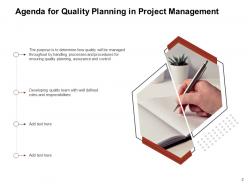
Slide 2: This slide shows the Agenda for Quality Planning in Project Management covering points such as The purpose is to determine how quality will be managed throughout by handling processes and procedures for ensuring quality planning, assurance, and control and Developing quality teams with well-defined roles and responsibilities.
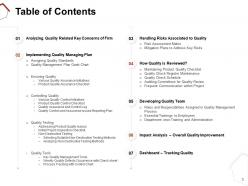
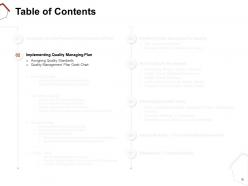
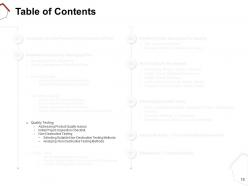
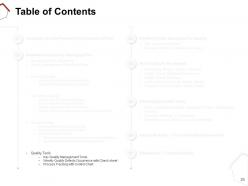
Slide 3: This is the Table of Contents slide with pointers including Analyzing Quality-Related Key Concerns of Firm, Implementing Quality Managing Plan, Handling Risks Associated to Quality, How Quality is Reviewed, Developing Quality Team, Impact Analysis – Overall Quality Improvement, and Dashboard – Tracking Quality.
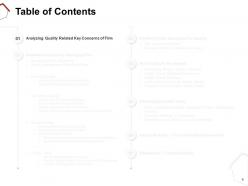
Slide 4: This slide introduces the Analyzing Quality-Related Key Concerns of Firm section of the Table of Contents.
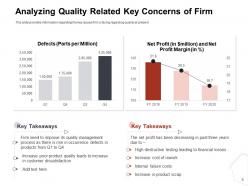
Slide 5: This slide shows the Analyzing Quality-Related Key Concerns of Firm with defects and net profit margin along with key takeaways.
Slide 6: This slide introduces the Implementing Quality Managing Plan section of this presentation with two sub-topics Assigning Quality Standards, and Quality Management Plan Gantt Chart.
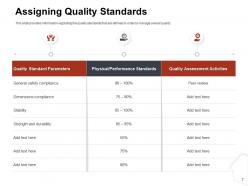
Slide 7: This slide shows the Assigning Quality Standards covering the Quality standard parameters, physical/performance standards, and quality assessment activities.
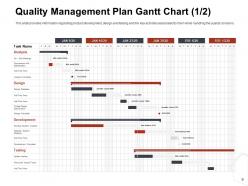
Slide 8: This slide displays the Quality Management Plan Gantt Chart in a tabulated format.
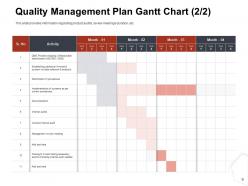
Slide 9: This is a continuation slide for Quality Management Plan Gantt Chart with activities for four months.
Slide 10: This slide covers the Ensuring Quality section of this deck with two sub-topics including Various Quality Assurance Initiatives, and the Product Quality Assurance Checklist.
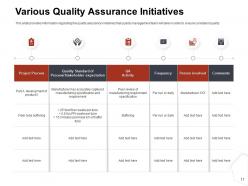
Slide 11: This slide shows the Various Quality Assurance Initiatives that the quality management team will take in order to ensure consistent quality.
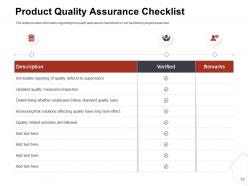
Slide 12: This slide displays the Product Quality Assurance Checklist which will be filled by the project supervisor.
Slide 13: This slide introduces the Controlling Quality section of this presentation with four subheadings including Various Quality Control Initiatives, Product Quality Control Checklist, Quality Assurance, and Control Log, and Quality Control and Assurance Issues Reporting Plan.
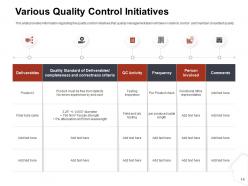
Slide 14: This slide displays the Various Quality Control Initiatives that the quality management team will take in order to control and maintain consistent quality.
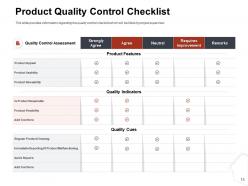
Slide 15: This slide showcases the Product Quality Control Checklist which will be filled by the project supervisor.
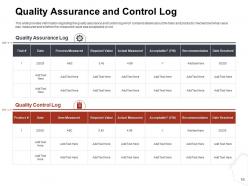
Slide 16: This slide shows the Quality Assurance and Control Log which contains details about the trials and products checked and what value was measured and whether the measured value was acceptable or not.
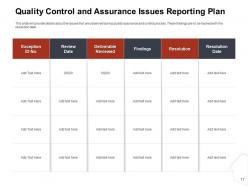
Slide 17: This slide presents the Quality Control and Assurance Issues Reporting Plan that will provide details about the issues that are observed during the quality assurance and control process. These findings are to be tracked with the resolution date.
Slide 18: This slide introduces the Quality Tools division of this presentation with three subheadings such as Key Quality Management Tools, Weekly Quality Defects Occurrence with Check sheet, and Process Tracking with Control Chart.
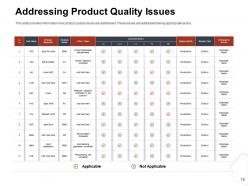
Slide 19: This slide shows the Addressing Product Quality Issues in a tabulated format.
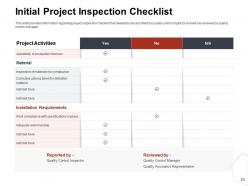
Slide 20: This slide displays the Initial Project Inspection Checklist with yes, no, and NA options.
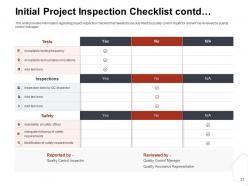
Slide 21: This slide is a continuation of the Initial Project Inspection Checklist that needed to be duly filled by the quality control inspector and will be reviewed by the quality control manager.
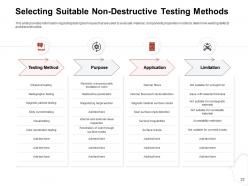
Slide 22: This slide covers the Selecting Suitable Non-Destructive Testing Methods with Limitation, Application, Purpose, and Testing Method.
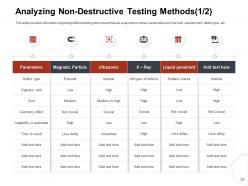
Slide 23: This slide shows Analyzing Non-Destructive Testing Methods covering parameters such as cost, operator skill, defect type, etc.
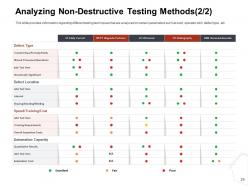
Slide 24: This slide is the continuation of Analyzing Non-Destructive Testing Methods in a tabular format.
Slide 25: This slide introduces the Quality Tools division of this presentation with three subheadings such as Key Quality Management Tools, Weekly Quality Defects Occurrence with Check sheet, and Process Tracking with Control Chart.
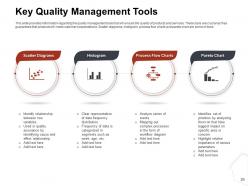
Slide 26: This slide displays the Key Quality Management Tools such as Scatter Diagrams, Histogram, Process Flow Charts, and Pareto Chart.
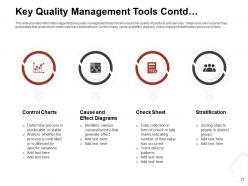
Slide 27: This slide is a continuation of Key Quality Management Tools with Control Charts, Cause and Effect Diagrams, Check Sheet, and Stratification.
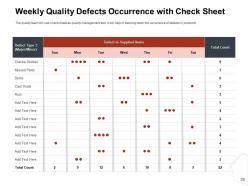
Slide 28: This slide shows the Weekly Quality Defects Occurrence with Check Sheet with a detailed table.
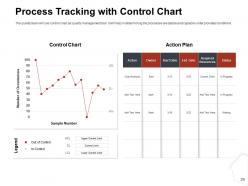
Slide 29: This slide displays the Process Tracking with Control Chart and Action Plan.
Slide 30: This slide introduces the Handling Risks Associated to a Quality section of this presentation with two subtopics including Risk Assessment Matrix, and Mitigation Plans to Address Key Risks.
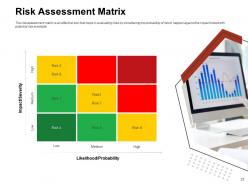
Slide 31: This slide shows the Risk Assessment Matrix for Likelihood/Probability with respect to Impact/Severity.
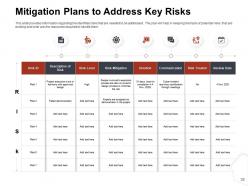
Slide 32: This slide displays the Mitigation Plans to Address Key Risks. The plan will help in keeping the track of potential risks that are existing and what are the resources required to handle them.
Slide 33: This slide introduces the How Quality is Reviewed section of this deck with five sub-topics such as Maintaining Product Quality Checklist, Quality Check Register Maintenance, Quality Check Schedule, Auditing Committees for Quality Review, and Frequent Communication within Project.
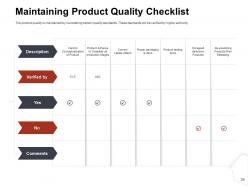
Slide 34: This slide shows the Maintaining Product Quality Checklist with Description, Verified by, Yes, No, and Comments.
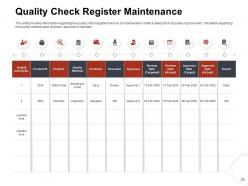
Slide 35: This slide displays the Quality Check Register Maintenance in order to keep track of quality improvement. The details regarding the quality method used, reviewer, the approver are reported.
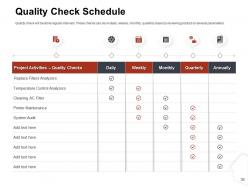
Slide 36: This slide showcases the Quality Check Schedule. These checks can be on a daily, weekly, monthly, quarterly basis by reviewing products on several parameters.
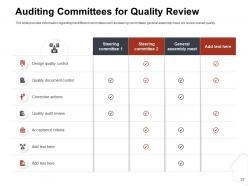
Slide 37: This slide presents Auditing Committees for Quality Review regarding the different committees such as steering committees, general assembly meet, will review overall quality.
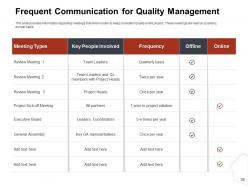
Slide 38: This slide details the Frequent Communication for Quality Management for meetings that are held in order to keep consistent quality entire project. These meetings are held on a quarterly, annual basis.
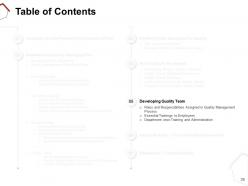
Slide 39: This slide covers the Developing Quality Team division of the table of content with three sun-topics such as Roles and Responsibilities Assigned in Quality Management Process, Essential Training to Employees, and Department wise Training and Administration.
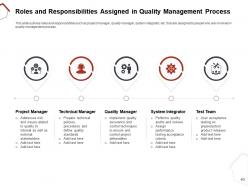
Slide 40: This slide shows the Roles and Responsibilities Assigned in Quality Management Process with the Project Manager, Technical Manager, Quality Manager, System Integrator, and Test Team.
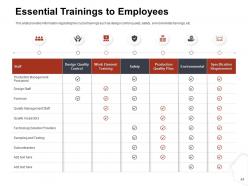
Slide 41: This slide displays the Essential Training to Employees such as design control quality, safety, environmental training, etc.
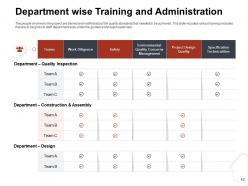
Slide 42: This slide shows the Department-wise Training and Administration. The people involved in the project are trained and notified about the quality standards that needed to be achieved. This slide includes various training modules that are to be given to staff department-wise under the guidance of the project supervisor.
Slide 43: This slide introduces the Impact Analysis – Overall Quality Improvement section of this presentation.
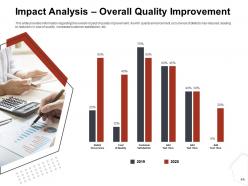
Slide 44: This slide presents the Impact Analysis – Overall Quality Improvement. As with quality enhancement, the occurrence of defects has been reduced, leading to a reduction in the cost of quality, increased customer satisfaction, etc.
Slide 45: This slide introduces the Dashboard – Tracking Quality.
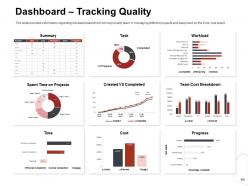
Slide 46: This slide shows the Dashboard for Tracking Quality with Summary, Task, Workload, Spent Time on Projects, Created VS Completed, Team Cost Breakdown, Time, Cost, and Progress.
Slide 47: This slide shows the additional Icons for Quality Planning in Project Management.
Slide 48: This slide shows the Additional Slides provided with this presentation layout.
Slide 49: This is the About Us slide covering Preferred by Many, Values Client, and Target Audiences.
Slide 50: This slide shows the Our Mission section with Vision, Mission, and Goal.
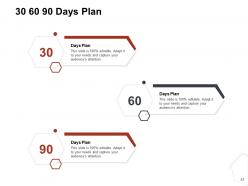
Slide 51: This is the 30 60 90 Days Plan slide to showcase your project progression.
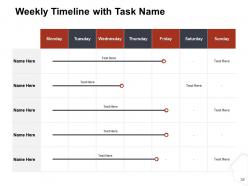
Slide 52: This slide presents the Weekly Timeline with Task Name.
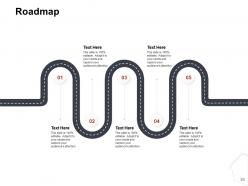
Slide 53: This is the Roadmap slide with five stages and dedicated text boxes.
Slide 54: This is the thank You slide with your company's Address, Contact Numbers, and Email Address.
Quality planning in project management powerpoint presentation slides with all 54 slides:
Use our Quality Planning In Project Management Powerpoint Presentation Slides to effectively help you save your valuable time. They are readymade to fit into any presentation structure.




FAQs for Quality planning in project management
Key components of an effective quality planning process include quality objectives setting, resource allocation, risk assessment, process mapping, and performance measurement frameworks. These elements work together by establishing clear standards, identifying potential issues early, and creating accountability structures, with many organizations finding that this systematic approach ultimately delivers improved customer satisfaction, reduced operational costs, and sustained competitive advantage.
Quality objectives are defined by translating organizational goals into specific, measurable quality targets that address customer requirements, operational efficiency, and strategic priorities. This alignment process involves cross-functional collaboration between leadership, quality teams, and operational departments, ensuring objectives support broader business outcomes like market expansion, cost reduction, and customer satisfaction, while establishing clear metrics and accountability frameworks.
Stakeholders provide critical insights into quality requirements, expectations, and constraints that shape comprehensive quality planning strategies. Through structured interviews, surveys, workshops, and collaborative review sessions, organizations can systematically gather stakeholder input, ensuring quality standards align with business objectives, customer needs, and operational capabilities, ultimately delivering enhanced products and stronger stakeholder satisfaction.
Risk management integrates into quality planning through comprehensive risk assessments, preventive control identification, contingency protocol development, and quality standard alignment with potential failure points. Through systematic risk mapping and mitigation strategies, organizations streamline quality processes, minimize costly defects, and enhance operational reliability, ultimately delivering consistent outcomes and competitive advantage in increasingly demanding markets.
Effective quality planning tools include quality management plans, process flowcharts, statistical process control charts, failure mode analysis, and benchmarking frameworks. These methodologies streamline project outcomes by establishing clear standards, identifying potential issues early, and enabling continuous monitoring, with organizations across manufacturing, healthcare, and software development finding that systematic quality planning reduces rework costs while delivering superior client satisfaction.
Success in quality planning initiatives is measured through key performance indicators like defect reduction rates, customer satisfaction scores, process efficiency improvements, and cost savings achieved. Organizations typically track these metrics quarterly, with manufacturing companies finding that comprehensive quality planning delivers 15-30% fewer defects, faster production cycles, and enhanced customer retention, ultimately providing measurable competitive advantage.
Technology enhances quality planning through automation tools, data analytics, predictive modeling, digital workflow management, and real-time monitoring systems. These technologies streamline planning by eliminating manual errors, accelerating data collection, and enabling proactive quality controls, with many manufacturing and healthcare organizations finding that integrated digital platforms deliver faster compliance, reduced costs, and enhanced operational efficiency.
Changes in project scope should be managed through systematic quality impact assessments, revised quality standards alignment, stakeholder communication protocols, and updated testing procedures. This integrated approach enables organizations to maintain quality consistency while accommodating scope modifications, with many project teams finding that proactive quality re-planning ultimately delivers better outcomes and reduces costly rework downstream.
Common quality planning pitfalls include inadequate stakeholder involvement, unrealistic quality standards, insufficient resource allocation, poor communication channels, and lack of continuous monitoring mechanisms. These challenges can be avoided by engaging cross-functional teams early, establishing measurable and achievable benchmarks, securing dedicated quality resources, and implementing regular review cycles, ultimately delivering sustainable quality outcomes and competitive advantage.
Quality planning adapts to changing project circumstances through flexible frameworks, regular review cycles, continuous stakeholder feedback, and iterative quality metrics that can be adjusted mid-project. Organizations increasingly implement agile quality methodologies with built-in checkpoints, enabling teams to pivot quality standards based on evolving requirements while maintaining deliverable excellence and competitive advantage.
Documentation in quality planning ensures consistency, accountability, and continuous improvement by establishing clear standards, processes, and expectations across all organizational levels. Comprehensive documentation should include quality objectives, process workflows, acceptance criteria, roles and responsibilities, risk assessments, and measurement protocols, with many organizations finding that systematic documentation ultimately streamlines operations, reduces errors, and enables scalable quality management.
Quality planning scales through modular frameworks that adapt core processes like risk assessment, resource allocation, and milestone tracking to project scope and complexity. Large enterprises often implement tiered quality systems with automated monitoring for complex initiatives, while smaller projects utilize streamlined checklists and focused reviews, ultimately enabling consistent quality outcomes regardless of project size.
Key metrics for evaluating quality plan effectiveness include defect rates, customer satisfaction scores, process cycle times, cost of quality, and compliance audit results. These measurements enable organizations to track performance improvements, identify process bottlenecks, and demonstrate ROI, with many manufacturing and service companies finding that comprehensive quality metrics ultimately deliver enhanced operational efficiency and stronger competitive positioning.
Regulatory requirements significantly shape quality planning by mandating specific standards, documentation protocols, compliance audits, and risk management frameworks across industries. Healthcare organizations must meet FDA guidelines, financial institutions follow SOX compliance, and manufacturing companies adhere to ISO standards, with many finding that proactive regulatory alignment streamlines operations while delivering competitive advantage and market credibility.
Effective quality plan communication involves conducting comprehensive team briefings, creating accessible documentation, establishing clear feedback channels, and implementing regular progress reviews. Through structured workshops and digital dashboards, organizations enhance team alignment, minimize misunderstandings, and accelerate project delivery, with many finding that consistent communication protocols ultimately deliver improved quality outcomes and stronger team accountability.
-
Best way of representation of the topic.
-
Visually stunning presentation, love the content.