

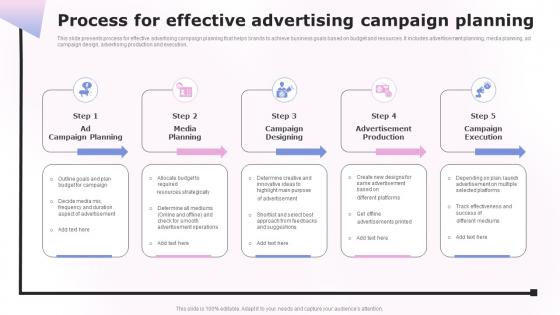
Process For Effective Advertising Campaign Planning




Try Before you Buy Download Free Sample Product
 Impress Your
 Audience
 100%
100% Editable
 Save Hours
 of Time


This slide presents process for effective advertising campaign planning that helps brands to achieve business goals based on budget and resources. It includes advertisement planning, media planning, ad campaign design, advertising production and execution.
People who downloaded this PowerPoint presentation also viewed the following :
Process For Effective Advertising Campaign Planning with all 6 slides:
Use our Process For Effective Advertising Campaign Planning to effectively help you save your valuable time. They are readymade to fit into any presentation structure.





FAQs for Process For Effective
Key components of a successful advertising campaign plan include clear objectives, target audience analysis, compelling messaging, strategic media selection, budget allocation, and performance metrics. These elements work together by aligning creative content with audience preferences, optimizing channel effectiveness, and enabling data-driven adjustments, with many organizations finding that integrated campaigns deliver higher engagement rates and measurable ROI improvements.
Defining your target audience involves analyzing demographics, psychographics, behavioral patterns, geographic locations, and purchasing habits through market research, customer surveys, and data analytics. This strategic combination enables advertisers to create precise customer personas and segment markets effectively, with many successful campaigns finding that detailed audience profiling significantly enhances message relevance, improves conversion rates, and maximizes advertising ROI across all channels.
**INPUT**: What are the essential elements to include in a campaign brief? **OUTPUT**: Campaign briefs include target audience profiles, clear objectives, key messaging pillars, budget parameters, timeline milestones, and success metrics. These elements streamline collaboration by aligning creative teams, media planners, and stakeholders around unified goals, while ensuring measurable outcomes, ultimately delivering consistent brand messaging and optimized resource allocation across all campaign touchpoints. **Word count: 52 words**
Market research contributes to effective advertising campaign planning by identifying target audience preferences, analyzing competitor strategies, and revealing optimal messaging approaches and channel selection. Through consumer surveys, focus groups, and behavioral analytics, brands can craft campaigns that resonate with specific demographics, ultimately delivering higher engagement rates, improved ROI, and stronger market positioning in increasingly competitive landscapes.
A UVP serves as the foundation of advertising campaigns by clearly differentiating products from competitors, guiding message consistency across channels, and compelling target audiences to choose specific brands. This strategic positioning enables companies to streamline their marketing investments, enhance customer acquisition rates, and deliver measurable ROI, with many successful campaigns finding that strong UVPs significantly reduce advertising costs while increasing conversion rates.
Setting measurable advertising goals involves defining specific KPIs like brand awareness metrics, conversion rates, click-through rates, cost-per-acquisition, and return on ad spend (ROAS). These objectives should align with broader business targets through SMART criteria, with many retail and financial services companies finding that clear benchmarks enable better budget allocation, performance tracking, and campaign optimization, ultimately delivering improved ROI and strategic competitive advantage.
Channel selection methods include audience analysis, competitive research, budget allocation modeling, performance data review, and cross-platform testing. Through strategic combination of demographic insights and historical campaign data, organizations can optimize their media mix across digital, traditional, and emerging platforms, ultimately delivering higher engagement rates and better ROI while minimizing wasted ad spend.
Creating a compelling creative brief requires defining clear campaign objectives, target audience insights, key messaging hierarchy, brand positioning guidelines, and desired emotional outcomes. Through strategic combination of market research data, competitive analysis, and creative parameters, marketing teams streamline campaign development, enhance creative alignment, and deliver more targeted messaging, ultimately reducing revision cycles and accelerating time-to-market for impactful advertising initiatives.
Best practices for advertising campaign budgeting include setting clear objectives, analyzing historical performance data, allocating 60-70% to proven channels, reserving 20-30% for testing new platforms, and maintaining contingency funds. Successful campaigns balance reach and frequency while tracking cost-per-acquisition across channels, with many brands finding that diversified spending across digital, traditional, and emerging platforms delivers optimal ROI and sustainable growth.
Developing consistent brand messaging requires establishing core brand pillars, standardizing visual elements, and adapting platform-specific formats while maintaining unified voice and values. This strategic approach enables brands to deliver cohesive experiences across digital, print, and broadcast channels, with companies like Nike and Starbucks successfully maintaining recognizable messaging that resonates consistently, ultimately strengthening brand recognition and customer loyalty.
Key advertising campaign metrics include reach, impressions, click-through rates, conversion rates, cost-per-acquisition, return on ad spend, and brand awareness lift. These measurements enable marketers to assess performance across awareness, engagement, and conversion stages, with many organizations finding that combining quantitative data with qualitative insights delivers comprehensive campaign optimization and sustained competitive advantage.
A/B testing integrates into advertising campaign planning through systematic variation testing of headlines, visuals, targeting parameters, and messaging strategies across different audience segments. This approach enables marketers to optimize budget allocation, refine creative elements, and enhance campaign performance before full-scale deployment, ultimately delivering higher conversion rates and improved ROI across channels.
Real-time campaign adaptation strategies include A/B testing adjustments, budget reallocation toward high-performing channels, audience targeting refinements, creative optimization, and messaging pivots based on engagement metrics. These approaches enable marketers to maximize ROI by shifting resources from underperforming elements to successful ones, with many brands finding that agile optimization delivers significantly improved conversion rates and cost efficiency.
Ensuring compliance requires establishing clear guidelines based on advertising regulations, conducting regular legal reviews, and implementing approval processes for all campaign materials. Through comprehensive compliance frameworks, organizations streamline content verification, minimize regulatory risks, and maintain brand integrity, with many advertising agencies finding that proactive compliance strategies ultimately deliver consumer trust and competitive advantage.
Storytelling transforms advertising campaigns by creating emotional connections, enhancing brand recall, simplifying complex messages, and differentiating products in competitive markets. Through compelling narratives, companies across retail, automotive, and healthcare sectors deliver memorable experiences that resonate with target audiences, ultimately driving higher engagement rates, stronger customer loyalty, and improved conversion outcomes.
-
The ease of modifying templates is just superb! Also, the vast collection offers plenty of options to choose from.
-
“I required a slide for a board meeting and was so satisfied with the final result !! So much went into designing the slide and the communication was amazing! Can’t wait to have my next slide!”