


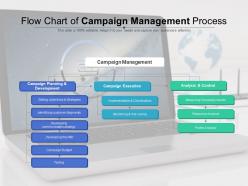
Flow chart of campaign management process





Try Before you Buy Download Free Sample Product
 Impress Your
 Audience
 100%
100% Editable
 Save Hours
 of Time


Get your ideas across to a bigger audience with our Flow Chart Of Campaign Management Process. They enable better distribution.
People who downloaded this PowerPoint presentation also viewed the following :
Flow chart of campaign management process with all 5 slides:
Ensure expansive coverage with our Flow Chart Of Campaign Management Process. Function on a broader bandwidth.
FAQs for Flow chart of
Honestly, you gotta nail four things: clear goals, knowing your audience, smart budget splits, and tracking everything. Figure out what success actually looks like first - conversions, awareness, whatever you're after. Then research where your people really spend time online (not where you assume they do). Split your budget based on that data. Track from day one or you'll be flying blind. Oh, and don't just launch and pray - check your numbers weekly and move money to what's actually working. Most people forget that last part and wonder why campaigns flop.
Honestly, data analytics just shows you what's actually working instead of guessing. You'll see which channels bring in real conversions and which ones are money pits - trust me, we've all burned cash on campaigns that felt promising but totally bombed. The cool part is catching problems early instead of waiting weeks to realize you screwed up. Real-time tweaks save so much headache. I'd start simple though, maybe track 3 key metrics that actually tie to your goals. You can always add more fancy stuff later once you get the hang of it.
So instead of blasting the same boring message to everyone, you segment your audience first. Demographics, behavior, interests - whatever makes sense for your business. Then you can actually write stuff that hits different for each group. Enterprise clients care about totally different things than small startups, right? I learned this the hard way when I kept wondering why my campaigns were flopping. Pick your top 3-4 segments to start with. Test different messages for each one and you'll see way better results than that one-size-fits-all approach that never works anyway.
Dude, forget just tracking clicks and conversions. Brand sentiment shifts matter way more - plus share of voice changes and how it affects customer lifetime value. Brand lift surveys are honestly my new obsession because they actually show if people give a damn about your message. Quality engagement beats quantity every time, and watch for improvements in customer acquisition costs too. Oh, and see if your campaign boosts organic searches for your brand terms - that's huge. The game changer? Attribution modeling shows how your campaign touches the whole customer journey, not just that final click before purchase.
Honestly, get yourself a decent project management thing first - Asana or Monday.com work great for tracking all your campaign stuff. Canva's perfect for quick graphics, but if you're doing serious design work, Adobe's worth the money. Oh, and set up shared storage like Google Drive so people aren't constantly asking "where's that file again?" Google Analytics is a must, obviously. For social posts, Buffer or Hootsuite will save your sanity - scheduling beats posting manually every single time. Just make sure whatever you pick actually connects together. Nothing's worse than entering the same data twice because your tools don't play nice.
So A/B testing is basically where you compare two versions of something to see which performs better. Subject lines are a great starting point - I've seen open rates jump like 15% just from tweaking those. You can test pretty much anything though: CTAs, images, send times, whatever you're wondering about. Just change one thing at a time or you won't know what actually made the difference. Make sure you've got enough people in your test group for the results to mean something, then use the winner for everyone else. Honestly, start simple and you'll probably be shocked at what small changes can do.
First thing - get those automated rules running before you launch. They'll pause crappy ads and boost budget on winners so you're not glued to your screen all day. During launch week, check your metrics every hour (yeah it sucks but trust me). Switch up headlines and images based on what's actually working. Real-time A/B testing is your friend here - move money to winning segments fast. Oh, and social listening tools are clutch for catching when people start talking shit early. Honestly, having everything automated beforehand saves you from panic-tweaking when stuff inevitably goes wrong.
Dude, you NEED cross-channel integration or you're basically throwing money away. Running separate campaigns is like having your left hand fight your right hand - total mess. Your audience gets confused when they see different messages everywhere, and you can't track what's actually working. But when everything's connected? That's where the magic happens. People see your brand consistently across platforms, you get way better data on what converts, and honestly the performance boost is nuts - we're talking 15-35% better results. My advice? Don't go crazy at first. Pick like 2-3 channels, get your messaging aligned, then build from there. Way less overwhelming.
Honestly, most campaigns fail because of terrible audience targeting and mixed-up messaging across platforms. Don't launch anything without testing first - I've watched campaigns crash over stupid broken links that nobody bothered checking. Unrealistic timelines will kill you too, especially when you're dealing with multiple people who all need to approve stuff. Build in extra time because approvals always drag on forever (seriously, always). Oh, and track everything from the start or you'll hate yourself later. Make a checklist and stick to it every time - sounds boring but it works.
Dude, social media totally changes the game for campaigns. You get instant feedback on your messaging - like, you'll know within hours if something's working based on engagement. The comments section can be a nightmare sometimes, but honestly? That's where you find out what people actually think. Instead of just broadcasting stuff, it becomes this back-and-forth thing. You can pivot super fast when you see what's resonating. Daily metric checks are clutch for spotting trends early. Just make sure you've got someone ready to jump on community management because things move quick.
Honestly, you've gotta set clear budgets upfront - don't just guess. I learned this the hard way when a campaign ate through $500 in like two hours lol. Check your spend every single day and use automated rules to cap things at 80%. Keep about 15% tucked away for when something's actually working and you need to double down fast. Cost-per-acquisition is your best friend here. Weekly reports save your ass with the boss too. Oh, and write down what worked! You'll thank yourself later when you're planning next quarter and can't remember why that one Facebook campaign crushed it.
Honestly, stories beat feature lists every single time. People remember narratives way better than "we offer A, B, and C." Find customer success stories your audience actually relates to - like "here's how Sarah fixed her exact problem." Behind-the-scenes stuff works great too. I've watched campaigns do a complete 180 when they ditched the corporate speak for real stories. Your audience needs to see themselves in it though, not some generic success tale. Pick 2-3 stories that hit your audience's specific pain points. Oh, and keep it authentic - people can smell fake stories from miles away.
Dude, you absolutely can't wing campaigns solo - trust me on this one. Get your creative team looped in on strategy from day one. Data people need to share insights that actually move the needle, not just random metrics. And stakeholders? Make them give feedback early or they'll wreck everything later (learned this the hard way). Regular check-ins keep everyone sane. Shared dashboards help too, though honestly half the team probably won't check them anyway. Just map out who you need for each phase before you start. Makes everything way less chaotic.
Dude, you absolutely cannot just translate your ads and call it localization - I made that mistake once and it was embarrassing. Colors mean different things everywhere. Your messaging tone needs to match how people actually communicate there. A super direct approach that kills it in NYC? Total disaster in relationship-focused cultures. Religious holidays matter, social norms matter, even your CTA buttons need tweaking. Tokyo and São Paulo aren't just different languages - they're completely different mindsets. Find native speakers who get the cultural stuff, not just someone who can translate words. Oh, and research local consumer habits first or you'll waste so much budget.
Honestly, just don't be shady with people's data or lie about what you're doing with it. That stuff will bite you later. Be upfront about funding sources and any partnerships too. When targeting ads, avoid anything that feels discriminatory - pretty obvious but worth saying. Respect when people opt out (seriously, don't be that company). I always think about whether I'd actually want to receive whatever campaign I'm running. Quick gut check before launching anything new usually saves headaches down the road. Transparency really is your best friend here.
No Reviews