

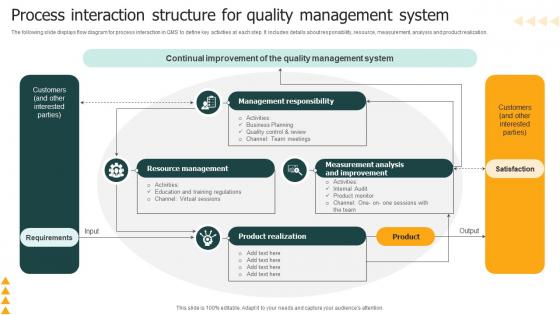
Process Interaction Structure For Quality Management System




Try Before you Buy Download Free Sample Product
 Impress Your
Audience
 100%
Editable
 Save Hours
of Time


The following slide displays flow diagram for process interaction in QMS to define key activities at each step. It includes details about responsibility, resource, measurement, analysis and product realization.
People who downloaded this PowerPoint presentation also viewed the following :
Process Interaction Structure For Quality Management System with all 6 slides:
Use our Process Interaction Structure For Quality Management System to effectively help you save your valuable time. They are readymade to fit into any presentation structure.






FAQs for Process Interaction Structure For
So you need the basics first: documentation, process management, risk stuff, and ways to keep improving. Training programs are huge too. Don't forget internal audits and getting customer feedback - that's where the real insights come from honestly. The documentation feels like a total nightmare at first but you'll thank yourself later. Most people just follow ISO 9001 since it's already figured out for you. I'd start by mapping what you're doing now and see where the gaps are. Way easier than trying to build everything from scratch, trust me.
Honestly, don't make this harder than it needs to be. Build improvement stuff right into your day-to-day work instead of treating it like some side project. Regular audits help, plus you gotta actually listen to what customers are telling you. Track the metrics that genuinely move the needle for your business - not just vanity numbers. Management reviews sound boring but they're where real change happens if you're not just going through the motions. Look at your data trends, figure out what's actually causing problems, then set goals you can measure. Oh, and create an environment where people aren't scared to speak up with ideas. Start with one process, get some quick wins, then build from there.
ISO 9001 is basically your roadmap for building a solid QMS. Instead of winging it, you get detailed instructions covering all the key stuff - customer requirements, document control, management reviews, continuous improvement, the whole deal. It's actually pretty thorough once you dive in. Following the standard means you won't miss critical pieces, and honestly, it's a framework that's been proven to work. My old boss swore by it. If you want certification later, you'll already have the right structure in place. I'd start by mapping what you're doing now against their requirements.
Honestly, leadership commitment can make or break your whole QMS. I've seen this play out so many times - when executives actually care and put real resources behind it, everything flows better. They use the quality data for actual decisions instead of just filing reports away somewhere. But if they treat it like some compliance thing they have to check off? That attitude spreads like wildfire through the whole team. Your employees aren't dumb - they'll mirror whatever energy leadership brings to it. So if you're trying to fix your QMS, get leadership to actually participate and be visible champions of it. Don't just have them sign papers and disappear.
Honestly, the worst part is dealing with people who just don't want to change anything. Leadership's usually skeptical about spending money upfront too. Documentation becomes this huge mess if you're not careful from day one - learned that the hard way. Getting everyone trained consistently? Total pain. Plus once the novelty wears off, keeping momentum is rough. Oh, and don't even get me started on resource allocation battles. Here's what actually works though: start with small pilot programs first. Celebrate those quick wins early so people can see it's not just busywork. Shows real value fast.
Look, training and engagement are everything for a QMS. Without them you're just shuffling paperwork around. Your team needs to actually get the processes AND feel like they matter. When that happens, they'll catch problems early and come up with better solutions themselves. I can't tell you how many times I've watched companies bomb their QMS rollout because they treated training like an afterthought. Make it relevant to what people do every day. Show them how better quality makes their jobs easier too - honestly that's half the battle right there. Find your natural quality nerds and let them help teach everyone else.
Track both process and outcome stuff - customer satisfaction, defect rates, on-time delivery, cost of quality. Cycle times matter too. Don't sleep on employee training completion rates though, seriously everyone forgets about that one but it's huge. Oh and audit findings obviously. Here's the thing - pick maybe 5-7 metrics that actually move the needle for your business. Don't go crazy tracking everything. Figure out what quality success looks like for you first, then work backwards to find the metrics that'll show if you're getting there. Way easier approach.
Oh definitely, you can totally combine them! Honestly, running three separate systems is such a nightmare - I'd go nuts with all that paperwork. Most places do an "integrated management system" thing where everything lives under one roof. Look for where your processes already overlap - stuff like document control, training, audits. That's where the magic happens. The ISO standards (9001, 14001, 45001) actually play nice together since they're built that way. Just map out what you're doing now first. Way easier than you'd think once you spot the patterns.
First thing - train your auditors right. They gotta know the QMS stuff but also how to ask questions without pissing people off. Rotate through different areas systematically so you don't miss anything. Here's the thing though - focus on actual evidence, not just what people claim they do. Trust me, there's usually a gap there. Spend more time on your critical processes, obviously. Document clearly and actually follow up on past issues (people hate when you don't). The whole trick is making it collaborative instead of feeling like you're hunting for problems. Way better results that way.
Look, customer feedback is like taking your QMS's temperature - tells you what's working and what's broken. Most places do surveys, track complaints, read reviews, the usual stuff. But here's where everyone screws up: they collect all this data then just... sit on it. Such a waste! The good companies actually use those insights to fix their processes and update training. Oh, and definitely track whether your changes are helping satisfaction scores go up. Otherwise you're just guessing if anything you did mattered.
Start by figuring out what actually needs documenting - don't document everything or you'll go crazy. Map your current workflow, then nail down who does what and what goes in/out of each step. Write it step-by-step but keep it simple. Visual stuff helps way more than walls of text. Definitely talk to whoever's doing the work daily since they know all the weird edge cases that'll trip you up. Test your docs with someone new to catch obvious gaps. Oh, and set up regular reviews so it doesn't just collect dust on a shelf somewhere.
Honestly, QMS software is a game changer for document control - no more digging through spreadsheets or lost files. You'll get real-time tracking of non-conformances and corrective actions, plus version control that doesn't make you want to scream. The dashboards actually show useful metrics instead of those useless pretty charts everyone ignores. Here's the thing though - don't try to overhaul everything at once. Pick something that plays nice with your current systems first. I'd start with just one process area and build from there. Way less painful that way.
Look, risk management in your QMS is huge because it catches problems before they blow up in your face. Think of it like being a detective - you're hunting for weak spots that could mess with product quality or tick off customers. Companies that skip this? They get burned, trust me. The whole point is staying ahead of trouble instead of scrambling after. Map out your main processes first, then ask yourself "what could go sideways here?" Once you spot the risks, you can set up controls and show auditors you're not just winging it. Way better than playing catch-up later.
Honestly, don't overthink it - most companies already do half this stuff without realizing. Pick your biggest headaches first (customer orders, quality checks, complaints) and just write down what actually happens. ISO 9001 sounds scary but it's mostly common sense wrapped in fancy language. Grab some free templates online and make someone your "quality person" to keep track of everything. I'd focus on maybe 2-3 processes max to start. Document those really well, then add more later. The whole thing works way better when you're consistent rather than trying to be perfect right away.
Honestly, a good QMS is like turning your business into a trust-building machine. Customers start expecting consistent quality from you, which means way fewer complaints and better reviews. When problems do happen - and trust me, they will - you'll catch them fast and fix them before they blow up. Sometimes that quick response actually impresses people more than never messing up in the first place. Your reputation gets a serious boost too. You become *that* company people recommend without hesitation. Track your satisfaction scores from day one so you can actually see the improvement once everything's running smoothly.
-
“I really like the convenient operation and professionalism I saw on the SlideTeam website. I want to express my regards and appreciation to the team.”
-
I want to thank SlideTeam for the work that they do, especially their customer service.