

Integrated Quality Management System For Pharmaceutical Industry





Try Before you Buy Download Free Sample Product
 Impress Your
 Audience
 100%
100% Editable
 Save Hours
 of Time


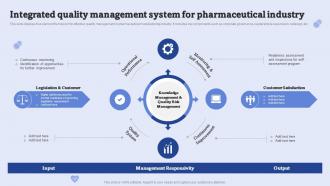
This slide displays four element framework for effective quality management in pharmaceutical manufacturing industry. It includes key components such as corporate governance, leadership and supervision, redesign, etc.
People who downloaded this PowerPoint presentation also viewed the following :
Integrated Quality Management System For Pharmaceutical Industry with all 6 slides:
Use our Integrated Quality Management System For Pharmaceutical Industry to effectively help you save your valuable time. They are readymade to fit into any presentation structure.





FAQs for Integrated Quality Management System
So you've got four main things to focus on: process management, risk management, compliance tracking, and continuous improvement. Document control is huge too - that stuff gets chaotic fast if you're not careful. Performance metrics help you figure out if anything's actually working. Here's the thing though - most companies try to manage all this separately when they should be connecting it. Your IQMS works best when it links quality standards like ISO 9001 with day-to-day operations. Otherwise you're just doing double work. I'd start by looking at what systems you already have. You might be surprised how close you are to having it all integrated.
Honestly, IQMS is a game-changer for compliance stuff. You get one system that handles ISO 9001, AS9100, whatever standards you need. No more spreadsheet hell - it tracks your corrective actions, keeps audit trails clean, and manages calibration schedules automatically. Training records? Covered. Risk management? Yep. The best part is when auditors show up, you're not frantically digging through files because everything generates reports on its own. I learned this the hard way at my last job. Just figure out which standards matter for your industry first, then set up the modules to match.
So basically an IQMS connects everything into one system, which cuts out all those annoying redundant steps between departments. You'll catch bottlenecks way earlier instead of scrambling later. The automated reporting is honestly a game-changer - your team stops doing boring data entry and can actually work on stuff that matters. Decision-making gets faster since everyone's looking at the same real-time info. Oh, and fewer errors because the workflows become standardized. I'd map out what you're doing now first, then figure out which messy areas need help most.
Think of continuous improvement as your IQMS's heartbeat - it's always running in the background, collecting data and spotting where things could work better. Honestly, it felt pretty overwhelming when I first started with it. You're not just keeping up with standards, you're actually pushing them higher by learning what works (and what totally doesn't) across all your integrated systems. The trick? Don't try to overhaul everything at once - that's a recipe for burnout. Pick one small process improvement each quarter instead. Way more manageable that way.
Tech can totally automate your compliance tracking and put all your documentation in one spot. Cloud platforms are honestly pretty amazing for this - they connect document control with audit management instead of making you juggle ten different systems. Automation handles the boring stuff like approvals and reminders, plus you get dashboards that actually show you problems before they blow up. The trick is finding tools that actually work together (so many don't, which is annoying). I'd start by figuring out what's driving you crazy right now, then find software that fixes those specific headaches.
Honestly, the worst part is dealing with people who absolutely refuse to change how they work. I've watched entire teams just shut down when you mention new processes. Getting different departments on the same page? Good luck with that mess. Trying to mesh ISO 9001, 14001, and 45001 together gets pretty overwhelming fast. Plus you're juggling training people while they're still doing their regular jobs - it's like changing a tire while driving. My take? Don't go big right away. Try pilot programs first and make sure the higher-ups actually support you. Otherwise you're fighting an uphill battle.
Look, your team's engagement basically determines if your IQMS actually works or just becomes expensive busywork. Engaged employees give you solid data and catch problems early. The disengaged ones? They'll check boxes but miss everything important - which honestly drives me crazy because then leadership wonders why the system "isn't working." These are the people actually running your processes every day, so their buy-in matters way more than fancy dashboards. Get them involved in designing workflows from the start. Give them real ownership over quality outcomes in their specific areas and you'll see the difference immediately.
Honestly, start with defect rates and customer satisfaction scores - those two tell you the most right off the bat. Process cycle times and cost of quality are solid picks too. Oh, and compliance audit results if that's your thing. Don't sleep on employee training completion rates though! Most people totally overlook that one but it actually matters a ton for making everything work smoothly. First-time-right rates are clutch too. My advice? Pick like 3-4 that match whatever's giving you the biggest headaches right now. You can always add more once you've got your groove down.
So here's the thing - an IQMS basically puts all your data in one spot where you can actually see what's happening in real time. No more digging through a million different systems (which is honestly such a pain). You'll have quality metrics, performance stuff, risk indicators - everything right there. What I'd do first is figure out what decisions you're currently making blind. Those should be your priority. The system also makes sure everyone's collecting data the same way, so your teams aren't all over the place with their analysis. Trust me, having actual facts instead of guessing makes a huge difference.
Look, risk management basically IS your quality system - you can't separate them. Your IQMS helps you spot risks everywhere, figure out how bad they could be, then build controls right into your daily work. Way better than scrambling to fix things after they break. The key part? Make your risk assessments talk directly to your quality procedures. They should feed each other info constantly. It's honestly pretty straightforward once you get the hang of it, but a lot of companies still treat risk management like some separate thing they have to check off a list.
Get everyone involved right from the start - don't just email them updates later. Map out who really matters: customers, suppliers, your team, regulators, all of them. Set up regular meetings where they can actually speak up and suggest changes. Quality councils work great, or even just casual check-ins. The thing that drives me crazy? When companies treat this like they're just ticking boxes instead of actually listening. Oh, and definitely show people how you used their feedback - otherwise they'll tune out next time. People want to see their input actually changed something, you know?
Mix up your IQMS training - don't just do boring presentations. Hands-on workshops work way better since people actually practice the processes. I'd pair newbies with someone who really gets the system, plus make those quick reference cards they can keep at their desk. Honestly, multiple short sessions beat one giant training marathon every time. Get feedback on what's tripping people up too. Oh, and make sure it connects to what they're doing daily - otherwise it's just another compliance thing they'll forget. The practical stuff is what sticks.
So basically it's about making sure customers get what they want consistently. You combine all your quality stuff - design, delivery, support - into one system so nothing gets missed. Like a safety net that catches problems before customers see them. The system tracks feedback and complaint patterns, then you use that data to actually improve things. Everyone follows the same processes too, which means customers don't get wildly different experiences depending on who helps them. I'd start by looking at where customers interact with you and spot the gaps - that's usually where things get messy.
So manufacturing, aerospace, pharma, and automotive see the biggest wins with IQMS. Healthcare and food production too - basically anywhere that quality screwups could actually kill people. Those sectors get insane ROI. Financial services and software companies are hopping on now because it catches problems early, which saves tons of money down the road. My cousin works in med device manufacturing and swears by their system. Even less regulated industries benefit if they're juggling multiple quality standards. Worth checking out if you're dealing with compliance headaches.
Honestly, if you're running a small team, don't overthink your IQMS setup. Stick to the basics that actually impact your day-to-day work and ditch all that corporate red tape nonsense. Simple docs work fine when it's just a few people. But once you hit that bigger company territory? Yeah, you'll need way more structure - formal procedures, approval chains, the whole nine yards. Otherwise things get messy fast with tons of people in the mix. My advice: build something basic that won't break when you scale up. Choose tools that can grow with you instead of boxing you in later.
-
I had them make a presentation for an office retirement party. They were very helpful in understanding what we wanted and delivered the perfect presentation. Highly recommended!
-
Well-designed and informative templates. Absolutely brilliant!