


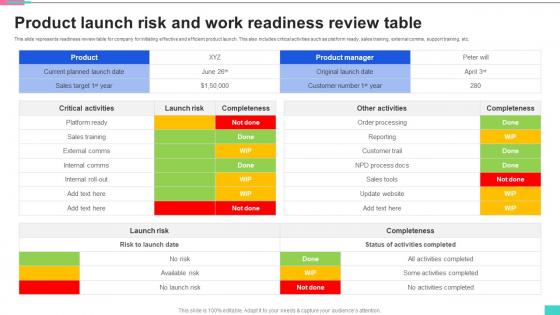
Product Launch Risk And Work Readiness Review Table




Try Before you Buy Download Free Sample Product
 Impress Your
 Audience
 100%
100% Editable
 Save Hours
 of Time


This slide represents readiness review table for company for initiating effective and efficient product launch. This also includes critical activities such as platform ready, sales training, external comms, support training, etc.
People who downloaded this PowerPoint presentation also viewed the following :
Product Launch Risk And Work Readiness Review Table with all 9 slides:
Use our Product Launch Risk And Work Readiness Review Table to effectively help you save your valuable time. They are readymade to fit into any presentation structure.








FAQs for Product Launch Risk And Work
Key components of an effective risk assessment process include risk identification, probability analysis, impact evaluation, risk prioritization, and mitigation strategy development. These elements work together by systematically cataloging potential threats, quantifying their likelihood and consequences, and creating actionable response plans, with many organizations finding that this structured approach significantly enhances decision-making and operational resilience.
Organizations quantify and prioritize risks through risk matrices, probability-impact scoring, quantitative modeling, financial exposure analysis, and scenario planning techniques. These methodologies enable businesses to allocate resources strategically, with financial institutions using advanced analytics for credit risks and manufacturers implementing predictive models, ultimately delivering operational efficiency and competitive advantage.
Data analysis enhances risk assessment accuracy by identifying patterns, trends, and correlations within large datasets, enabling predictive modeling and real-time threat detection. Through advanced analytics and machine learning algorithms, organizations streamline risk identification, automate compliance monitoring, and deliver more precise forecasting, ultimately enabling faster decision-making and strategic risk mitigation across industries.
Regulatory requirements significantly shape risk assessment practices by mandating specific compliance frameworks, reporting standards, and evaluation methodologies across sectors. Financial services must adhere to Basel III capital requirements, healthcare organizations follow HIPAA privacy protocols, and manufacturing companies comply with OSHA safety standards, with each industry developing specialized risk management approaches that ensure regulatory compliance while enhancing operational efficiency.
Common pitfalls include insufficient stakeholder involvement, outdated data analysis, inadequate risk prioritization, poor documentation practices, and lack of regular updates. These challenges often result from rushed timelines or limited resources, with many organizations finding that incomplete assessments lead to missed vulnerabilities, ultimately compromising strategic decision-making and operational resilience.
AI and machine learning enhance risk assessment by analyzing vast datasets in real-time, identifying patterns humans might miss, and providing predictive analytics for future risk scenarios. These technologies streamline risk evaluation through automated data processing, continuous monitoring, and adaptive algorithms, with financial institutions and insurance companies finding significantly improved accuracy, faster decision-making, and enhanced regulatory compliance.
Best practices for communicating risks to stakeholders include using clear, jargon-free language, providing quantified impact assessments, establishing regular reporting schedules, tailoring messages to specific audiences, and presenting actionable mitigation strategies. These approaches enhance transparency and decision-making by ensuring executives understand financial implications, operational teams grasp tactical requirements, and board members receive strategic insights, ultimately enabling faster responses and stronger organizational resilience.
Organizations should conduct comprehensive risk assessments annually, with quarterly reviews for high-risk areas and continuous monitoring of critical processes. Financial institutions and healthcare organizations increasingly implement monthly assessments for regulatory compliance, while manufacturing companies focus on operational risks during peak seasons, ultimately ensuring proactive risk management that delivers competitive advantage and regulatory adherence.
Key metrics for evaluating risk management effectiveness include risk reduction percentages, incident frequency rates, financial loss prevention, compliance scores, and recovery time objectives. These metrics enable organizations to measure strategy performance across operational, financial, and regulatory dimensions, with many financial institutions and healthcare systems finding that comprehensive measurement frameworks ultimately deliver enhanced decision-making capabilities and competitive advantage.
Organizations integrate risk assessment into strategic planning by embedding risk evaluation throughout decision-making processes, aligning risk appetite with business objectives, and establishing cross-functional governance structures. Through regular risk monitoring and scenario planning, companies in sectors like financial services and manufacturing can anticipate challenges, optimize resource allocation, and maintain competitive advantage while pursuing growth opportunities.
Qualitative risk assessment uses descriptive scales, expert judgment, and categorical rankings to evaluate risks, while quantitative methods employ numerical data, statistical models, and mathematical calculations for precise measurements. Through qualitative approaches, organizations streamline initial risk identification and stakeholder communication, whereas quantitative analysis delivers specific probability calculations and financial impact projections, ultimately enabling strategic resource allocation.
Emerging risks like cyber threats and climate change require dynamic assessment frameworks that combine traditional risk modeling with real-time monitoring, scenario planning, predictive analytics, and cross-functional collaboration. These approaches enable organizations to identify vulnerabilities early, stress-test against multiple scenarios, and develop adaptive strategies, with many financial institutions and multinational corporations finding that integrated risk platforms deliver enhanced resilience and competitive advantage.
Employee training enhances risk assessment capabilities by developing staff expertise in identifying potential threats, understanding regulatory requirements, and implementing proper risk mitigation protocols. Through comprehensive training programs, organizations enable employees to recognize operational vulnerabilities, financial risks, and compliance gaps more effectively, ultimately creating a proactive risk-aware culture that strengthens overall organizational resilience.
Risk assessment frameworks can be customized by adapting evaluation criteria, adjusting risk tolerance levels, incorporating industry-specific regulations, modifying assessment frequency, and aligning methodologies with organizational objectives. These tailored approaches enable companies across sectors like healthcare, finance, and manufacturing to address unique operational challenges, compliance requirements, and strategic priorities, ultimately delivering more accurate risk identification and enhanced decision-making capabilities.
Organizational culture significantly impacts risk assessment effectiveness by influencing employee reporting behaviors, leadership transparency, and cross-departmental collaboration. Companies with open, accountability-focused cultures typically experience more comprehensive risk identification and faster response times, while hierarchical or blame-oriented environments often suppress critical information sharing, ultimately limiting strategic risk visibility and organizational resilience.
-
Great product with effective design. Helped a lot in our corporate presentations. Easy to edit and stunning visuals.
-
I was never satisfied with my own presentation design but SlideTeam has solved that problem for me. Thank you SlideTeam!
-
Amazing product with appealing content and design.
-
Professionally designed slides with color coordinated themes and icons. Perfect for enhancing the style of the presentations.