

Project Management Executive Summary Powerpoint Ppt Template Bundles





Try Before you Buy Download Free Sample Product
 Impress Your
Audience
 100%
Editable
 Save Hours
of Time


Our Project Management Executive Summary Powerpoint Ppt Template Bundles are topically designed to provide an attractive backdrop to any subject. Use them to look like a presentation pro.
People who downloaded this PowerPoint presentation also viewed the following :
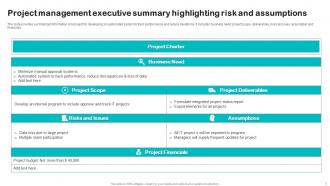
Project Management Executive Summary Powerpoint Ppt Template Bundles with all 17 slides:
Use our Project Management Executive Summary Powerpoint Ppt Template Bundles to effectively help you save your valuable time. They are readymade to fit into any presentation structure.











FAQs for Project Management Executive Summary Powerpoint
So there's five main phases: initiation, planning, execution, monitoring, and closure. But honestly? They're more like a messy dance than clean steps. First you define what you're actually trying to do and set goals. Then map out your timeline and resources - this part's crucial but boring. Execution is where you do the real work while constantly checking if things are going sideways (spoiler: they usually are). You'll bounce between phases constantly. Like, monitoring will show your plan sucks so you'll loop back to adjust stuff. Oh, and document everything from the start or you'll hate yourself later.
Honestly, good communication prevents like 90% of project meltdowns. Make sure everyone knows their role and deadlines upfront - saves you from those nightmare "oh I thought Sarah was doing that" situations. Regular check-ins are clutch too. When people feel safe bringing up problems early, you can actually fix stuff before it spirals. Stakeholders won't blindside you with random changes if you keep them in the loop (well, most won't anyway). The trick is being ridiculously specific about what you want and when. Trust me on this one.
Think of risk management as your project's safety net. Spot potential problems early before they blow up your timeline. Figure out what could realistically go wrong and how you'd handle it. Honestly, I've watched way too many projects implode because people just crossed their fingers and hoped everything would work out perfectly. Build in extra time and backup plans from day one - don't wait until you're scrambling. Oh, and spend like 15 minutes weekly updating your risk list based on what's actually happening. Way better than playing catch-up later.
Think of it like a seesaw - bump up scope and you'll need more time or money. Budget gets slashed? Something's gotta give with either timeline or what you're delivering. The annoying part is stakeholders act like this basic math doesn't exist. You've got to make the trade-offs super obvious. I usually throw together a quick visual showing how tweaking one thing screws with the others. Before anything kicks off, figure out which constraint is your "untouchable" one. That way when changes come (and they will), you know exactly where you can push back.
Dude, project management software is a lifesaver. No more hunting through random spreadsheets or trying to remember what Karen said in that email from Tuesday. Everything's in one spot - deadlines, who's working on what, budgets, the whole mess. Your team can actually update stuff in real time instead of playing phone tag about project status. Honestly, those "quick status meetings" become way less painful when everyone can just check the dashboard. Trello's pretty solid for beginners, or Asana if you want something beefier. Just pick one and try it - you'll wonder how you survived without it.
Honestly, your leadership style makes or breaks team dynamics. Autocratic leaders get quick decisions but teams just sit around waiting for orders. Collaborative types build way better buy-in, though sometimes you'll get stuck overthinking everything (ugh, the worst). Democratic approaches usually pump up morale since people actually feel heard. Transformational leaders? They're amazing for motivation but can totally burn everyone out if you go overboard. Really depends on your project and who's on your team. Just watch how your current style affects everyone's energy and tweak from there.
First thing - figure out who all your stakeholders are and how much power/interest they actually have. Then talk to each group differently based on what they care about. I made this mistake once where I sent super detailed reports to everyone and half the people were like "why are you sending me this novel?" Honestly, some execs just want the 30-second version. Get your key players involved in decisions when it makes sense, and don't sugarcoat problems. Write stuff down as you go. Oh, and set expectations upfront about who does what - saves so much drama later. Maybe start with a basic stakeholder list this week?
So here's the thing with agile - you work in these short 1-4 week chunks instead of planning everything upfront for months. When stuff changes (and it always does), you can actually pivot without losing your mind. Daily check-ins catch problems before they explode, and those weekly retrospectives? Super helpful for figuring out what's broken. You're constantly showing stakeholders real working pieces they can give feedback on. Honestly, it beats the old waterfall approach by miles. Try breaking your next project into smaller bits and do weekly reviews to see what's clicking.
Track the obvious stuff first - did you hit your budget, timeline, and deliverables? But that's honestly just scratching the surface. Stakeholder happiness matters way more than people think, plus team morale and quality metrics like how much rework you're doing. The big question though: did this thing actually solve the problem it was meant to? Sometimes projects look successful on paper but don't move the business forward at all. Pick maybe 3-5 metrics that your stakeholders actually care about - don't overcomplicate it.
Honestly, diverse teams are amazing for creativity - you'll get so many different angles on problems that you'd never think of alone. Different backgrounds mean different skills and approaches, which usually leads to way better solutions. That said, it's messy at first. Communication styles clash, people have totally different ideas about deadlines, and sometimes there are language barriers that just make things awkward. I've seen teams struggle with feedback styles too - some cultures are super direct while others are more subtle. The trick is creating that safe space early on where everyone feels comfortable being themselves. Figure out how each person likes to communicate and set some ground rules together.
Okay so first thing - get everyone to sign off on a detailed scope document before you start anything. I cannot stress this enough lol. Then when they inevitably ask for "just one tiny addition," you've got something to point to. Set up a formal change request process because otherwise you'll be drowning in random asks. Document everything as you go (trust me on this one). Regular check-ins are your friend - catch the scope creep early before it turns into a nightmare. Don't be afraid to say no or push stuff to phase two. Your sanity will thank you later.
Honestly, it comes down to communication and making people feel valued. Weekly one-on-ones are huge - that's where you'll actually figure out what motivates each person. Ask "what's blocking you?" and then follow through on fixing those issues. People want to understand how their work matters in the bigger picture, so connect those dots for them. Celebrate the small wins too, not just major milestones. Oh and give them real autonomy where you can - nobody likes being micromanaged. When decisions affect their work, bring them into the conversation. It sounds basic but most managers skip these fundamentals.
You really need to do this while everything's still fresh - like within two weeks max. After that, people forget all the messy details that actually matter. Honestly, I've seen teams make the exact same dumb mistakes because they never bothered to debrief properly. Document what worked, what was a disaster, and those weird issues that came out of nowhere. It'll save you so much pain later when you're planning the next project. Your estimation skills get way better too. Just get everyone in a room and hash it out - trust me on this one.
Ugh, budget constraints are the worst - you basically have to become ruthless about what actually matters. I always start by separating must-haves from nice-to-haves because that's where the real decisions happen. You'll probably end up cutting features, pushing deadlines, or hunting for cheaper options (maybe all three if you're unlucky). The trick is being super transparent about trade-offs from day one. Stakeholders hate hearing "no" but they hate surprises even more. Document every decision too - when someone inevitably asks why their favorite feature got axed, you'll have receipts. Build backup plans now because money always runs out faster than expected.
Honestly, AI tools are everywhere now - they're changing how we schedule stuff, assess risks, and allocate resources. Remote work isn't going anywhere either, so you'll need solid virtual team management skills. Everything's gone "agile" these days (even my dentist office claims to be agile, lol). Data analytics are becoming standard too. Don't sleep on the sustainability angle - ESG factors are creeping into project planning more than you'd think. My advice? Start playing around with AI project management tools now and get comfortable managing remote teams. Those skills will definitely make you stand out when everyone else is still figuring it out.
-
Amazing slides! Unique, attractive, and easy to understand.
-
The design is very attractive, informative, and eye-catching, with bold colors that stand out against all the basic presentation templates.