

Project management knowledge areas ppt slide examples




Try Before you Buy Download Free Sample Product
 Impress Your
 Audience
 100%
100% Editable
 Save Hours
 of Time


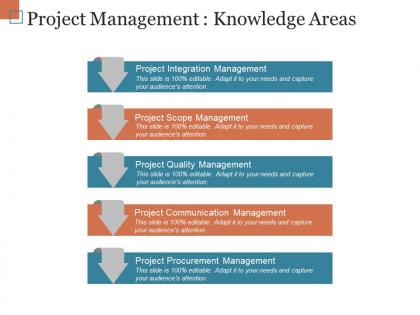
Identify the various areas related to project management with our project management knowledge areas PPT slide examples. This presentation layout of PMBOK has been created by our professional team members and helpful for people to understand all aspects of project knowledge areas which can be classified into nine categories. Our PMI knowledge areas PPT slideshow allows you to categorize project knowledge areas into different parts such as Integration management, scope management, schedule management, cost management or quality management. With the help of this project management areas template you can document the end result of the planning phase and can ensure the successful outcome of the project. This slideshow is helpful to show the control project work, monitor management, perform value analysis, project status reports, and identify potential project changes. Our project scope management presentation slide allows you to review which processes belong to which process group and to create scope for collecting requirements. Download this project management tools and techniques template and for more visit our website. Avoid haste with our Project Management Knowledge Areas Ppt Slide Examples. They ensure you don't waste.
People who downloaded this PowerPoint presentation also viewed the following :
Project management knowledge areas ppt slide examples with all 5 slides:
Gain entry to elite groups with our Project Management Knowledge Areas Ppt Slide Examples. The favored few will gladly accept you.




FAQs for Project management knowledge areas
Integration management involves project charter development, project management plan creation, directing and managing project work, monitoring and controlling project work, performing integrated change control, and closing the project. These processes work together by coordinating all project elements, ensuring seamless communication across teams, and maintaining alignment with business objectives, with many organizations finding that effective integration management ultimately delivers improved project success rates and enhanced stakeholder satisfaction.
Scope management ensures project objectives are met by clearly defining deliverables, establishing boundaries, and controlling changes throughout the project lifecycle. Through detailed scope statements and work breakdown structures, project managers prevent scope creep, maintain focus on essential outcomes, and allocate resources efficiently, ultimately delivering projects on time and within budget while meeting stakeholder expectations.
Time management serves as the backbone of project schedule adherence by establishing realistic timelines, tracking progress against milestones, and identifying potential delays before they cascade into major setbacks. Through systematic scheduling techniques, project managers streamline resource allocation, enhance team coordination, and maintain stakeholder confidence, with many organizations finding that disciplined time management ultimately delivers projects on budget while minimizing operational disruptions.
Risk management strategies mitigate project challenges by identifying potential threats early, developing contingency plans, and establishing clear response protocols. Through proactive risk assessment and monitoring, organizations streamline project delivery, minimize costly delays, and enhance stakeholder confidence, with many finding that structured risk frameworks ultimately deliver more predictable outcomes and competitive advantage.
Effective project cost management techniques include budget baseline establishment, earned value management, variance analysis, cost forecasting, and regular expenditure tracking. These methods enhance financial control by monitoring actual versus planned spending, identifying cost overruns early, and enabling corrective actions, with many organizations finding that systematic cost oversight ultimately delivers improved project profitability and resource optimization.
A communication management plan significantly enhances stakeholder engagement by establishing clear communication channels, defining message frequency and formats, and identifying key stakeholder information needs throughout project phases. Through structured communication protocols, project managers streamline stakeholder interactions, minimize misunderstandings, and maintain consistent project visibility, ultimately delivering stronger stakeholder buy-in and collaborative project outcomes.
Procurement management contributes to project success by ensuring strategic vendor selection, cost optimization, and risk mitigation through comprehensive contract management. Through effective supplier relationships and streamlined acquisition processes, organizations enhance project delivery timelines, reduce operational costs, and maintain quality standards, while many project teams finding that strategic procurement ultimately delivers competitive advantage and improved stakeholder satisfaction.
Essential quality management tools include quality checklists, statistical process control charts, fishbone diagrams, Pareto analysis, and quality audits. These tools enhance project outcomes by identifying defects early, tracking performance metrics, and ensuring deliverable standards, with many organizations finding that systematic quality monitoring reduces rework costs while accelerating project delivery timelines.
Human resource management practices significantly influence team dynamics by establishing clear roles, fostering effective communication channels, implementing performance management systems, and creating collaborative work environments. Through strategic team building, conflict resolution protocols, and skills development programs, project managers enhance team cohesion, minimize interpersonal conflicts, and boost overall productivity, with many organizations finding that structured HR approaches ultimately deliver higher project success rates and improved stakeholder satisfaction.
Stakeholder management ensures project success by identifying key parties, understanding their expectations, maintaining consistent communication, and aligning diverse interests with project objectives. Through strategic engagement and regular updates, project managers minimize resistance, secure necessary resources, and build collaborative relationships, with many organizations finding that proactive stakeholder involvement significantly reduces project risks while accelerating delivery timelines.
Project charter development serves as the foundational document that formally authorizes a project during initiation, establishing project objectives, scope boundaries, stakeholder roles, and success criteria. This critical deliverable enables project managers to secure resources, align stakeholder expectations, and transition into planning phases, with many organizations finding that well-crafted charters significantly reduce scope creep and enhance project success rates.
Best practices for enhancing project monitoring and controlling include establishing clear performance metrics, implementing regular status reviews, maintaining updated project dashboards, conducting variance analysis, and ensuring timely corrective actions. These approaches streamline oversight by providing real-time visibility, enabling proactive risk mitigation, and facilitating data-driven decisions, with many organizations finding that systematic monitoring ultimately delivers improved project outcomes and enhanced stakeholder confidence.
Agile methodologies significantly influence project management knowledge areas by emphasizing iterative planning, continuous stakeholder engagement, adaptive scope management, and cross-functional team collaboration. Through sprint-based cycles and daily standups, organizations streamline communication, enhance risk responsiveness, and accelerate delivery timelines, with many finding that agile approaches ultimately deliver greater flexibility and customer satisfaction.
Project management knowledge areas work synergistically to drive project success by ensuring comprehensive planning, execution, and control across all project dimensions. When integration, scope, time, cost, quality, resources, communications, risk, procurement, and stakeholder management operate cohesively, organizations achieve higher delivery rates, reduced costs, and enhanced stakeholder satisfaction, with many finding that strong knowledge area alignment directly correlates with competitive advantage.
Lessons learned can be integrated through structured documentation processes, regular project retrospectives, centralized knowledge repositories, standardized templates, and cross-project team rotations. These approaches enable organizations to capture critical insights, streamline decision-making, and enhance project outcomes, with many companies finding that systematic knowledge transfer reduces project risks while accelerating delivery timelines.
-
Informative presentations that are easily editable.
-
Great experience, I would definitely use your services further.