


Project phases showing planning execution tracking with opportunity analysis





Try Before you Buy Download Free Sample Product
 Impress Your
 Audience
 100%
100% Editable
 Save Hours
 of Time


Easy aptly describes our Project Phases Showing Planning Execution Tracking With Opportunity Analysis. Any difficult activity becomes a cakewalk.
People who downloaded this PowerPoint presentation also viewed the following :
Content of this Powerpoint Presentation
Description:
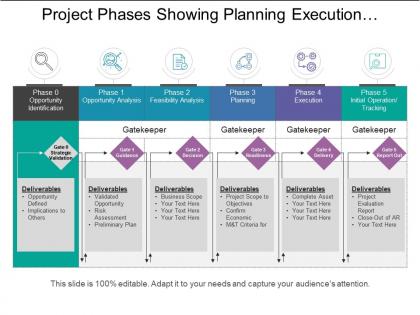
This image depicts a slide titled "Project Phases Showing Planning Execution" which outlines the various stages of a project's life cycle, from ideation to operational tracking. Each phase is marked with a "Gatekeeper" checkpoint that acts as a quality control and review mechanism before moving on to the next stage.
1. Phase 0, "Opportunity Identification," the focus is on defining the opportunity and understanding its implications. The deliverables here include defining the opportunity and its impacts on others.
2. Phase 1 is "Opportunity Analysis," where the opportunity is validated, risks assessed, and a preliminary plan developed. "Gate 1 Guidance" serves as the checkpoint here.
3. Phase 2, "Feasibility Analysis," involves understanding the business scope, setting objectives, and establishing economic and measurement & tracking criteria. The key deliverable at this stage is a detailed business scope, with "Gate 2 Decision" ensuring the project is feasible before proceeding.
4. In Phase 3, "Planning," the project's scope is defined in detail including specific objectives and metrics, moving through "Gate 3 Readiness" as the checkpoint before entering the execution phase.
5. Phase 4, "Execution," is where the actual work of the project takes place, resulting in a complete asset. Its progress is monitored through "Gate 4 Delivery."
6. Phase 5, "Initial Operation/Tracking," is where the project’s ongoing operation is tracked, and project evaluation reports are created, with "Gate 5 Report Out" marking the checkpoint for reviewing the operational success and learnings.
Use Cases:
Industries where this slide can be effectively used:
1. Construction:
Use: Managing construction projects from initial opportunity analysis to execution and operation.
Presenter: Project Manager or Lead Planner.
Audience: Construction team members, investors, and stakeholders.
2. Information Technology:
Use: Overseeing IT project development cycles including software releases and system upgrades.
Presenter: IT Project Manager or CTO.
Audience: IT department employees, executives, and related stakeholders.
3. Healthcare:
Use: Planning and tracking healthcare initiatives, such as the adoption of new treatment protocols or facility expansions.
Presenter: Healthcare Administrator or Program Manager.
Audience: Medical staff, hospital board members, and department heads.
4. Manufacturing:
Use: Streamlining product development, from conceptualization to manufacturing and market release.
Presenter: Product Manager or Manufacturing Engineer.
Audience: Product development team, quality assurance officers, and supply chain representatives.
5. Automotive:
Use: Launching new vehicle models, tracking through stages from design feasibility to production and sales tracking.
Presenter: Automotive Engineer or Product Development Lead.
Audience: Executives, manufacturing teams, and marketing departments.
6. Energy:
Use: Guiding energy projects like new power plant constructions or renewable energy integrations through their lifecycle.
Presenter: Energy Project Lead or Operations Manager.
Audience: Engineers, environmental analysts, and investors.
7. Aerospace:
Use: Managing aerospace projects including new aircraft design, testing phases, and final production.
Presenter: Aerospace Engineer or Project Director.
Audience: Design team, regulatory compliance officers, and company stakeholders.
Project phases showing planning execution tracking with opportunity analysis with all 5 slides:
Our Project Phases Showing Planning Execution Tracking With Opportunity Analysis care for your feelings. They get you over any hardship.

FAQs for Project phases showing planning execution tracking
So waterfall is super rigid - you plan everything upfront and then just follow the steps in order. Can't really pivot once you're halfway through (hence the name, I guess). Agile breaks everything into short sprints instead. You get feedback constantly and can actually change direction when stakeholders realize they want something different. Honestly, waterfall's fine if your requirements are totally locked down from day one. But if there's any chance things might evolve? Go with agile. Most projects these days need that flexibility since nobody really knows what they want until they see it.
Good communication stops people from working in their own little bubbles. Clear expectations and deadlines prevent that annoying thing where two people accidentally do the same task. Daily check-ins are honestly a lifesaver - you'll catch problems before they blow up during crunch time. The real game-changer though? When your team feels comfortable speaking up about issues or throwing out random ideas. I'd suggest quick daily standups or maybe a shared project board where everyone can actually see what's happening. Makes such a difference when people aren't guessing what others are up to.
So for real-time tracking, I'd probably try Asana, Monday.com, or Jira first. Asana's perfect if your team likes those visual board layouts. Jira though? Total overkill unless you're coding – learned that the hard way lol. Monday.com works well for most people since their dashboards actually update right when tasks get checked off. Honestly the biggest thing is just getting everyone to use it consistently. Doesn't matter if the tool is amazing if Sarah from marketing never updates her stuff. I'd test out free trials for like 2-3 options and see what your team gravitates toward naturally.
Okay so first thing - figure out who actually has decision-making power, not just whoever's being loudest about the project. Different people want different levels of detail, so adapt to that. Some executives just want bullet points, others need the full breakdown. Send updates regularly even when there's not much happening - radio silence freaks people out and then they start imagining worst-case scenarios. The moment scope changes or deadlines shift, hit them with the news right away plus your reasoning. Honestly, most project drama comes from people feeling blindsided. Regular check-ins keep everyone on the same page as things inevitably change.
Think of risk management as your project's smoke detector - catches problems before they become fires. I got burned on this once when our main vendor ghosted us mid-project. Honestly, we should've seen it coming. Now I always identify what could go sideways, rate how likely each thing is, then prep backup plans. Don't just do this once at kickoff though - make it part of your regular check-ins. Quick homework: write down your 5 biggest project risks and what you'll do if they hit. Trust me, future you will thank you.
Honestly, Gantt charts are a game changer for project timelines. When your boss inevitably asks "so when's this gonna be ready?" you can actually show them instead of scrambling for an answer. They help you spot which tasks can happen at the same time and where everything connects. The visual thing is huge - way better than those nightmare spreadsheets nobody wants to look at. Plus you'll catch schedule issues before they blow up. I'd say start with just the big milestones first, then get into the weeds later. Makes the whole thing less overwhelming.
Honestly, you've gotta get super clear on boundaries from day one. Get everyone to sign off on a detailed scope doc, then create a formal process for any changes. Trust me - I learned this the hard way when "quick little updates" completely wrecked a project timeline. Document everything and make sure leadership sees when people request changes. Train your stakeholders early that extras = more time and money. Sometimes you just have to say no or push stuff to phase two. It feels awkward at first but it'll save your sanity later.
Oh man, cultural stuff can absolutely wreck global projects if you're not careful. Different communication styles are huge - some people are blunt as hell, others basically speak in riddles when there's a problem. Time zones suck obviously, but what's worse is how cultures view deadlines and authority differently. Like, I've seen team members stay quiet about major issues because they don't want to contradict someone higher up. Super frustrating. Set clear communication rules from day one and do regular check-ins with everyone individually - gives people space to actually speak up.
Get everyone together within 2-3 weeks while it's all still fresh. Pull in devs, designers, stakeholders - basically anyone who was in the trenches with you. Cover three things: what worked, what sucked, and what you'd change next time. But here's what I learned the hard way - don't let it become a finger-pointing session or people will just shut down. Keep things constructive. Actually document the action items and follow through. I can't tell you how many post-mortems I've sat through that went nowhere. Set up a shared doc beforehand too - some people won't speak up in meetings but they'll drop honest feedback anonymously.
Honestly, the hardest part isn't the logistics - it's keeping everyone actually connected. Daily standups help, plus you'll want something like Asana to track who's doing what. But here's the thing: remote teams fall apart when communication gets weird. I'd do virtual coffee chats or retrospectives where people can vent about blockers. Don't let problems sit there festering because someone's too awkward to speak up on Slack. Overcommunicate everything, even the obvious stuff. Oh, and create shared spaces where everyone can peek at the whole project - not just their little piece of it.
Look, definitely track the basics - scope, timeline, budget. Did you hit what you promised? But that's honestly just scratching the surface. Stakeholder happiness matters way more than people think. Team morale too - burned out teams don't deliver great work. Oh, and track whether the thing actually worked after launch. Quality issues that pop up later will haunt you. Business outcomes are huge - did it move the needle? My take: choose maybe 4 solid metrics from the start. Don't go overboard or you'll drown in spreadsheets later.
Okay so first thing - write down everything you need to do and figure out what's blocking what. Like, what literally can't start until something else is done? Then I look at deadlines, who's breathing down my neck about what, and whether I actually have people free to work on stuff. That urgency vs importance grid thing is honestly pretty helpful even though it sounds basic. Your team's bandwidth matters too - no point planning like you have unlimited people. Oh and external stuff you can't control will definitely mess with your plans. I check in on priorities every week because things change constantly, and just tell everyone when stuff shifts around.
Honestly, breaking big projects into smaller chunks is a lifesaver - celebrate those little wins! Check in with people regularly, but not just "how's the project going?" Actually ask how they're feeling. Switch things up too, maybe grab lunch together or let people spend some time on stuff they're excited about. Oh, and definitely explain the why behind everything - people work harder when they get the bigger picture. I learned this the hard way on my last project lol. Watch for burnout signs early though. Short bursts of energy are way better than grinding everyone into the ground.
Build feedback into your timeline from day one - don't wait until the end like I did once (total nightmare). Weekly check-ins with your main people, monthly for everyone else. Honestly, random comments are useless, so use forms or actual structured sessions. Here's the thing though - you've gotta close the loop. Tell them what you heard and your plan, even if you can't do everything they want. It keeps people happy and engaged. Oh, and make it predictable so they know what to expect.
Ugh, scope creep is the worst - it'll destroy your project faster than anything. Also unrealistic timelines and crappy communication. Write everything down upfront and make people fill out actual forms for changes (sounds bureaucratic but trust me). Your estimates? Add like 30% more time because stuff always goes sideways. Get your team involved in the planning part too. Set up weekly check-ins and use something like Slack or Asana so everyone knows what's happening. Basically catch problems early before they turn into complete disasters.
-
Easily Understandable slides.
-
Awesome use of colors and designs in product templates.